


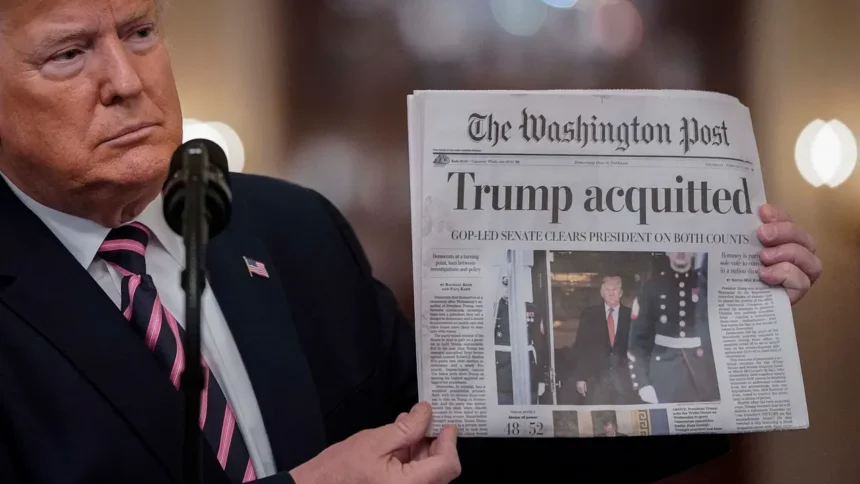
One of America’s most prestigious newspapers, The Washington Post, is going through the toughest period in its history. Jeff Bezos’ media company has reported losses of approximately $100 million in 2024, which is 30 percent higher than 2023.
What Happened to The Washington Post?
The newspaper that once exposed the Watergate scandal and stood as a voice for democracy is now struggling for its survival. Recently, the paper laid off one-third of its staff, including more than 300 journalists.
Executive Editor Matt Murray called this move a “strategic reset,” but former editor Marty Baron described it as “one of the darkest days in the paper’s history.” Baron has also questioned Jeff Bezos’ decisions, saying they have damaged the newspaper’s reputation.
Subscriber Crisis: Why Are Readers Leaving?
Before the 2024 presidential election, The Washington Post faced a major controversy. While the paper had traditionally endorsed candidates in every election, this time Bezos blocked the prepared endorsement for Kamala Harris. What happened next?
Approximately 250,000 subscribers canceled their subscriptions. That’s not all. When Bezos redesigned the opinion pages around “free markets” and “personal liberties” in January 2025, another 75,000 subscribers left the paper.
The paper’s digital visitors are also declining. While 114 million people visited the website monthly in November 2020, that number dropped to just 54 million by November 2024.
The Bezos-Trump Connection
Things got more complicated when Jeff Bezos started building closer ties with the Trump administration. Here are some examples:
Amazon donated $1 million to Trump’s inauguration fund. Bezos himself sat in a prominent seat at Trump’s inauguration ceremony. Most surprisingly, Amazon paid $75 million for First Lady Melania Trump’s documentary, with $40 million for rights and $35 million for marketing.
The documentary earned only $7 million in its opening weekend, a clear financial loss. Ironically, Caroline O’Donovan, The Washington Post’s Amazon beat reporter, was among those laid off.
Impact of Layoffs: Which Sections Were Eliminated?
Wednesday’s mass layoffs brought these major changes:
The sports section has been completely shut down. The books desk has been eliminated. Foreign coverage has been drastically cut – the entire Middle East team, including the Cairo bureau chief, was laid off. The Asia editor position was eliminated, and the New Delhi and Sydney bureau chiefs were also let go.
Local metro coverage has also shrunk. The popular “Post Reports” podcast has been suspended.
The Money Game: Can Bezos Afford It?
Here’s the most interesting twist. Jeff Bezos’ net worth currently stands around $245-250 billion. If The Washington Post is losing $100 million a year, Bezos could afford these losses for 1,400 years with his current wealth.
In other words, what the paper loses in a week, Bezos can gain or lose in a single day through stock market fluctuations. In just the first year of Trump’s second term, Bezos’ wealth increased by $8.5 billion.
Is This a Financial Decision or Ideological?
Many laid-off journalists have openly stated this isn’t purely a financial decision. Reporter Emmanuel Felton tweeted: “This wasn’t a financial decision, it was an ideological one.”
The Washington Post Guild, the paper’s union, says years of layoffs have not brought financial stability. The real problem is the paper’s business strategy, not the number of journalists.
The union stated: “Layoffs are not a business strategy.” Their point seems valid because despite repeated staff cuts, the paper’s losses haven’t decreased.
The Broader Media Industry Crisis
The Washington Post isn’t alone. In 2026, the entire media industry is facing a storm of layoffs. In January alone, 154,445 jobs were cut in the technology sector. The Atlanta Journal-Constitution also laid off 15 percent of its staff.
But The Washington Post’s case is different because it’s not just any newspaper – it’s America’s capital newspaper. It has been democracy’s watchdog. These layoffs mean government accountability reporting will weaken.
Voices of the Reporters
Many senior journalists have left the paper. Veteran columnist Jen Rubin recently resigned and started her own Substack. She wrote: “Corporate and billionaire media are failing to meet the moment.”
Former fact-checker Glenn Kessler sharply attacked Bezos, saying he’s trying to help the newspaper “survive” the Trump era rather than save it.
What Does This Mean for the Public?
The biggest impact of this entire situation will be on the public. Local reporting in Washington D.C. and surrounding areas will decrease. International news coverage will decline, especially from the Middle East and Asia.
At a time when the Trump administration is making major policy changes, the lack of accountability journalism is concerning for everyone. NPR media correspondent David Folkenflik rightly said: “This really kind of helps to unravel the identifiers that knit together Washington, D.C. and the greater community.”
What’s Next?
The question is whether The Washington Post can remain the paper it once was. Will it be limited to just politics and national security? And the biggest question – will Jeff Bezos’ close relationship with Trump affect the paper’s independence?
Right now, an iconic American newspaper that was known for aggressive reporting from the Watergate scandal to Trump’s first term is heading toward an uncertain future.
The paper’s remaining journalists are rallying outside headquarters on Thursday. The union’s message is clear: “A newsroom cannot be hollowed out without consequences for its credibility, its reach and its future.”
This is a testing time for democracy and free press. The future of The Washington Post is not just about one newspaper, but a mirror for American journalism itself.