


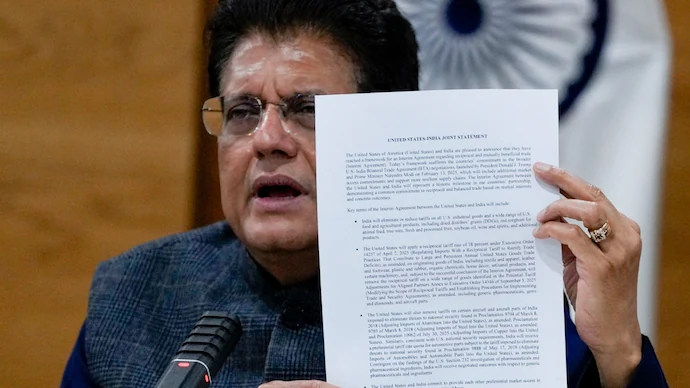
India and the United States have unveiled a framework for an interim trade agreement that will eliminate tariffs on several key Indian exports while reducing overall duties from 50 percent to 18 percent. Commerce Minister Piyush Goyal hailed the deal as opening access to a 30 trillion dollar market, though opposition critics have questioned whether India gave up too much in return.
Major Wins for Indian Exporters
The agreement brings immediate relief to several critical sectors that have struggled under high US tariffs over the past year. According to Piyush Goyal, zero tariffs will apply to gems and diamonds, pharmaceutical products exported in large quantities from India, and smartphones.
Aircraft parts will also enjoy zero-duty access to the American market, a significant win for India’s growing aerospace manufacturing sector. Tariff rate quotas on auto parts have been negotiated, providing additional export opportunities in the automotive components industry.
For the gems and jewelry sector in particular, the deal represents crucial relief. Kirit Bhansali, Chairman of the Gems and Jewellery Export Promotion Council, stated the agreement will provide much-needed relief to a sector that has struggled with high tariffs over the last year. The United States remains India’s most critical export market for diamonds and jewelry, and industry leaders expect the zero-tariff provision to reverse sharp declines in trade volumes.
Agricultural Products Get Zero Treatment
Beyond manufactured goods, the agreement extends zero reciprocal tariffs to a wide range of agricultural exports. Items like spices, tea, coffee, coconut and coconut oil, vegetable wax, areca nut, Brazil nut, cashew nut, and chestnut will face no additional duties. Many fruits and vegetables are also included in this category.
This represents a significant opportunity for Indian farmers and agricultural exporters who have faced barriers accessing the lucrative American market. The zero-tariff status on these traditional Indian exports could substantially boost rural incomes and support the agricultural economy.
Commerce Minister Goyal emphasized that products where India has achieved self-reliance have been strategically excluded from the framework, protecting domestic industries while maximizing export opportunities in sectors where India holds competitive advantages.
The 18 Percent Baseline Tariff
For goods not receiving zero-tariff treatment, the reciprocal tariff will be reduced from fifty percent to just eighteen percent. This applies to major export categories including textiles and apparel, leather and footwear, plastic and rubber products, organic chemicals, home décor items, artisanal products, and certain machinery.
Goyal pointed out that 18 percent is lower than tariffs imposed by India’s neighboring countries and other nations with which Indian exporters compete. This differential should provide Indian products with improved price competitiveness in the American market compared to alternatives from Bangladesh, Vietnam, Pakistan, and other regional competitors.
The sectors benefiting from this 18 percent rate represent substantial portions of India’s export basket to the United States. Textiles and apparel alone employ millions of workers, particularly women, across India. The reduced tariff burden should help these labor-intensive industries maintain and expand their American market share.
What India Protected
A critical aspect of the agreement involves what India kept off the table. Commerce Minister Goyal stressed that sensitive agricultural and dairy products have been protected, including maize, wheat, rice, ethanol, tobacco, and some vegetables.
Goyal was particularly emphatic about dairy protection, stating that India granted no exemptions to the United States on any dairy products. This addresses concerns from India’s substantial dairy farming community, which feared American dairy imports could undermine local producers.
The minister also highlighted that no concessions were given on meat, sugar, poultry, soybean, and various other agricultural products where domestic production needs protection. Products like sorghum, millet, ragi, amaranth, certain fruits, green tea, cocoa, and gram also remain shielded from increased American competition.
This defensive approach reflects lessons learned from previous trade negotiations where agricultural liberalization proved politically and economically damaging to farming communities. By ring-fencing these sensitive sectors, the government aims to avoid rural backlash while still capturing gains in manufacturing and services exports.
The Russian Oil Factor
The trade agreement comes with significant geopolitical strings attached. The framework announcement followed President Trump’s statement that tariffs would be lowered after Prime Minister Modi agreed to stop buying Russian oil.
This represents a major shift in India’s energy policy. India has been purchasing heavily discounted Russian crude oil since Western sanctions began following Russia’s invasion of Ukraine. These purchases helped India manage domestic fuel prices and maintain energy security while providing Russia with crucial revenue despite Western restrictions.
The decision to abandon Russian oil purchases in exchange for reduced American tariffs demonstrates the difficult trade-offs India faces between economic pragmatism and geopolitical alignment. It also reveals the Trump administration’s willingness to use trade policy as leverage to advance broader foreign policy objectives.
Critics have questioned whether giving up cheap Russian energy was worth an 18 percent tariff rate, particularly given that energy costs affect the entire economy while tariff reductions benefit specific export sectors.
Job Creation Claims
Commerce Minister Goyal made ambitious predictions about the agreement’s employment impact. He said the increase in exports was likely to create hundreds of thousands of new job opportunities, with particular benefits expected for women and youth who dominate employment in textiles, gems processing, and pharmaceutical manufacturing.
The government is positioning the trade deal as a key element in India’s development strategy. Goyal described it as an important milestone in India’s journey toward becoming a developed nation by 2047, the centennial of independence.
However, actual job creation will depend on several factors beyond tariff rates, including global demand conditions, exchange rates, competitiveness relative to other suppliers, and domestic manufacturing capacity. The government’s projection assumes that reduced tariffs will translate directly into increased exports, which in turn will require additional workers.
Economic researchers have noted that trade agreements often produce more modest employment effects than political rhetoric suggests, as increased exports in some sectors can be offset by reduced activity in others facing new import competition.
Opposition Criticism
The agreement has faced sharp criticism from opposition parties who argue India gave up too much for too little. Critics point to several concerns that the government has yet to adequately address.
First, the commitment to stop purchasing Russian oil eliminates a significant cost advantage India enjoyed. Russian crude was being purchased at substantial discounts to market prices, and shifting to alternative suppliers will increase India’s energy import bill by potentially billions of dollars annually.
Second, opposition leaders question whether an 18 percent tariff truly represents a major concession by the United States. They note that this rate remains higher than what many other countries face for similar exports, and point out that some products already entered the US market duty-free or at lower rates before Trump imposed his reciprocal tariffs.
Third, critics argue the agreement lacks concrete commitments on services exports, particularly IT and business process outsourcing services where India holds major competitive strengths. The framework mentions working toward a broader bilateral trade agreement, but provides no specifics on timelines or guaranteed outcomes.
Fourth, some analysts worry about setting a precedent where India makes significant geopolitical concessions in exchange for trade benefits. If the United States can demand changes to India’s energy policy in trade negotiations, what else might be demanded in future discussions?