


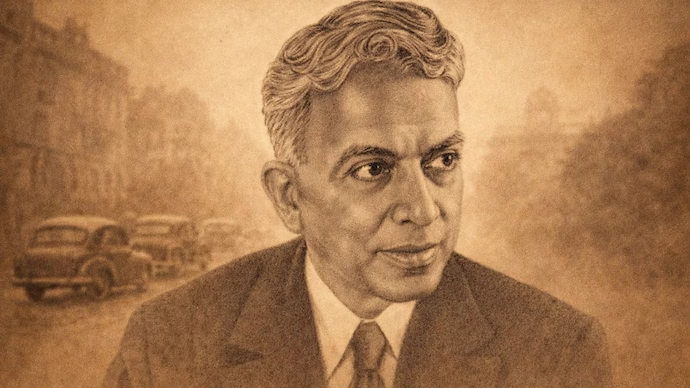
Every year, India celebrates the legacy of its Constitution and rightly honours Dr. B.R. Ambedkar as its chief architect. But behind the final document that emerged in 1950, there was another man—a brilliant civil servant and legal mind—who penned the very first complete draft. His name was Sir Benegal Narsing Rau, and history has largely forgotten him.
Born on February 26, 1887, in Mangalore, BN Rau’s journey from a studious boy to the man who laid the foundation for the world’s longest written constitution is a story of quiet, monumental contribution.
The Making of a Legal Mind
Rau’s brilliance was evident early on. After graduating with top honours from Presidency College in Madras, he went to Trinity College, Cambridge. His reputation preceded him. A young Jawaharlal Nehru, also at Cambridge, wrote home describing Rau as “frightfully clever,” noting that he was always studying and rarely did anything else.
In 1910, Rau joined the elite Indian Civil Service, passing one of the most difficult examinations of the era. He spent years studying how governments function and how the words in law could shape the lives of millions.
His first major test came in the mid-1930s, following the Government of India Act, 1935. Tasked with helping to reorganise and rewrite large parts of the statutory framework, he completed this Herculean exercise in less than two years. The British government recognised his work, knighting him in 1938. He later served as a judge on the Calcutta High Court and briefly as the Prime Minister of Jammu and Kashmir in 1944, gaining direct administrative experience.
The Task of a Lifetime: Drafting a Constitution for a New Nation
When India finally achieved independence in 1947, it had freedom, but it did not yet have a Constitution. The Constituent Assembly needed a starting point.
On August 29, 1947, BN Rau was appointed Constitutional Adviser to the Constituent Assembly. Though not a member of the Assembly itself, his role was pivotal.
His first step was to look outward. He travelled to the United States, Britain, Ireland, and Canada, meeting judges and legal scholars, asking questions, and absorbing the best practices from established democracies.
Then, in a remarkable burst of intellectual effort, he completed the first draft of India’s Constitution in just eight weeks. This document, containing 240 Articles and 13 Schedules, was the first complete version of the Constitution. It became the base document upon which Dr. Ambedkar’s Drafting Committee would later work. Many changes were made, but Rau’s structure remained the foundation.
Two Enduring Contributions
Beyond the structural framework, BN Rau was responsible for two critical elements that shape India’s constitutional identity to this day.
1. The Heart of the Constitution (Article 32)
Rau firmly believed that fundamental rights should not remain mere promises on paper. He proposed that citizens must have the right to directly approach the Supreme Court if their rights were violated. This powerful idea became Article 32, which Dr. Ambedkar would later call the “heart and soul” of the Constitution.
2. ‘Procedure Established by Law’ vs. ‘Due Process’
His early drafts included the phrase “due process of law,” a concept from American jurisprudence that gives courts wide powers. During his US visit, Rau met Supreme Court Justice Felix Frankfurter, who warned that this phrase could allow courts to block social legislation passed by elected governments.
Rau took this advice seriously. He reflected on it and suggested an alternative phrase: “procedure established by law.” This change entered the final Constitution and fundamentally shaped the balance of power between Parliament and the judiciary in India for decades.
The Final Chapter and a Forgotten Legacy
After the Constitution was adopted in 1950, Rau moved to the global stage, serving as India’s Permanent Representative to the United Nations. In 1952, he was elected as a judge to the International Court of Justice (then the Permanent Court of International Justice) at The Hague, one of the highest legal honours in the world.
He died in 1953, less than a year into his tenure.
Despite his monumental contributions, BN Rau’s name remains unfamiliar to most Indians. Perhaps it is because he shunned the political spotlight, working quietly with papers rather than giving speeches from public platforms. As constitutional scholar Granville Austin has noted, Rau was undeniably among the key figures in the making of the Constitution.
On his birth anniversary, remembering Sir Benegal Narsing Rau is not just an act of historical correction. It is restoring a missing chapter in the story of how India became a republic.