


Director: Kleber Mendonça Filho
Cast: Wagner Moura, Carlos Francisco, Tânia Maria, Robério Diógenes, Maria Fernanda Cândido, Gabriel Leone, Alice Carvalho, Hermila Guedes, Isabél Zuaa, Udo Kier
Runtime: 161 minutes
Language: Portuguese
Release: Currently in theatres
Verdict: ★★★★★ (5/5)
Kleber Mendonça Filho’s The Secret Agent is not just a film; it is an experience that lingers—a masterful anatomy of political fear that cements itself as one of the year’s most urgent and essential cinematic works. Set in Recife, Brazil, in 1977, it uses the language of a tense thriller to explore the machinery of state violence, the resilience of memory, and the quiet terror of living under a dictatorship.
Plot: A Man on the Run
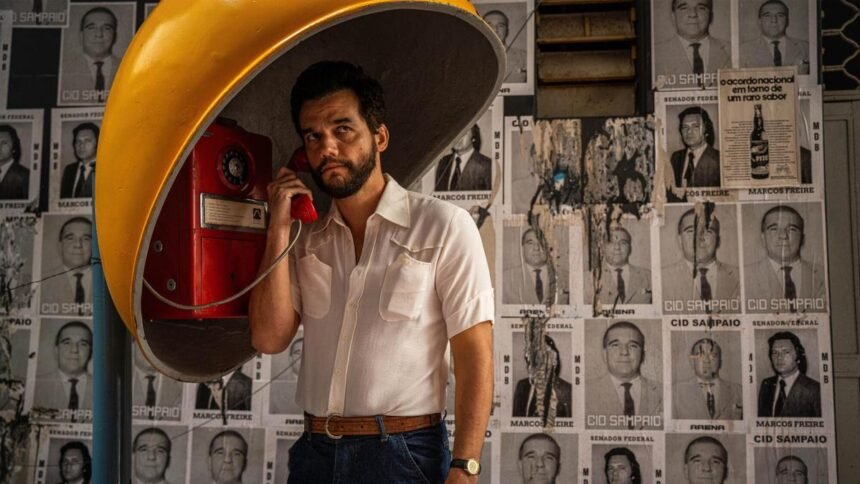
The film follows Marcelo (played by a spectacular Wagner Moura), a widowed university researcher forced to flee São Paulo after crossing a federal official who attempted to privatize his publicly funded work. Adopting a false name, he arrives in Recife during the chaos of Carnaval, seeking refuge in a safe-house apartment building overseen by the world-weary Dona Sebastiana (a terrific Tânia Maria). The building is a temporary haven for dissidents, migrants, and others on the margins.
As Marcelo navigates his new life—working in a government identification office while secretly searching for traces of his vanished mother—he is stalked by hired killers and a corrupt police force that treats the carnival’s chaos as perfect cover. The tension mounts not through grand set pieces, but through the quiet, terrifying proximity of danger in offices, streets, and stairwells.
A Director at the Height of His Powers
Mendonça Filho, the Oscar-nominated director of Pictures of Ghosts and Aquarius, constructs the film with meticulous control. He understands that cinema teaches us where to deposit our fears. Here, he masterfully weaves together the real (a ruthless dictatorship) and the surreal (a recurring motif of a Janus cat, a severed leg pulled from a shark’s stomach) to translate the unnameable terror of state violence into a kind of folklore.
The decision to cut intermittently to the present day—showing young researchers transcribing cassette tapes connected to Marcelo’s case—frames the narrative as an act of historical recovery. It suggests that the past is never truly past; it persists through material traces, waiting to be interpreted.
Wagner Moura’s Career-Defining Performance
As Marcelo, Wagner Moura delivers a performance of profound restraint and intelligence. He plays a man trained to minimize his footprint, whose moral clarity emerges through careful listening and precise action. Moura’s ability to convey decades of political fatigue and quiet resistance through a simple glance or posture is nothing short of mesmerizing. He smoulders with an internal fire that never needs to erupt into spectacle.
The supporting cast is equally impeccable. From the weary resilience of Tânia Maria’s Dona Sebastiana to the chillingly casual routines of an aging hitman and his younger partner, every character feels fully realized. The ensemble grounds the film’s broader political themes in deeply human experiences.
Why It Resonates Beyond Brazil
While deeply rooted in Brazil’s specific history of military dictatorship, The Secret Agent’s exploration of fear, surveillance, and normalized coercion has a chilling universality. The film’s genius lies in showing how authoritarianism becomes a “banal ecosystem of casual cruelties”—a logic that feels disconcertingly familiar in many parts of the world today.
As the reviewer notes, the “grammar of fear” depicted here—the use of bureaucracy as a weapon, the wiretapped conversations, the casual expectation of compliance—resonates far beyond 1970s Recife. It is this uncomfortable truth that elevates the film beyond mere period drama and into the realm of essential political art.
The Verdict
The Secret Agent is a work of immense ambition, executed with breathtaking precision. It is a thriller that refuses easy spectacle, a historical drama that speaks directly to the present, and a meditation on memory that argues for the power of fiction to hold truths that official records erase. With its stunning anamorphic cinematography, meticulous period detail, and a career-best performance from Wagner Moura, it is not just a contender for the best film of the year—it is a masterpiece.