


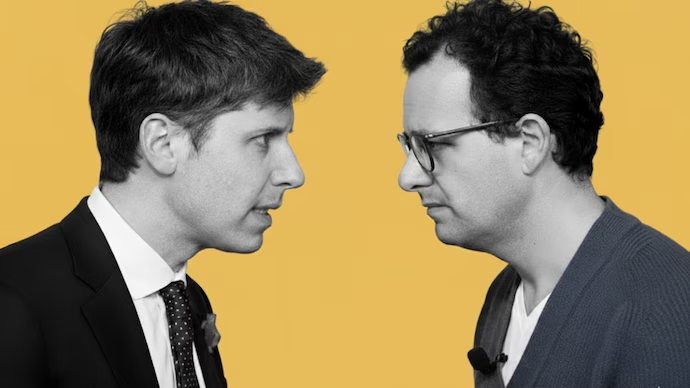
A high-stakes ideological battle is unfolding between two of the world’s leading AI companies and the U.S. government. Anthropic, the AI firm behind the Claude chatbot, has announced it will sue the Pentagon over a rare “supply chain risk” designation, while rival OpenAI’s CEO, Sam Altman, has taken an indirect swipe, asserting that private companies cannot be more powerful than the government.
The conflict underscores the deepening ethical and political divisions in the AI industry over collaboration with the military.
Why Anthropic Is Suing the Pentagon
On March 4, 2026, the U.S. Department of Defense sent a letter to Anthropic designating the company as a “supply chain risk” to America’s national security. This label, typically reserved for foreign adversaries like Huawei, effectively forces all U.S. defense contractors to cut ties with Anthropic.
The designation stems from Anthropic’s refusal to accept the Pentagon’s terms for unrestricted AI use. The company has consistently expressed concerns that its systems could be misused for mass domestic surveillance or the development of autonomous weapons.
In a statement, Anthropic said: “We do not believe this action is legally sound, and we see no choice but to challenge it in court.” CEO Dario Amodei assured users that the label would not impact them directly, applying “only to the use of Claude by customers as a direct part of contracts with the Department of War.”
OpenAI’s Opposite Path and Altman’s Jibe
In stark contrast to Anthropic’s adversarial stance, OpenAI rushed to reach an agreement with the Pentagon. This move has drawn immense backlash online, with reports of ChatGPT uninstallations surging by nearly 300% as users switched to Anthropic’s Claude.
During the Morgan Stanley Technology, Media & Telecom Conference, OpenAI CEO Sam Altman appeared to directly address the philosophical divide. According to CNBC, he stated, “The government is supposed to be more powerful than private companies.”
He further argued that it was “bad for society” if a company abandoned its commitment to the democratic process simply because “some people don’t like the person or people currently in charge.”
The Political Accusation
Following OpenAI’s agreement with the Pentagon, an internal memo from Dario Amodei reportedly suggested that OpenAI’s acceptance was due to political donations made to the Trump campaign last year. It is a matter of public record that OpenAI President Greg Brockman and his wife donated $25 million to a Trump super PAC.
Altman’s recent comments seem to indirectly address these accusations, defending his company’s choice to engage with the government regardless of who is in power. He reaffirmed that OpenAI had put in place similar “red lines” to prevent misuse, and that the company simply aimed to “de-escalate tensions” between the Pentagon and the US military.
Who Looks Like the ‘Hero’?
As the legal battle looms, the public perception is sharply divided. Dario Amodei has claimed that Anthropic looks like “heroes” to the public for refusing the Pentagon’s demands. The surge in Claude’s user base has even caused the chatbot to experience two outages recently, a testament to the public’s response.
| Company | Stance Toward Pentagon | Outcome/Public Response |
|---|---|---|
| Anthropic | Refused terms; now suing over ‘supply chain risk’ label. | Seen as principled by critics; user surge for Claude. |
| OpenAI | Reached agreement; accepted terms of engagement. | Faced backlash; ChatGPT uninstalls surged ~300%. |
What This Means for the Future of AI
This unprecedented clash between a major AI firm and the U.S. government sets a critical precedent. It raises fundamental questions about the role of AI in military applications, the limits of corporate autonomy versus national security, and the ethical responsibilities of companies building powerful, dual-use technologies. The outcome of Anthropic’s court challenge will be watched closely by the entire tech industry.