


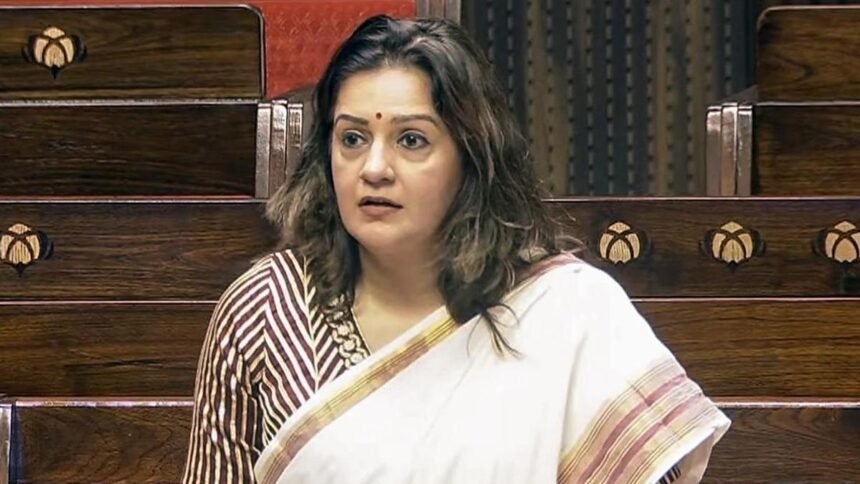
NEW DELHI: Shiv Sena (UBT) Rajya Sabha MP Priyanka Chaturvedi on Friday launched a sharp critique of the Supreme Court’s recent directions regarding a Class 8 NCERT textbook, terming it an instance of “judicial overreach.” Speaking in the Upper House, she urged the government to ensure that all three branches of governance—the legislature, executive, and judiciary—remain equal under the law and open to public scrutiny.
The Background: A Controversial Textbook Chapter
The controversy stems from a chapter in a Class 8 Social Science textbook published by the National Council of Educational Research and Training (NCERT) that allegedly contained references to “corruption in the judiciary.”
- Initial Action: Last month, the Supreme Court imposed a blanket ban on the textbook carrying the chapter.
- Recent Directions: On March 11, the Court expressed dissatisfaction with the NCERT’s “laconic” affidavit. It then directed the education body to “disassociate” from the three-member Textbook Development Team that drafted the chapter and barred the members from holding any future role funded by public money.
Chaturvedi’s Argument: A Question of Balance
In her Rajya Sabha speech, Ms. Chaturvedi laid out a detailed argument questioning the proportionality and propriety of the Court’s actions.
| Point of Argument | Chaturvedi’s Statement |
|---|---|
| Initial Understanding | The initial decision to ban the chapter was understandable if the judiciary felt unfairly targeted. “Up to that point, we felt it was fine.” |
| Escalation as Overreach | “But the matter did not end there. Those involved kept pushing it further, saying that if anyone criticises on social media, the Supreme Court will take action.” |
| Punishment Beyond Apology | Noted that the NCERT had already apologized, yet the punitive directions against the textbook development team continued. |
| Questioning Judicial Sensitivity | Raised the example of allegations involving Justice Yashwant Varma (where burnt cash was discovered in an outhouse linked to the judge), questioning why the judiciary becomes “so sensitive” when corruption is discussed, while other institutions face routine investigation. |
| Demand for Parity | Urged that all three branches of governance be open to scrutiny, stating the judiciary should not be an exception. |
The Justice Varma Reference
Ms. Chaturvedi’s reference to Justice Yashwant Varma is significant. Last March, burnt cash was discovered in an outhouse linked to the then Delhi High Court judge. An inquiry was ordered by the then Chief Justice of India, and the judge was later transferred to the Allahabad High Court. A notice seeking his removal, moved by the Opposition, remains pending in the Rajya Sabha.
She contrasted this with the Court’s aggressive response to the textbook, implying a double standard. “Whereas an impeachment motion was brought against a sitting High Court judge,” she noted, highlighting the pending notice.
The Core Constitutional Question
The MP’s intervention raises a fundamental question about the separation of powers and the limits of judicial authority. While the judiciary has a role in correcting errors, Chaturvedi’s argument suggests that punitive actions against individuals in the executive branch, based on content the court found objectionable, may blur the lines between judicial review and judicial overreach.