


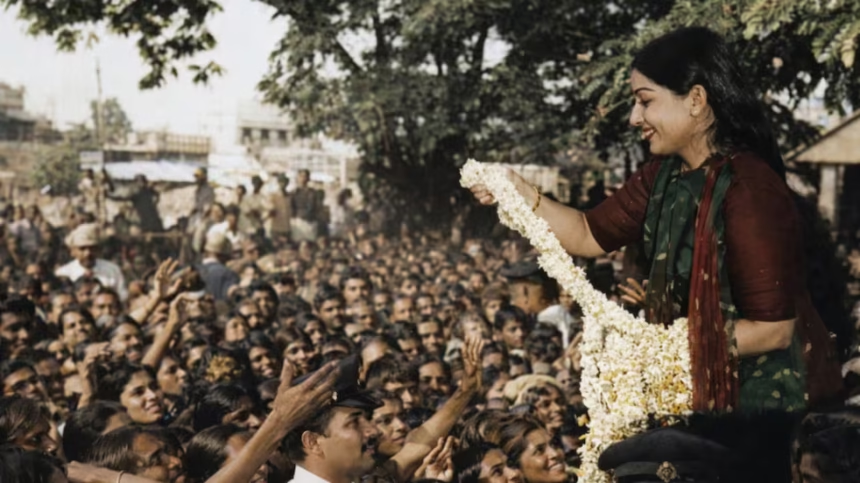
Tamil Nadu has long confounded national political parties. It buried the Congress at its peak in 1967. It has humbled the BJP in every election since 2014. To understand why the state remains the strongest citadel of regionalism, one must look back at the architects of its modern identity. In the 35th part of India Today’s series Jayalalithaa’s Crown, senior journalist TR Jawahar digs deep into the Iron Lady’s first reign—a period of absolute power, groundbreaking welfare schemes, and the quiet rise of a shadow government.
After the assassination of Rajiv Gandhi and the blood-stained ballot of the 1991 polls, the state emerged into a dawn dominated by a single, uncompromising silhouette: J. Jayalalithaa. The student of MGR had finally become the master of Fort St. George.
The Making of a Leader: From Propaganda Secretary to Iron Lady
Jayalalithaa’s journey to the throne was forged in the fiery crucible of the 1980s.
| Year | Milestone |
|---|---|
| 1982 | MGR introduced her as AIADMK propaganda secretary. Her debut speech in Cuddalore showcased a linguistic brilliance that bridged English and Tamil oratory. |
| 1984 | During MGR’s illness, when the party old guard tried to erase her, she took to the streets, connecting directly with the Thalikulam (the women of the state). |
| 1984-1989 | As a Rajya Sabha MP, she commanded respect in Delhi with her sophisticated English and Hindi, building a rapport with Indira and Rajiv Gandhi, and learning the mechanics of federalism. |
| 1989 | After MGR’s death and a party split, she reunited the factions—not through merger, but by consuming her rivals. |
The 1989 assembly incident, where her hair was dishevelled by opposition members, provided the moral armour for her crusade. She transformed from a party functionary into an incensed icon.
The 1991 Landslide: A Mandate of Vengeance
The 1991 election was a whirlwind of political energy. Jayalalithaa crisscrossed the state in her customised van, turning the grief of Rajiv Gandhi’s assassination into a tidal wave of support. The result was a mandate of biblical proportions: the AIADMK-led alliance swept nearly the entire house. On June 24, 1991, at 43, she became the state’s youngest chief minister and the first woman to hold the post in a full-fledged manner.
She entered the secretariat not as a first among equals, but as a monolith. In stark contrast to MGR, her cabinet meetings were noted for their heavy silence. The prostration protocol began—senior ministers prostrating before her in public view. As the writer notes, “The two leaves had been replaced by the two feet of Amma.”
The Welfare Queen: Governance by Decree
Jayalalithaa’s first term was marked by a series of populist welfare schemes that secured her status as the guardian of the hearth.
- Prohibition (1991): She banned country liquor and arrack, recognizing the havoc it caused in domestic hearths. While the state exchequer faced a fiscal famine, she argued the dignity of the home was more important.
- Cradle Baby Scheme (1992): Piloted in Salem to combat female infanticide, this landmark policy placed cradles in government hospitals, inviting desperate mothers to hand over their daughters to the state rather than the dustbins. She positioned herself as the “eternal mother” of abandoned children.
- Noon Meal Scheme Expansion (1992): Building on MGR’s legacy, she added eggs and bananas to the midday meal for millions of schoolchildren, turning classrooms into cradles of health.
- 15-Point Program for Child Welfare: Added layers of health check-ups and medical support for toddlers.
- Education: Free uniforms, textbooks, and footwear were distributed to lakhs of students.
The Marina Marathon: Water as a Weapon
In July 1993, Jayalalithaa launched an 80-hour fast at the MGR Samadhi on Marina Beach to protest the perceived central lethargy on the Cauvery water dispute. This was not a desk protest; it was a theatrical masterclass.
Under the blistering sun, she forced the centre to send its ministers to negotiate with her, turning the federal hierarchy on its head. She was demanding recognition of a lower riparian state’s sovereignty over its resources. The fast ended only after a central assurance was extracted, cementing her image as the state’s fierce protector.
Industrial Ignition: The Seeds of an Automotive Hub
As the nation liberalized its economy, Jayalalithaa seized the moment. In 1992, she unveiled a comprehensive industrial policy that streamlined approvals. The groundwork for SIPCOT Irungattukottai was laid, designed to provide world-class infrastructure for international giants. By the end of 1993, Tamil Nadu was outpacing its neighbours in foreign investment interest—the seeds of the future automotive hub were planted.
The Shadow of the Mannargudi Mafia
Amidst the welfare and industrial growth, a parallel power structure was quietly consolidating.
The early 1980s had seen the entry of Sasikala into Jayalalithaa’s inner sanctum. Initially a video cassette supplier, she soon became an emotional anchor. Her husband, M. Natarajan, a public relations officer, provided the tactical spine, helping navigate the internal fissures of the party. By the 1991 coronation, this partnership had moved from supplying cassettes to securing the keys to the secretariat.
By 1993, the power structure had become a fortress of favoritism. Dr. Subramanian Swamy began his relentless offensive, dubbing the inner circle as the “Mannargudi Mafia.” Ministers realized that the path to the sceptre lay through the shadow. Whispers of influence over tenders and transfers began to fuel cadre murmurs of a parallel power center, eroding the legacy of MGR, who was known for his easy approachability.
The Mahamaham Tragedy
In February 1992, during the once-in-12-years Mahamaham festival in Kumbakonam, a massive stampede claimed nearly 50 lives. The presence of Jayalalithaa and Sasikala at the tank during the peak hour was seen as a security snafu that impeded crowd flow. It was a sobering reminder that even an absolute mandate cannot control the chaos of the crowd—a lesson in the fragility of public adulation.
The Mandate of the Goddess
As 1993 ended, Jayalalithaa stood as the undisputed leader of the gilded age. She had united a fractured party, anchored child welfare, and provided a cradle for the crying. Her first reign was a whirlwind of welfare and willpower.
But the shadows were lengthening. The Sasikala factor and the reservoir of partiality were beginning to cast a chill over the achievements of her first reign. The stage was set for the middle years of the decade, when the extravagance of the garden would meet the headwinds of public opinion.