


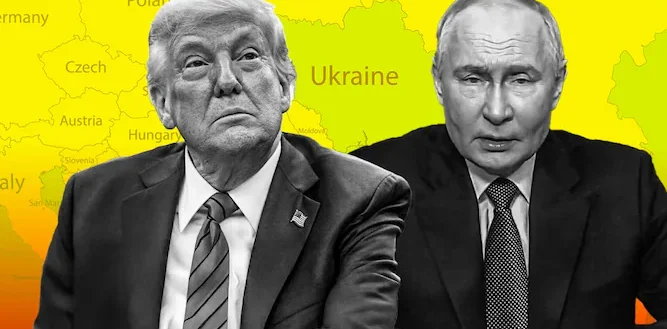
In August 2025, as the war in Ukraine dragged into its fourth year, a high-stakes diplomatic moment unfolded in Alaska. U.S. President Donald Trump and Russian President Vladimir Putin met in a summit that sent shockwaves through Kyiv and across Europe. While the meeting ultimately did not produce a lasting ceasefire, it revealed the deep anxieties of Ukraine’s allies about the direction of American diplomacy.
This is a look back at the summit, the fears it generated, and the diplomatic fault lines it exposed.
The Summit: A ‘Feel-Out Session’
On August 15, 2025, Trump and Putin met in Alaska for what Trump described as a “feel-out session” to assess the likelihood of a ceasefire in Ukraine. Speaking at a White House press conference before the talks, Trump asserted he would know “within two minutes” if a deal was feasible. He also left the door open to a dramatic outcome, suggesting he might tell Putin to “keep fighting” or declare that “we can make a deal.”
| Key Details | Information |
|---|---|
| Date | August 15, 2025 |
| Location | Alaska, USA |
| Participants | U.S. President Donald Trump, Russian President Vladimir Putin |
| Purpose | “Feel-out session” to assess ceasefire feasibility |
| Zelensky’s Role | Excluded from the summit |
The Fears: A Deal Favoring Moscow
The summit alarmed Kyiv and European capitals for one primary reason: Ukraine was not at the table. European officials and Ukrainian President Volodymyr Zelensky feared that any deal brokered without their involvement would inevitably favor Russia.
Putin was expected to demand two concessions that Kyiv had consistently rejected:
- Exclusion of Ukraine from NATO
- Official recognition of Russia’s territorial gains since the February 2022 invasion
Zelensky had made it clear that he would not give up on NATO membership or allow any official acquisition of territory.
The ‘Land Swaps’ Controversy
Adding to the anxiety were Trump’s remarks about potential “land swaps” —a vague concept that European officials warned could jeopardize Ukraine’s sovereignty. The notion of trading territory for peace was anathema to Kyiv, which had consistently opposed giving land to Russia.
Europe’s Response: A United Front
In the days leading up to the Alaska summit, European leaders scrambled to present a unified position.
- Germany: Chancellor Friedrich Merz convened a virtual conference with Zelensky, NATO Secretary-General Mark Rutte, and several EU leaders. Merz’s office emphasized that Ukraine must make its own decisions “independently and autonomously” and that boundaries “must not be shifted by force.”
- European Commission: Vice-President Kaja Kallas warned that any agreement made without Ukraine’s approval would be “dead on arrival.”
- UK & Canada: Prime Ministers Keir Starmer and Mark Carney issued a joint statement insisting that peace “must be built with Ukraine, not imposed upon it.”
The Kremlin’s Position
The Kremlin downplayed expectations of any future meeting with Zelensky, maintaining that the conditions for direct talks remained distant. Meanwhile, the war continued unabated. Ukrainian drone attacks struck inside Russia, and Russian air defenses intercepted dozens of drones over Crimea.
The Outcome
The Alaska summit did not produce a breakthrough. Trump spoke with Zelensky after the talks “out of respect,” but the fundamental disagreements remained. Ukraine’s position was unchanged, Russia’s demands were unmet, and the war continued to grind on.
The summit, however, served as a stark reminder of the precarious position of Ukraine’s allies, caught between a desire for peace and a fear that a rushed deal could come at the cost of Ukrainian sovereignty.