


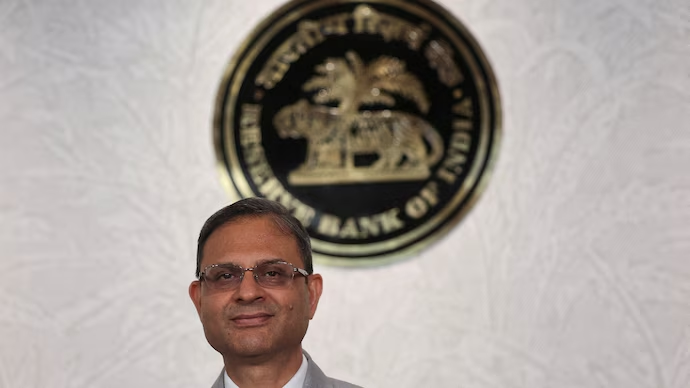
The Reserve Bank of India’s (RBI) Monetary Policy Committee (MPC) began its meeting on Monday, with the policy decision set to be announced on Wednesday, April 8. This time, the meeting comes at a difficult moment, as global tensions and rising oil prices have made the central bank’s job more complex.
The repo rate currently stands at 5.25% . The RBI will decide whether to keep it unchanged, increase it, or cut it. Most experts believe a rate cut is unlikely this time.
The Biggest Challenge: West Asia Conflict
| Strait of Hormuz | Effectively closed by Iran |
| Normal Traffic | 200-300 ships per week; now drastically reduced |
| Brent Crude | Touched $118/barrel; hovering near $100 |
| US Dollar Index | Remains strong above 100 |
The biggest challenge for the RBI right now is the ongoing conflict in West Asia. A US-Israel military campaign against Iran has led to a sharp escalation. Iran has responded by shutting the Strait of Hormuz, a key route for global oil and gas supply. Normally, around 200 to 300 ships pass along this route every week. Now, this has dropped drastically, which has sharply reduced supply.
Why India Is More Exposed
| Crude Import Dependence | 85-90% |
| Hormuz Dependency | 40-52% of imports via Strait of Hormuz |
| Impact per $10 Oil Rise | Adds ~$14 billion to import bill |
| Rupee Depreciation | 4.1% since Feb 28; touched record low of 92.35/$ |
India is among the countries most affected by this situation. It imports around 85-90% of its crude oil needs. A large part of these imports comes through the Strait of Hormuz, meaning any disruption directly affects India’s energy supply and costs.
Market Impact Already Visible
| Rupee | Weakened ~4.1%; touched record low of 92.35/$ |
| FII Outflows (March) | Sold nearly ₹1.2 lakh crore in Indian equities |
| Sensex & Nifty | Fell over 5%; wiped out ₹12 lakh crore in investor wealth |
The impact is already visible on the currency and markets. Foreign investors have pulled out large amounts of money, and stock markets have seen significant pressure.
Growth and Inflation Projections
| Oil at $80/barrel (HSBC) | 6.3% | – |
| Oil at $100/barrel (HSBC) | ~6.0% | – |
| Oil at $130/barrel (CEA) | 6.4% (FY27) | 5.5% |
| RBI’s February Projections | 7.4% (FY26) | 2.1% (FY26) |
| Current Expectations | 6.5-6.7% (FY27) | 4.5-5.1% (FY27) |
Rising oil prices and global uncertainty are also affecting the growth outlook. India’s Chief Economic Advisor has warned that if oil prices remain at $130 per barrel for two to three quarters, inflation could rise to 5.5% and growth could slow to 6.4% in FY27.
The RBI’s Tall Task
| Higher Inflation | Keep rates high or increase them |
| Slower Growth | Cut rates to support economy |
The RBI now faces a tough choice. On one side, higher oil prices can push inflation up, requiring high interest rates. On the other side, slower growth may require lower interest rates. Since February 2025, the RBI has already reduced the repo rate by 125 basis points. However, it has kept rates unchanged in its last three policy reviews.
Expert Views
| Aditi Nayar (ICRA) | “RBI likely to stay on pause and watch how inflation moves.” |
| Madan Sabnavis (Bank of Baroda) | “No change in repo rate or stance. Tone will be cautious.” |
| Rajani Sinha (CareEdge Ratings) | “Conflict could hurt growth while keeping inflation high.” |
From ‘Goldilocks’ to Uncertainty
Just two months ago, the situation looked very different. In its February 6 meeting, the RBI had projected inflation for FY26 at 2.1% and GDP growth at 7.4%. Governor Sanjay Malhotra had described the economy as being in a “Goldilocks phase”—steady growth with low inflation.
However, the situation has changed quickly. Inflation expectations for FY27 are now seen in the range of 4.5% to 5.1% , and growth estimates have been lowered to around 6.5-6.7% .
What It Means for You
| Loan EMIs | Likely stable for now if rates unchanged |
| Future Rate Cuts | Less likely if inflation rises |
| Fuel Costs | Higher oil prices may increase daily expenses |
For common people, this policy matters because it affects loan EMIs, deposit rates, and the overall cost of living. If the RBI keeps rates unchanged, EMIs are likely to remain stable for now. However, if inflation rises further, the chances of rate cuts in the near term may reduce.
The RBI’s decision on April 8 will give a clearer direction on how it plans to handle this situation. For now, caution is likely to remain the key approach as global uncertainty continues.