


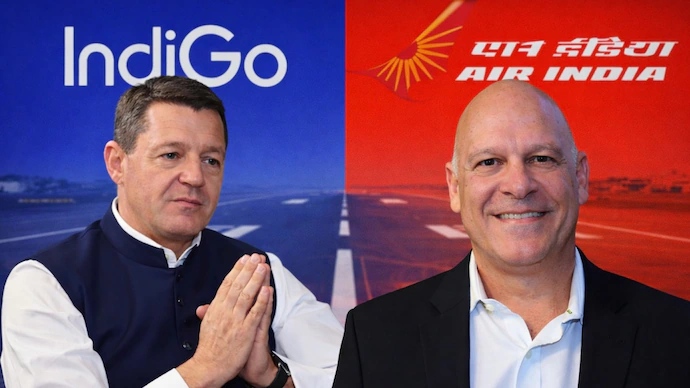
Two of India’s largest airlines are seeing leadership changes at a time when the sector is facing one of its most testing phases in recent years. IndiGo and Air India, which together dominate the market (IndiGo ~60%, Air India ~30%, ~90% combined), are dealing with rising costs, operational disruptions, regulatory pressure, and global tensions.
The exits of their CEOs are not isolated events. They come as the aviation sector grapples with a mix of domestic setbacks and global shocks, raising questions about whether the industry is entering a reset phase.
IndiGo’s Crisis: A Quick Leadership Shift
| Aspect | Details |
|---|---|
| Outgoing CEO | Pieter Elbers |
| Reason | Worst operational crisis in two decades |
| December Crisis | 4,500 flights cancelled during holiday season (failed to prepare for stricter pilot rest rules) |
| Impact | Stranded thousands of passengers; damaged reliability reputation |
| Incoming CEO | Willie Walsh (aviation veteran) |
| Jefferies View | Fast appointment shows “urgency and clarity” |
IndiGo’s CEO Pieter Elbers stepped down after the airline faced its worst operational crisis in two decades. In December, the airline cancelled 4,500 flights during the holiday season after failing to prepare for stricter pilot rest rules, stranding thousands of passengers.
The airline has now brought in aviation veteran Willie Walsh as its next CEO. Analysts see this as a clear signal that IndiGo’s board wants quick corrective action. Brokerage Jefferies said the fast appointment shows “urgency and clarity” at the airline.
Air India CEO Exit Amid Losses and Regulatory Pressure
| Aspect | Details |
|---|---|
| Outgoing CEO | Campbell Wilson |
| Original Term | Until 2027 (resigned early) |
| Financials | Combined loss of Rs 98.08 billion in FY25 |
| Safety Issues | Flying aircraft without airworthiness certificate; operating without checking emergency equipment |
| Fatal Incident | Crash last year killed 260 people |
Air India’s CEO Campbell Wilson has also resigned, even though his term was set to run until 2027. His exit comes as the airline continues to report losses and faces increased scrutiny.
The carrier has been pulled up by regulators for safety lapses, including flying an aircraft eight times without an airworthiness certificate and operating planes without checking emergency equipment. A crash last year that killed 260 people added to the pressure.
Despite these challenges, industry experts say Wilson played a key role in stabilising the airline after the Tata Group takeover.
“Over the last four years, Campbell did a good job in very tough circumstances,” Brendan Sobie, an independent aviation analyst, told Reuters.
Global Conflicts Driving Costs Higher
| Factor | Impact |
|---|---|
| Iran War | Fuel prices surged; longer routes required |
| Pakistan Airspace Closure | Longer routes for west-bound flights |
| Brent Crude | Surge directly impacting ATF costs |
| Govt Cap | Monthly ATF price increase capped at 25% for domestic flights |
Beyond company-specific issues, global tensions are adding to the pressure on airlines. The ongoing West Asia conflict, especially the Iran war, has pushed fuel prices higher and forced airlines to take longer routes, increasing both flying time and operating costs.
The situation has been made worse by regional tensions closer home. After the India-Pakistan conflict in May last year, Pakistan shut its airspace to Indian airlines, forcing carriers to take longer routes for west-bound flights.
Analyst Views on Financial Impact
| Firm | View |
|---|---|
| Motilal Oswal | Higher fuel costs, rupee depreciation, weaker international ops could hit IndiGo’s earnings; cut profit estimate by 15% |
| Brendan Sobie | Wilson did a good job in tough circumstances; finding right candidate for Air India will not be easy |
Analysts at Motilal Oswal said higher fuel costs, rupee depreciation, and weaker international operations could hit IndiGo’s earnings for the current financial year. They cut their profit estimate for the airline by 15%.
Expansion Plans Add Execution Pressure
| Airline | Expansion Plans |
|---|---|
| IndiGo | Major push into long-haul international; ordered A321XLR and A350; flies to 40+ international destinations |
| Air India | Ordered 500+ aircraft; currently operates 191 planes; facing delivery delays and supply chain issues |
At the same time, both airlines are trying to grow. Walsh’s appointment is being seen as a move to support IndiGo’s global expansion. Air India continues to face delivery delays and supply chain issues.
What the Twin Exits Signal
The back-to-back leadership changes point to a wider shift in India’s aviation sector. Airlines are no longer just dealing with demand recovery. They are managing:
- Higher costs
- Tighter regulations
- Global conflicts
- Complex expansion plans simultaneously
With India set to remain one of the fastest-growing aviation markets, the next phase for its top airlines will depend not just on demand, but on how well they handle rising risks and execution challenges.