


As India marks the first anniversary of the April 22 Pahalgam terror attack and the subsequent launch of Operation Sindoor, new details have emerged highlighting a critical moment when the Indian Air Force thwarted a potentially devastating strike on the national capital.
At the height of the India-Pakistan conflict in May last year, a Pakistani ballistic missile, believed to be from the Fateh or Shaheen series, was intercepted mid-air over Haryana before it could reach its suspected target, Delhi.
The Interception
| Timing | May last year (during India-Pakistan conflict) |
| Missile Type | Pakistani ballistic missile (Fateh or Shaheen series) |
| Target | Suspected to be Delhi |
| Location of Interception | Mid-air over Haryana |
| Weapon System Used | Barak-8 surface-to-air missile system |
| Unit Responsible | IAF unit stationed at Sirsa (45 Wing) |
The Hero: Air Commodore Rohit Kapil
| Name | Air Commodore Rohit Kapil |
| Position | Air Officer Commanding, 45 Wing, Sirsa |
| Background | Su-30MKI pilot; led an operational Su-30MKI squadron |
| Award | Yudh Seva Medal (2025, conferred by President Droupadi Murmu) |
Leading the operation was Air Commodore Rohit Kapil, Air Officer Commanding of 45 Wing, whose command decisions and rapid response proved decisive in preventing large-scale damage.
Commodore Kapil and his team’s successful vigil against incoming Pakistani missiles might have saved several lives last year; however, it is not well-known.
The Weapon System: Barak-8
The interception was executed using the Barak-8 surface-to-air missile system, showcasing the operational readiness and technological strength of India’s air defence grid.
Debris recovered from Sirsa days later confirmed the scale of the threat, with visuals circulating widely at the time.
India’s Evolving Air Defence Architecture
| Name | Sudarshan programme |
| Goal | Expand nationwide, multi-layered air defence shield |
| Systems Being Integrated | S-400, Barak-8, indigenous interceptors |
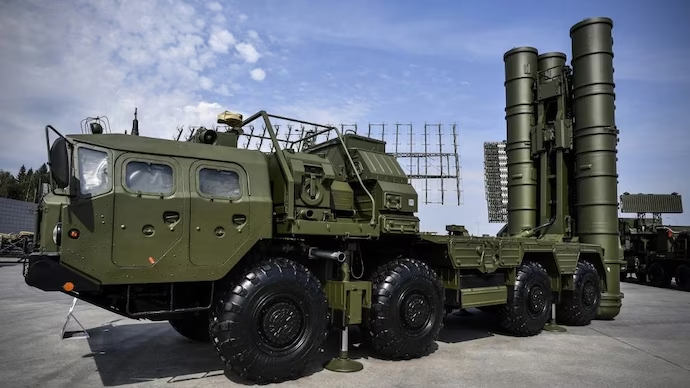
The episode has since become a defining example of India’s evolving air defence architecture. With efforts underway to expand a nationwide, multi-layered shield under the Sudarshan programme, integrating systems like S-400, Barak-8, and indigenous interceptors, the Sirsa interception stands as a reminder of the importance of vigilance, coordination, and swift execution in modern warfare.