


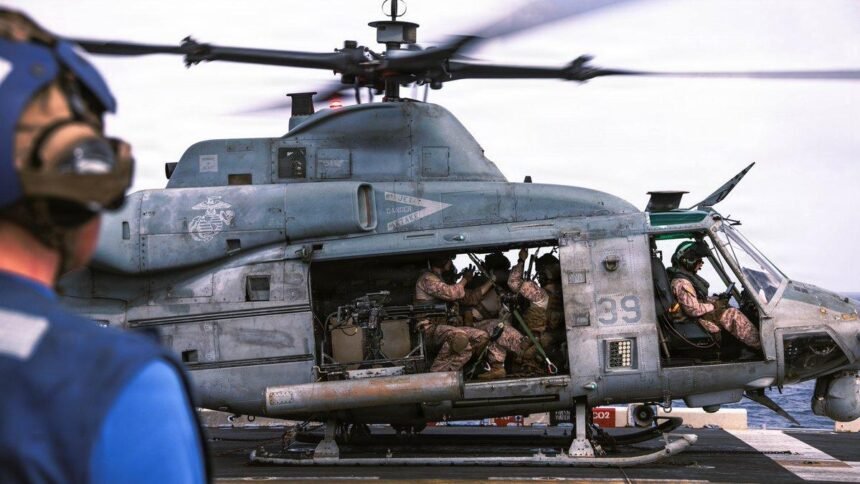
The United States has launched a third wave of retaliatory strikes against Iranian military targets following the downing of an American AH-64 Apache attack helicopter over the strategic Strait of Hormuz .
US Central Command (CENTCOM) confirmed the operation began as a “proportional response” at the direction of President Donald Trump after Iran shot down the helicopter, which was on a routine patrol mission near the coast of Oman .
Apache Downed by Iranian ‘Kamikaze’ Drone
Two US Army pilots were aboard the helicopter when it was struck by an Iranian Shahed “kamikaze” drone, according to CNN citing US officials . In a significant success for the US military’s new unmanned systems, the pilots were rescued approximately two hours later by an uncrewed surface drone (USV) operated by the US Navy’s Bahrain-based Task Force 59 .
President Trump confirmed both soldiers are “safe and uninjured.” However, he vowed a forceful response: “Nevertheless, the United States must, of necessity, respond to this attack” .
CENTCOM stated that the rescue efforts were a joint operation involving Naval Forces Central Command, the 82nd Airborne Division, and the 5th Fleet .
US Launches ‘Third Wave’ of Strikes
As the standoff escalates, US media reports citing a US official confirmed that a third wave of American strikes is currently underway against Iranian air defense infrastructure .
Explosions have been reported across southern Iran, particularly in Hormozgan province near the Strait of Hormuz. Iranian state media, including IRNA and Press TV, confirmed blasts in strategic locations such as Bandar Abbas, Qeshm Island, Sirik, and Jask .
The US has indicated that the strikes are intended as a “warning shot” to demonstrate resolve, though officials have signaled that more attacks could follow .
Iran Vows ‘No Attack Unanswered’
Tehran has responded with fierce rhetoric, raising fears of a full-scale regional war, even as diplomatic backchannels remain active.
Foreign Minister Abbas Araghchi issued a stark warning to Washington: “Leave our region if you want to be safe. History of the Persian Gulf has many chapters on dire fates of intruding outsiders” .
He added, “Our Powerful Armed Forces will leave no attack or threat unanswered” .
Iran’s top negotiator, Mohammad Baqer Qalibaf, posted on social media that while Tehran prefers “the language of diplomacy, we speak other languages far more fluently,” signaling readiness for a broader conflict if the US continues its strikes .
Global Repercussions
India’s Stance: The Ministry of External Affairs (MEA) issued a statement on Monday, expressing “deep regret” over the renewed attacks. India called for “immediate de-escalation” and urged parties to conclude negotiations for a diplomatic solution, noting that the conflict has already caused “immense human suffering” and a “debilitating impact on the global economy” .
Israeli Front: The escalation with the US comes as Israel and Iran continue to trade fire. Israel has conducted strikes in Iran and Lebanon, while Iran’s Revolutionary Guard claimed responsibility for targeting military bases in Israel as part of “Operation Nasr” (Victory) .
The Houthi Threat: Adding to the maritime chaos, Yemen’s Iran-backed Houthi rebels have announced they are banning Israeli shipping in the Red Sea, threatening to disrupt one of the world’s most critical trade chokepoints .