


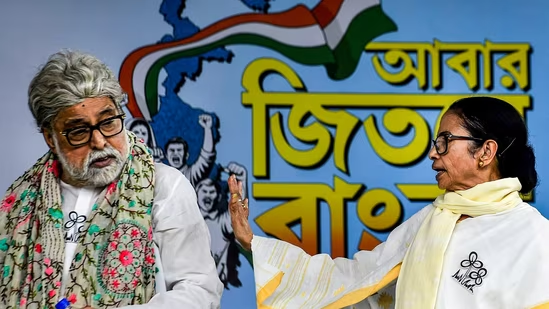
Senior Trinamool Congress MP Sudip Bandyopadhyay met Union Minister Bhupender Yadav at his Delhi residence on Saturday, accompanied by rebel MP Satabdi Roy, and later in the day held talks with Union Home Minister Amit Shah. The meetings have deepened the political crisis within the party as the dissident faction prepares to formally approach Lok Sabha Speaker Om Birla on Monday.
The development marks a major escalation in the rebellion that began with a split in the West Bengal Assembly and has now spread to Parliament. Bandyopadhyay, a six-time Lok Sabha MP and the Trinamool Congress leader in the lower house, had until recently been part of the party’s internal strategy meetings.
Rebel Camp Gains Strength
According to dissident MP Jagadish Chandra Barma Basunia, 19 of the party’s 28 Lok Sabha MPs have signed a letter supporting the formation of a separate parliamentary bloc, and the number could reach 20 if Bandyopadhyay formally joins the rebel camp.
“Our demand is that we are the ‘real Trinamool Congress’ and should be given recognition,” Basunia told IANS.
The rebel MPs, led by Kakoli Ghosh Dastidar, plan to meet Speaker Om Birla on Monday to seek recognition as a separate faction and request distinct seating arrangements in Parliament. Once recognised, the bloc has declared it would offer support to the BJP-led NDA.
Senior Figures React Sharply
Trinamool leaders have responded with sharp criticism. Party spokesperson Kunal Ghosh accused Bandyopadhyay of a history of political defections and suggested he had betrayed Mamata Banerjee’s trust.
“I was suspended earlier from the party for speaking against him and in favour of senior leaders like Tapas da. Let the leadership realise now what kind of person they supported before,” Ghosh said.
BJP minister and former Trinamool leader Tapas Roy called Bandyopadhyay and Satabdi Roy a “liability” for the TMC, stating: “They have contributed neither to the public nor to any political party”.
Legal Complexities Remain
TMC MP Mahua Moitra has argued that the rebel move has no legal basis under the anti-defection law, noting that the 91st Amendment removed provisions allowing a split within a party.
“The number of MPs is irrelevant — 2/3 of the original political party has to merge with another party. All 19 traitors need to resign and contest on BJP ticket,” she wrote on X.
Former TMC Rajya Sabha MP Saket Gokhale echoed this view, stating that forming a separate parliamentary group enjoys “zero protection under the law”.
Assembly Crisis Parallels
The parliamentary rebellion mirrors a split in the West Bengal Assembly, where 58 of 80 TMC MLAs broke away and secured recognition as the principal opposition bloc under expelled legislator Ritabrata Banerjee. The rebel camp has since claimed its strength has risen to 64 MLAs.
The crisis has also triggered high-profile departures from the Rajya Sabha, with Sukhendu Sekhar Ray, Sushmita Dev and Prakash Chik Baraik resigning from the party this week.
What’s Next
All eyes are now on the meeting between the rebel MPs and Lok Sabha Speaker Om Birla on Monday. The decision could fundamentally alter the opposition arithmetic in Parliament and determine whether the Trinamool Congress emerges as a united force or fragments into warring factions.
Bengal Chief Minister Suvendu Adhikari is also scheduled to arrive in Delhi on Sunday for a meeting with the rebel MPs, further signalling the BJP government’s coordination with the dissident camp.