


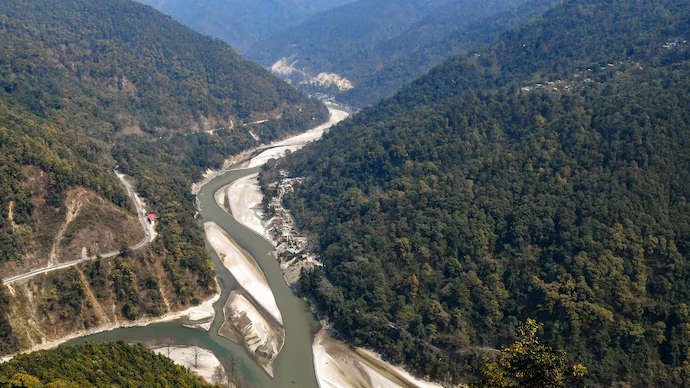
During Bangladesh PM Tarique Rahman’s China visit, Beijing agreed to accelerate a feasibility study for the Teesta river project near India’s Siliguri Corridor. This is why India will be looking closely at this development.
During Bangladesh Prime Minister Tarique Rahman’s visit to China, the two countries signed an agreement to conduct a feasibility study for the Teesta River Comprehensive Management and Restoration Project (TRCMRP). While the plan to reshape the Teesta River’s catchment area in northeastern Bangladesh through large-scale river engineering and infrastructure development represents growing ties between Dhaka and Beijing, the plan is likely to raise concerns in New Delhi, given the project’s proximity to India’s strategically sensitive Siliguri Corridor, according to experts.
Teesta, a 414-km transboundary river, originates in the eastern Himalayas, flows through Sikkim and West Bengal before entering Bangladesh, where it joins the Jamuna River (known as the Brahmaputra in India). Teesta has also long been a bone of contention between New Delhi and Dhaka, primarily over Bangladesh’s demands for a greater share of its water resources.
The project
The TRCMRP is a major river engineering and development initiative proposed by Bangladesh “to manage flooding, improve water security, restore the river ecosystem, and unlock economic potential along the Teesta River.”
The plan includes “extensive river dredging, embankment construction, land reclamation, and river training works to stabilise the Teesta’s course,” according to reports. It also envisions developing roads, irrigation systems, urban centres, tourism facilities, and special economic zones along the riverbanks.
At roughly 171 sq km, the reclaimed land would be nearly as large as Chandigarh and about one-eighth the size of Delhi. Bangladesh plans to excavate 140 million cubic metres of river sediment, reclaim 171 sq km of land, construct 82 jetties, reinforce embankments, and build a 224-km road network along the river.
Why Bangladesh chose China
There are two main reasons why Bangladesh chose to partner with China for the project. The first is the project’s sheer scale—such a massive undertaking demands both substantial financing and advanced engineering expertise. China is among the world’s leading builders of dams and river infrastructure, with extensive experience in flood control and irrigation. Chinese firms have also delivered major projects in Bangladesh, including the Padma Bridge, completed in 2022.
The second reason is the long-running deadlock between Bangladesh and India over sharing the Teesta’s waters. Bangladesh has long sought a larger share of the river’s dry season water to support irrigation, but despite agreeing on the broad contours of an interim pact in 2010, the two sides never finalised a deal. The principal hurdle has been the opposition from former West Bengal CM Mamata Banerjee, who argued that diverting more water to Bangladesh would hurt farmers in the eastern state.
China also moved faster than India. In 2024, New Delhi offered to finance the $1-billion Teesta project, but political turmoil following Hasina’s ouster stalled talks. With India’s proposal left in limbo, the Tarique Rahman government instead revived cooperation with Beijing.
Why India should be concerned
New Delhi has serious reasons to be concerned about the agreement. The core of India’s anxiety is geographical proximity. The Bangladeshi project areas of Nilphamari and Rangpur lie directly adjacent to India’s Jalpaiguri district, the precise location of the highly strategic Chicken’s Neck, or Siliguri Corridor. The narrow strip of land—measuring a mere 22 kilometres wide at its tightest point—is India’s sole land bridge connecting the northeastern states to the rest of the country.
According to strategic expert Tara Kartha, China’s influence in Bangladesh reinforces India’s two-front security challenge, with Beijing expanding its strategic reach as Pakistan continues to exploit vulnerabilities in the Northeast.
Consequently, stationing a large contingent of Chinese engineers, surveyors, and technical personnel so close to this sensitive border zone naturally raises major security alarms in New Delhi.
India’s response
Even though India’s offer to fund the Teesta project didn’t materialise, New Delhi continues to engage with Dhaka on the issue of sharing the river’s water resources. On June 3, foreign ministry spokesperson Randhir Jaiswal noted that India’s views on the Teesta Project had been conveyed to Dhaka, and that New Delhi’s approach would take into account “all related developments.”
For now, whether the feasibility study ultimately translates into a full-fledged project remains to be seen. But if China secures a long-term role in shaping the Teesta Basin, the river is likely to evolve from an India-Bangladesh bilateral water dispute into an area of India and China’s race for strategic space.