

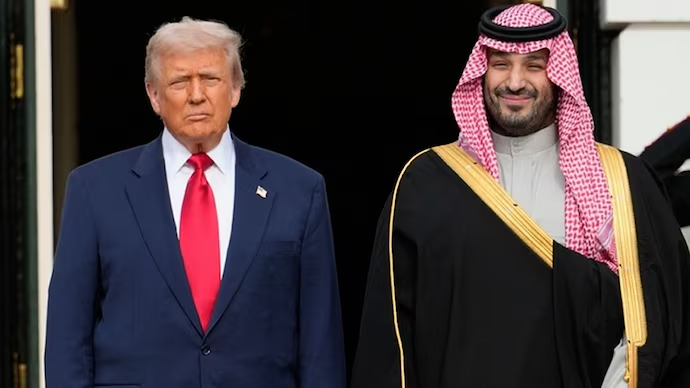
Washington D.C., USA – A landmark civil nuclear agreement approved by President Donald Trump has granted Saudi Arabia the right to domestically enrich uranium, a move that has sent shockwaves through the Middle East. The deal, which reportedly lacks several key non-proliferation safeguards traditionally demanded by Washington, has left Israel wary of a future nuclear-armed Saudi neighbor. Simultaneously, it has revived longstanding speculation that Pakistan, Riyadh’s decades-long strategic partner, could provide the technical expertise to transform enriched uranium into a functional weapon.
The agreement, centered on a ‘123 Agreement’ under the US Atomic Energy Act, is expected to last 30 years and be worth tens of billions of dollars. However, reports indicate it does not mandate the “gold standard” that permanently forgoes uranium enrichment and reprocessing of spent nuclear fuel—a commitment made by the UAE in 2009. It also reportedly does not require Saudi Arabia to adopt the International Atomic Energy Agency’s (IAEA) Additional Protocol, which allows for more intrusive inspections. Defence expert Sandeep Unnithan told India Today Digital, “What the Saudi-US deal does is give Saudi Arabia the right to enrich uranium without the safeguards to prevent nuclear weapons development.”
The deal has triggered alarm in Israel, where any nuclear capability in Saudi Arabia is viewed as a direct threat. Heritage Minister Amichay Eliyahu stated, “We will do as much as we can… to halt the possibility that in the Middle East a certain country… has a nuclear weapon.” Former defence minister Avigdor Liberman argued on X that “every military nuclear programme starts as a civilian programme.” This concern is amplified by the fact that the Trump administration reportedly delinked the nuclear agreement from Saudi-Israeli normalisation, a condition the previous Biden administration had sought.
The agreement also revives the long-speculated nuclear dimension of Saudi-Pakistan ties. According to Unnithan, a covert pact is believed to have been struck in the 1980s, where Saudi Arabia helped fund Pakistan’s nuclear program in exchange for potential access to warheads in a crisis. This is supported by a 2013 BBC investigation and a new mutual defence treaty signed in 2025, which reportedly placed Riyadh under Islamabad’s nuclear umbrella. Unnithan noted, “Pakistan desperately needs cash and has the human resources to make a Saudi bomb a reality,” adding that such cooperation is not unprecedented given Pakistan’s history of nuclear proliferation.
While the deal must still pass through US Congressional review, where lawmakers are expected to question the absence of stringent safeguards, the implications are profound. The prospect of Saudi Arabia enriching uranium without the “gold standard” safeguards and with potential Pakistani technical cooperation represents a significant shift in regional nuclear dynamics. As Unnithan concluded, any move to weaponize the program would likely trigger intense international monitoring, sanctions, and diplomatic fallout, but the agreement has undeniably opened a new chapter in the Middle East’s nuclear landscape.