

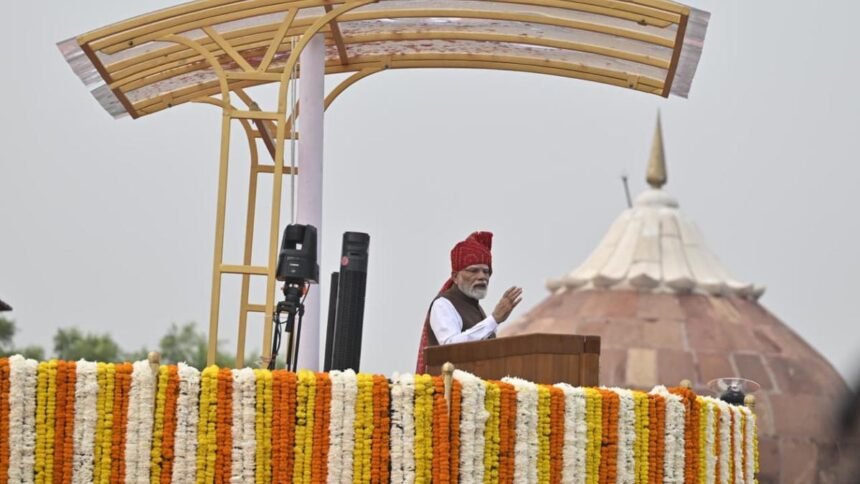
New Delhi, India – In his 13th consecutive Independence Day address from the Red Fort, Prime Minister Narendra Modi made a strong appeal to all political parties to support the implementation of women’s reservation in Parliament and State assemblies, urging them not to turn it into a political fight. “I appeal to and urge all political parties: come and venerate the women power. Come forward to honour women and ensure that our mothers and sisters secure 33% representation. You may take the credit, you may claim the accolades, but please grant our mothers and sisters their due rights,” he said. He noted that the matter has been stuck for 40 years due to political wrangling.
In his 75-minute speech marking the country’s 80th Independence Day, the Prime Minister also warned against individuals with a Maoist mindset, whom he termed “dimagi Naxals” (ideological Naxals), who have entrenched themselves within corridors of power for decades. “We have succeeded in eliminating armed Naxals… However, while the armed Naxals are gone, ‘dimagi Naxals’ are still lurking around, and those who harbour this mindset are waiting for an opportunity,” he said. He called for isolating such individuals and aligning the nation’s youth with the mainstream effort to transform India into a developed nation.
The Prime Minister outlined seven streams (saptadharas) to drive India forward, including manufacturing, technology, agriculture, and the green and blue economy. He also promised free online coaching for exams to ease the financial burden on poor and middle-class families, and announced a nationwide talent hunt for youth aged 5 to 15 to strengthen India’s Olympic presence, as India is a strong contender to host the 2036 Olympics.
He highlighted India’s transformation from the “Fragile Five” to the world’s fastest-growing major economy, stressed the need for self-reliance in energy and defence, and noted the attainment of criticality at the Prototype Fast Breeder Reactor (PFBR) in Kalpakkam. He also addressed the weaponisation of resources and strategic sea routes, emphasizing the need for domestic capacity in critical areas.