


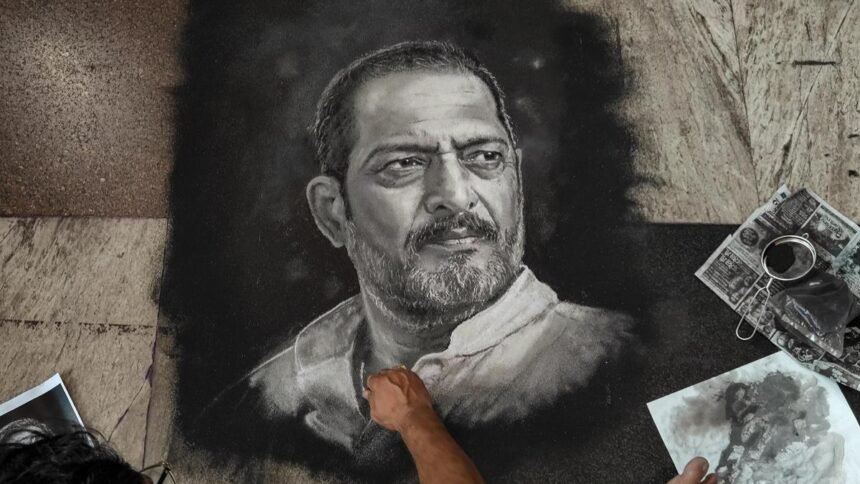
Mumbai, India – A tempestuous maestro who stripped acting of its artifice, Nana Patekar fell silent at 75 years on Thursday after a sudden cardiac arrest. From the terrifying vulnerability of Parinda (1989) and the primal scream against communalism in Krantiveer (1994) to the tragic grandeur of Natsamrat (2016), he harnessed a staccato rage and colloquial realism that redefined the contours of the screen hero.
Before Patekar’s rise to prominence in the late 1980s, anger in commercial Indian cinema was largely stylised and structured around the Angry Young Man trope. Patekar introduced a visceral, unpredictable, and highly localised form of rage, something the man on the street could identify with. Over a career lasting more than four decades, his distinctive style bridged parallel art-house movements and mainstream commercial cinema. Patekar actively resisted Bollywood’s assembly-line casting, refused to become a slave to fame, and chose characters which defied easy categorisation.
The three-time National Award and four-time Filmfare winner could discern which characters would stay with audiences and create a meaningful intervention in times. If in the rasping Krantiveer he exposed the hypocrisy of demagogues, then in the deeply philosophical Prahaar (1991), a film he also directed, he redefined nationalism. “Borders do not define it, but the moral discipline and collective empathy of a civilian society,” he once said. Perhaps that’s why his characters who speak up to the system and those who work for it became equally popular at different stages of his career.
Born in a modest household in a village in Raigad district of Maharashtra on January 1, 1951, Patekar developed a love for visual and performing arts from his father. After his father’s early demise, his mother became the pillar he could lean on. His passion led him to J.J. School of Arts, and he also became a popular face at inter-collegiate theatre events. Soon, theatre legend Vijaya Mehta discovered him and cast him in Hamidabai Chi Kothi and Purush, where he left audiences spellbound with his explosive intensity.
Before he could be bracketed, Patekar quickly shed his explosive, angry persona to deliver a masterfully poetic, whimsical, and gentle performance as the Rainmaker in Amol Palekar’s Thoda Sa Roomani Ho Jayen (1990), proving he could fascinate audiences entirely through lyrical charm. His performance as a deaf father in Sanjay Leela Bhansali’s Khamoshi: The Musical (1996) proved he could dominate a narrative entirely through silent expressions and sign language. In Natsamrat, his delivery of the iconic “Kuni ghar deta ka ghar?” speech is one of the most powerful emotional sequences in contemporary Indian cinema.
Must Read: Elon Musk Alleges ‘Oligarch’ Interference in Starlink’s India Launch
Beyond the arc lights, Patekar actively championed agrarian rights, secularism, and institutional transparency. Alongside fellow actor Makarand Anaspure, he co-founded the Naam Foundation, an NGO dedicated to supporting drought-hit farmers in Maharashtra. However, his acting methods sometimes blurred boundaries with his co-actors. Patekar was a central figure at the inception of India’s #MeToo movement when Tanushree Dutta accused him of sexually harassing and intimidating her on the sets of Horn Ok Please. He denied the allegations, and the Mumbai Police found the evidence insufficient to prosecute or substantiate the claims, but the incident fractured his image. The tag of an erratic, hot-tempered individual, originally viewed as a charming artistic quirk, was suddenly re-evaluated through a more critical lens.