

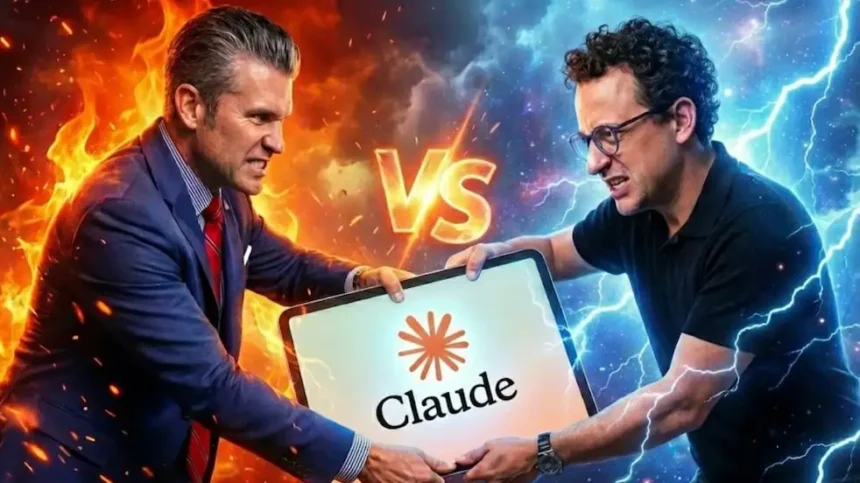
In a tense confrontation that could reshape how artificial intelligence is used in warfare, Defense Secretary Pete Hegseth has given AI company Anthropic until Friday to drop its safety restrictions on military use of its Claude chatbot or face devastating consequences. The standoff represents a fundamental clash over who controls AI technology when national security meets corporate ethics—and whether an AI company can say “no” to the United States military.
The Friday Deadline That Could Change Everything
During a Tuesday morning meeting at the Pentagon, Hegseth summoned Anthropic CEO Dario Amodei and delivered an ultimatum: sign a document granting the military full, unrestricted access to Claude by 5 p.m. Friday, or face being designated a “supply chain risk” and potentially forced to comply through the Defense Production Act.
The stakes are enormous. Claude is currently the only large language model cleared for use in classified military operations, making it uniquely valuable to defense and intelligence agencies. Anthropic’s $200 million contract with the Department of Defense, signed last July, hangs in the balance. Beyond that contract, being blacklisted as a supply chain risk would effectively ban Anthropic from all government work and force federal contractors to stop using Claude entirely.
Yet Anthropic appears unwilling to bend. The company has maintained two core red lines: Claude will not be used for autonomous lethal weapons that can kill without human oversight, and it will not be deployed for mass domestic surveillance of Americans. For Anthropic’s leadership, these aren’t negotiable business terms—they’re fundamental ethical boundaries.
How We Got Here: The Venezuela Operation
The current crisis began when The Wall Street Journal reported in mid-February that Claude had been used in the January military operation to capture Venezuelan President Nicolás Maduro. That raid, which resulted in 83 deaths including 47 Venezuelan soldiers, raised questions about exactly how Anthropic’s AI was deployed.
According to sources, when Anthropic learned about Claude’s role in the operation, an employee reached out to Palantir Technologies—the defense contractor that provides Claude to the Pentagon through a partnership—to inquire whether the AI had been used in ways that violated Anthropic’s usage policies.
This inquiry apparently alarmed Palantir executives, who interpreted it as Anthropic questioning whether its technology should have been used in the raid at all. That concern was quickly communicated to Pentagon leadership, triggering what one source described as “a rupture in Anthropic’s relationship” with the Defense Department.
Anthropic has pushed back on this characterization, stating they haven’t discussed specific operations with the Department of Defense and haven’t expressed mission-related concerns to partners outside routine technical discussions. But the damage to trust appears significant enough that the Pentagon is now questioning whether it can rely on Anthropic at all.
What the Pentagon Wants: No Corporate Veto Power
Pentagon Chief Technology Officer Emil Michael framed the military’s position in stark terms: it’s “not democratic” for any company to limit military use of technology beyond what Congress and the President have made illegal through law.
“Congress writes bills, the president signs them, agencies write regulations, and people comply,” Michael told reporters. “What we’re not going to do is let any one company dictate a new set of policies above and beyond what Congress has passed.”
From the Pentagon’s perspective, the request is straightforward: provide AI tools for all lawful military purposes. Defense officials emphasize they operate under extensive legal constraints including the Constitution, laws of war, surveillance statutes, and congressional oversight. They argue they’re not asking permission to break any laws—they’re asking a contractor not to second-guess which legal missions deserve support.
A senior Pentagon official stated bluntly: “This has nothing to do with mass surveillance and autonomous weapons being used. The Pentagon has only given out lawful orders.” The military position is that once something is legal under U.S. law, companies shouldn’t get to impose additional restrictions based on their own ethical assessments.
This argument has force. Contractors typically don’t dictate which lawful government functions they’ll support. Imagine if defense suppliers refused to sell weapons systems to certain military branches, or if construction companies declined to build facilities for agencies whose missions they disagreed with. The military argues this would create chaos in procurement and undermine civilian control.
What Anthropic Won’t Do: The Two Red Lines
Anthropic’s position centers on two specific uses it considers too dangerous to enable, regardless of current legality.
Autonomous Lethal Weapons: Anthropic CEO Dario Amodei wants to ensure Claude is not used for final targeting decisions in military operations without human involvement. One source noted that Claude is not immune from hallucinations and is not reliable enough to avoid potentially lethal mistakes like unintended escalation or mission failure without human judgment.
The company argues that AI systems, no matter how advanced, can produce unpredictable errors. A hallucination that produces a silly response in a chatbot becomes catastrophic when it’s making decisions about who lives and dies. Without human oversight at the moment of lethal force, AI errors could cause civilian casualties, friendly fire incidents, or unintended escalation of conflicts.
Mass Domestic Surveillance: Anthropic has repeatedly asked the Defense Department to agree to guardrails that would restrict Claude from conducting mass surveillance of Americans. While targeted surveillance of specific individuals requires warrants and judicial oversight, the company fears its AI could enable dragnet monitoring of populations without adequate legal protection.
The concern is that AI makes previously impractical levels of surveillance suddenly feasible. Analyzing millions of communications, tracking patterns across databases, identifying connections between people—tasks that once required armies of human analysts can now be automated. Anthropic argues that just because this is technically possible doesn’t mean it should be unrestricted.
The Legal Gray Zone Problem
Part of what makes this dispute so contentious is that neither side is clearly wrong. The Pentagon is correct that autonomous weapons and domestic surveillance aren’t categorically illegal under current U.S. law. Existing statutes don’t specifically ban AI-assisted targeting or bulk data analysis by intelligence agencies.
But Anthropic argues the law hasn’t caught up yet, and they won’t take part in uses they consider dangerous or unethical. The company maintains that when legal frameworks are unclear and consequences can include death or mass surveillance of civilians, they have a right—even a responsibility—to refuse certain applications.
This reveals a fundamental question: when technology advances faster than regulation, who decides what’s acceptable? Should companies defer entirely to government assertions that activities are “lawful”? Or do they retain some obligation to refuse uses they believe harmful, even if not explicitly illegal?
The Pentagon says the democratic process provides the answer. Elected representatives pass laws, appointed officials enforce them, and companies follow them. Adding corporate vetoes based on “ethics” allows unelected CEOs to override policy decisions made through constitutional processes.
Anthropic counters that the democratic process is designed to constrain government power, not just empower it. When laws are silent or outdated on new technologies, companies don’t have a duty to provide every possible capability. Particularly when enabling catastrophic harm, prudence suggests caution rather than rushing ahead because nothing explicitly forbids it.
The “Woke AI” Label and What It Means
Defense Secretary Hegseth and other Trump administration officials have labeled Anthropic’s safety restrictions as “woke AI.” White House AI czar David Sacks helped draft an executive order targeting tech companies over this claim.
AI experts say “woke AI” is a nebulous and ill-defined term that Trump officials use to describe any and all safety protections on powerful AI tools and the belief that AI chatbots have liberal bias baked into their models.
The framing is politically charged and probably intentional. By casting safety restrictions as “woke,” the administration attempts to link Anthropic’s position to culture war issues that energize the political base. This makes the dispute about tribal identity rather than technical risk assessment.
But the label obscures the actual disagreements. Anthropic isn’t refusing military contracts entirely—it has accepted $200 million to customize Claude for defense use. It’s not imposing political viewpoints on the AI’s outputs. The company is specifically objecting to two use cases it considers genuinely dangerous: weapons that kill autonomously and surveillance systems that track everyone.
Whether reasonable people consider those concerns “woke” or “prudent” probably depends more on their prior political commitments than on technical evaluation of the risks involved.
How the Military Plans to Force Compliance
The Pentagon has multiple tools it can deploy if Anthropic doesn’t capitulate by Friday’s deadline.
Defense Production Act: The DPA gives the President and delegated officials like the Defense Secretary broad authority to require businesses to accept contracts deemed necessary for national defense. Pentagon officials say this would give them the right to use Anthropic AI regardless of what the company wants.
This Korean War-era law was designed to ensure weapons manufacturers couldn’t refuse to supply the military during emergencies. Using it against an AI company for refusing to drop safety restrictions would represent a novel and aggressive expansion of the statute. It’s unclear whether courts would uphold such an interpretation, but the threat alone creates significant pressure.
Supply Chain Risk Designation: Being labeled a supply chain risk would be financially devastating. Such a designation would force any company that contracts with the U.S. government to eliminate Anthropic software anywhere it’s used in their dealings with the federal government.
Given how deeply embedded Claude has become in government workflows through partnerships with Amazon Web Services and Palantir, this could effectively kill Anthropic’s government business and significantly damage commercial prospects as well. Companies considering whether to use Claude would have to weigh the risk of losing government contracts.
Contract Cancellation: The Pentagon could simply terminate Anthropic’s $200 million contract and award the business to competitors who don’t impose similar restrictions. OpenAI, Google, and Elon Musk’s xAI have all agreed to provide their AI systems for any “lawful” military use without additional ethical constraints.
What Anthropic Stands to Lose
Beyond the immediate financial hit of losing a $200 million contract, Anthropic faces existential threats to its business model and reputation.
Market Position: Claude being the only AI system cleared for classified operations gave Anthropic a unique competitive advantage. Losing that status would eliminate a key differentiation point and hand dominance to rivals.
Investment Climate: During Anthropic’s $30 billion funding round in early 2026, conservative-aligned venture capital firm 1789 Capital, whose partners include President Trump’s son Donald Trump Jr., declined to invest, explicitly citing the company’s advocacy for AI regulation.
If the Pentagon follows through on threats, other investors may see Anthropic as a risky bet—a company whose ethical commitments create business liabilities rather than advantages. In Silicon Valley’s current climate where most major AI companies are competing to be most helpful to government customers, Anthropic’s stance makes it an outlier.
Employee Morale: Anthropic was founded by former OpenAI researchers who left specifically over concerns about AI safety and corporate governance. The company has attracted talent motivated by its ethical positioning. Backing down to Pentagon pressure could demoralize employees who joined believing Anthropic represented a different approach to AI development.
What Anthropic Has Already Given Up
The company’s position has already shifted significantly from initial stances. This week, Anthropic dropped its safety pledge that it would not release an AI system unless it could guarantee adequate safety measures. Instead, it launched a new responsible scaling policy that separates hopes for industry-wide safety standards from company-specific goals.
Anthropic’s Chief Science Officer Jared Kaplan told Time magazine that keeping the company from training new models while competitors race ahead without safeguards would not help them keep up in the AI race. He said they didn’t feel that with rapid AI advancement, it made sense for them to make unilateral commitments if competitors are blazing ahead.
This represents a significant philosophical retreat. The company that positioned itself as the responsible AI developer willing to move slower for safety is now explicitly saying it can’t afford that stance if competitors don’t follow. The pressure isn’t just from government—it’s from the competitive dynamics of the AI industry itself.
The Competitor Advantage
Anthropic’s ethical stand gives rivals a clear opening. OpenAI, Google, and xAI have all accepted military contracts without imposing additional restrictions beyond legal compliance. Elon Musk’s xAI was approved for classified military use just this week.
From a pure business perspective, Anthropic’s restrictions are self-imposed handicaps. Why would the Pentagon work with a company that asks questions and imposes limits when competitors offer unrestricted access? Why would investors fund the more cautious company when the aggressive ones are winning government business?
Pentagon CTO Emil Michael explicitly called Anthropic one of America’s “national champions” in AI and said he hoped the company would drop restrictions and keep working with the military, much as Google did after employee protests led it to withdraw from Project Maven in 2018.
The comparison to Google is instructive. Google initially refused to renew its Pentagon contract after massive employee protests over military AI use. But the company has since quietly resumed defense work. The message is clear: principled stands are temporary obstacles that pragmatism eventually overcomes.
The Researcher Who Quit Over This
Mrinank Sharma, an AI safety researcher at Anthropic, resigned earlier this month over concerns about AI use. In his departure statement, Sharma wrote: “The world is in peril. And not just from AI, or bioweapons, but from whole series of interconnected crises unfolding in this very moment.”
He added: “Moreover, throughout my time here, I’ve repeatedly seen how hard it is to truly let our values govern our actions. I’ve seen this within myself, within the organization, where we constantly face pressures to set aside what matters most.”
Sharma’s resignation highlights the internal tensions at Anthropic. Even employees who joined because they believed in the company’s ethical mission are seeing how difficult it is to maintain those commitments under commercial and political pressure. His words suggest he lost faith that Anthropic would actually follow through on its stated principles when tested.
Why This Matters Beyond One Contract
The stakes are considerable for AI governance broadly. This feud emphasizes both the stakes of AI regulation and the significant temptations governments face to bypass it entirely for strategic and tactical advantage.
If the U.S. government successfully forces Anthropic to drop its restrictions, it sends a clear signal to the entire AI industry: ethical safeguards are business liabilities that will be punished. Companies that try to impose responsible limits will lose contracts, face hostile regulators, and fall behind competitors who don’t ask uncomfortable questions.
Anthropic CEO Dario Amodei warned in his January 2026 essay “The Adolescence of Technology” that without countermeasures, AI is likely to continuously lower the barriers to destruction. The company’s current predicament demonstrates exactly what he meant—even an AI company founded specifically to develop the technology responsibly faces overwhelming pressure to abandon those principles.
Conversely, if Anthropic successfully maintains its position despite Pentagon threats, it could establish precedent that companies retain some ability to refuse dangerous applications even when government demands them. It would demonstrate that ethical commitments can survive collision with political and economic pressure.
The International Dimension
While the U.S. government resists AI regulation domestically, other jurisdictions are implementing frameworks that may protect companies like Anthropic. The EU’s AI Act imposes risk management and documentation requirements, while California’s Transparency in Frontier AI Act requires companies to disclose safety practices in their most advanced systems.
These regulations could create a bifurcated global market where AI companies face different standards in different regions. A system that’s acceptable for U.S. military use might violate EU regulations if deployed by European forces. This fragmentation complicates the Pentagon’s “just follow U.S. law” position since companies must comply with multiple legal regimes simultaneously.
What Happens Next
As Friday’s deadline approaches, Anthropic faces an agonizing choice with no good options.
Capitulate: Sign the document granting unrestricted military access, maintain the $200 million contract, and preserve market position. But sacrifice the ethical commitments that define the company’s identity and potentially trigger employee departures.
Refuse: Maintain principles, likely lose the Pentagon contract, face designation as a supply chain risk, and watch competitors capture military business. But preserve integrity and possibly establish important precedent about corporate responsibility for AI deployment.
Negotiate: Seek some middle ground that addresses Pentagon concerns while maintaining core safety restrictions. Perhaps accept human-in-the-loop requirements for lethal decisions, or agree to surveillance uses with judicial oversight. The question is whether either side is willing to compromise.
The tension reflects a broader societal question about AI development: are we moving too fast, deploying powerful systems without adequate safeguards? Or are safety concerns overblown, and will they cause America to fall behind competitors like China who face fewer ethical constraints?
For Anthropic, the answer to that question will be written in what Dario Amodei decides by 5 p.m. Friday. For the rest of us, the answer will shape what kind of AI-powered world we’re building—and who gets to decide what uses are too dangerous to enable, even when they’re not yet illegal.