

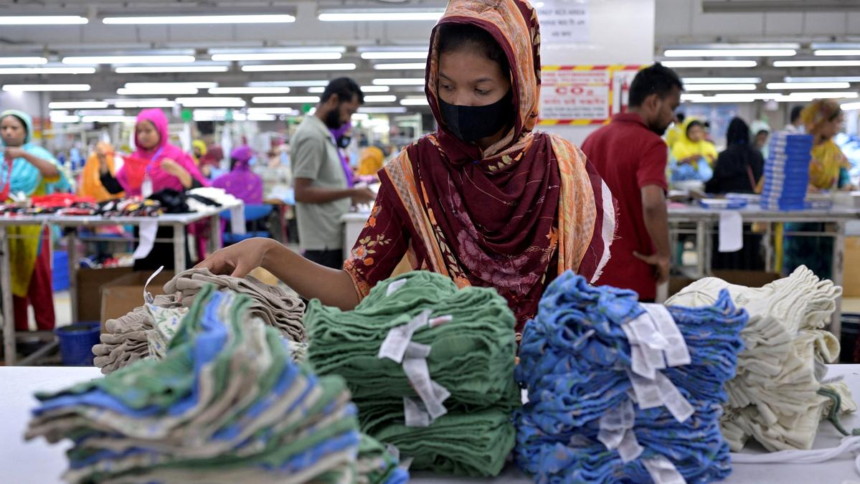
For nearly two decades, Bangladesh has been the undisputed champion of textile exports to the European Union, leaving its larger neighbour India far behind. But a historic shift is on the horizon. With the newly signed India-EU Free Trade Agreement (FTA) and Bangladesh’s impending graduation from its Least Developed Country (LDC) status in 2029, the tectonic plates of the global garment trade are moving.
Can India finally tailor a strategy to capture this lucrative market? We dive into the data to find out.
The Current Landscape: A Tale of Two Trajectories
The contrast in performance could not be starker. While India’s textile sector has been steadily losing ground in global markets, Bangladesh has woven together a remarkable success story, particularly in the EU.
As the following chart illustrates, India’s share of the EU’s total imports for knitted garments (like T-shirts and sweaters) has actually declined from nearly 6.5% in 2009 to about 4.4% in 2023. In the same period, Bangladesh’s share skyrocketed from 13% to a staggering 26%.
A similar pattern holds for woven garments (like shirts and trousers). India’s export value to the EU in this category has fallen in absolute terms, from a peak of about $3.5 billion to $2.9 billion.
Why Bangladesh Leads: The Price and Tariff Advantage
To understand this divergence, we must look at two critical factors: price and tariffs.
1. The Price Puzzle: A comparison of average per-unit prices reveals that India’s products are consistently more expensive across major categories. This could mean two things:
- Scenario A: India is exporting higher-quality, value-added garments, commanding a premium. However, its low market share suggests EU demand for such premium products is limited compared to the mass market.
- Scenario B (more likely): The higher prices reflect structural disadvantages—higher production costs, less integrated supply chains, and logistical inefficiencies that make Indian goods less competitive.
2. The Tariff Wall: This is perhaps the single biggest factor. Bangladesh, as an LDC, has enjoyed duty-free, quota-free access to the EU under the Everything But Arms (EBA) scheme. Critically, this zero-tariff access applies even when garments are made from imported fabric (bypassing the EU’s standard ‘double transformation’ rule). India, lacking such a deal, has faced Most Favoured Nation (MFN) tariffs of around 12% , a massive disadvantage in a price-sensitive industry.
The Coming Revolution: How the Rules Are Changing
The balance is poised for a major shift, thanks to two structural breaks.
| Factor | Impact on Bangladesh | Impact on India |
|---|---|---|
| Bangladesh LDC Graduation (2029) | Loses automatic duty-free EBA access. Will likely face 12% MFN tariffs or need to join GSP+ scheme with stricter rules. | Indirect benefit. Bangladesh’s primary tariff advantage erodes, potentially leveling the playing field. |
| India-EU FTA (Signed) | No direct impact. | Gains duty-free access subject to the double-stage processing rule (RoO). |
| Rules of Origin (RoO) | Major challenge. Relies heavily on imported fabric (often from India/China). May struggle to meet GSP+ ‘double transformation’ rule. | Significant advantage. India’s industry is vertically integrated (most yarn/fabric is domestic). Can easily meet RoO. |
The Verdict: A Window of Opportunity for India
Taken together, these changes create a rare convergence:
- Bangladesh’s advantage narrows: Its duty-free access ends, and its reliance on imported fabric becomes a liability under stricter rules.
- India’s disadvantage disappears: The new FTA removes the 12% tariff wall, and India’s vertical integration means it is perfectly positioned to meet the rules of origin without major restructuring.
The question is no longer if the opportunity exists, but whether India can seize it.
The Road Ahead: From Policy to Practice
To truly overtake Bangladesh and capture mass-market share, India must move beyond its fragmented approach. As the authors of the original analysis note, textiles remain one of India’s largest employers. Reviving exports to high-income markets like the EU could be a “much-needed tonic” for the country’s employment crisis.
The recent experience of Vietnam, whose apparel exports surged after its FTA with the EU in 2020, is a powerful indicator of what’s possible. For India, the fabric of success is now in place. It will take a coherent industrial policy focused on cost-competitive production and resolving logistical inefficiencies to finally stitch together a win in the European market.