


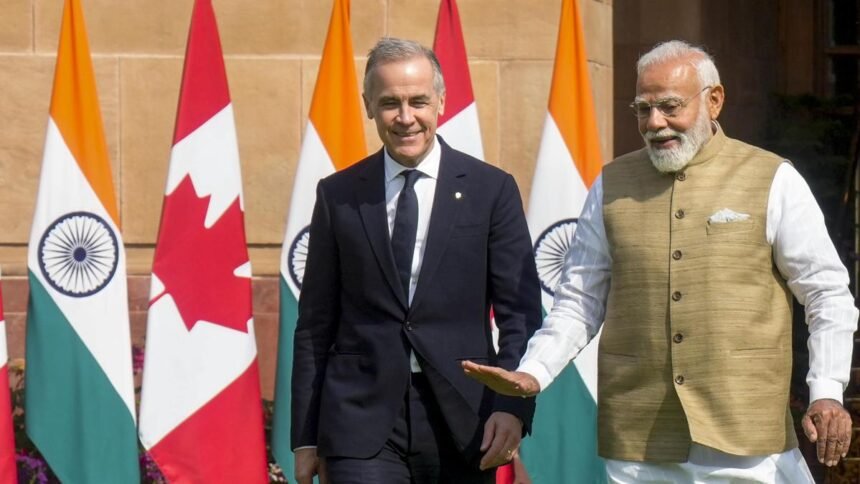
In a significant step toward energy security, India signed a CAD 2.6 billion (approximately ₹15,600 crore) deal with Canada’s Cameco on March 2, 2026, securing a supply of around 10,000 tonnes of uranium between 2027 and 2035. But where does this uranium go, and how does it fit into the larger picture of India’s civilian and strategic nuclear programme? We explain.
What Uranium Resources Does India Have?
India has both domestic reserves and imported stockpiles. Understanding the difference is key.
| Source | Details |
|---|---|
| Domestic Reserves | ~4.2-4.3 lakh tonnes of ore in Jaduguda & Turamdih (Jharkhand) and Tummalapalle (AP). Extractable uranium metal: ~76,000-92,000 tonnes. |
| Key Challenge | Indian ore is ‘low-grade’ (0.02-0.45% concentration), making extraction expensive and less efficient. |
| Imported Uranium | Currently meets nearly three-fourths of India’s civilian requirement. Key suppliers: Canada (Cameco), Kazakhstan (Kazatomprom), Uzbekistan, and Russia. |
| Strategic Reserve | The government is building a reserve intended to hold a five years’ supply of fuel to protect against supply chain shocks. |
The Significance of the Cameco Deal
The deal with Cameco, one of the world’s top three uranium producers, is crucial for two main reasons:
- Quality: Canada has high-grade ore (10-100x richer than Indian ore), making it more efficient and cost-effective for power generation.
- Scale: The supply of 10,000 tonnes over eight years will significantly bolster India’s fuel inventory for its civilian reactors.
The 2010 Agreement and Its Controversies
The Cameco deal operates under the India-Canada Civil Nuclear Cooperation Agreement (NCA) , signed in 2010. This agreement was made possible by two key international developments:
- The Nuclear Suppliers Group (NSG) ‘clean’ waiver in 2008, which ended a global nuclear trade ban on India.
- The India-U.S. 123 nuclear agreement.
However, the NCA has faced criticism from two opposing sides:
- Critics of the deal argue it compromises Indian sovereignty, as it requires India to provide “fissionable material accounts” to Canada, a level of scrutiny not required in deals with other countries like Kazakhstan.
- Critics of India’s nuclear programme argue the deal tacitly supports India’s weapons programme. The logic: by importing more uranium for civilian use, India can conserve its own limited domestic uranium for its military programme (nuclear warheads and naval reactors).
How India Uses Its Uranium
India’s uranium consumption is divided between civilian power generation, research, and strategic (military) purposes.
1. Civilian Power Generation
- India operates 24 nuclear reactors with a generation capacity of around 9 GW.
- The 700-MW pressurised heavy water reactors (PHWRs) are the mainstay, contributing roughly 3% of India’s total electricity.
- The government has an ambitious target to increase nuclear power capacity to 100 GW by 2047.
- The 2025-26 Union Budget also allocated Rs 20,000 crore to develop Small Modular Reactors (SMRs), which typically use 3-5% enriched uranium.
2. Research and Isotopes
- Research reactors like ‘Dhruva’ in Trombay use uranium to produce medical isotopes such as technetium-99m and iodine-131, vital for healthcare.
3. Strategic (Military) Use
- Domestic uranium is used for nuclear warheads (currently estimated at around 170).
- It is also used to fuel India’s nuclear-powered submarines, like the INS Arihant class.
India’s Three-Stage Nuclear Programme
The import deals are critical for India’s long-term nuclear strategy, which was envisioned by Homi J. Bhabha to eventually leverage India’s vast thorium reserves (20-25% of the world’s total).
| Stage | Reactor Type | Fuel | Output |
|---|---|---|---|
| Stage I (Current) | Pressurised Heavy Water Reactors (PHWRs) | Natural Uranium-235 | Electricity + Plutonium-239 (byproduct) |
| Stage II (Transitioning) | Fast Breeder Reactors (FBRs) | Mixed Oxide (Uranium-238 + Plutonium-239) | Electricity + Uranium-233 + more Plutonium-239 |
| Stage III (Future) | Advanced Heavy Water Reactors (AHWRs) | Plutonium-239 + Thorium-232 | Electricity + Uranium-233 |
The Prototype Fast Breeder Reactor (PFBR) in Kalpakkam is currently in an advanced stage of commissioning. However, the programme has faced numerous delays and cost overruns. The PFBR’s cost nearly doubled from its initial estimate.
Former DAE Chairman Anil Kakodkar has explained that the “doubling time” for FBRs (the time to produce enough fuel for a second reactor) is currently 15-20 years. To reach the 100 GW target, India will need to go through several such cycles, which explains the urgency and scale of the multiple uranium import deals being signed now. The large-scale use of thorium is still likely decades away, possibly in the 2060s or later.