

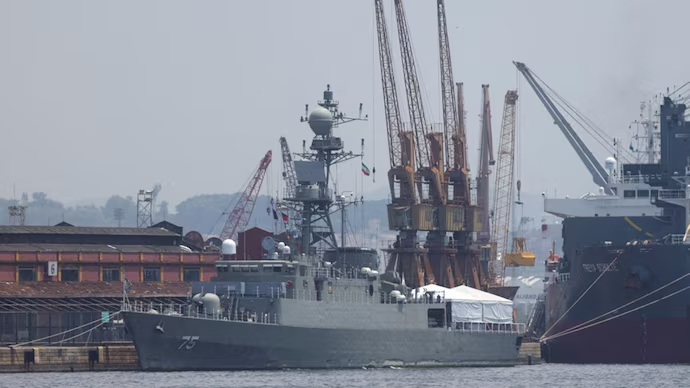
NEW DELHI/KOCHI: In a significant revelation that adds a new layer to the ongoing West Asia crisis, India granted urgent docking permission to an Iranian naval vessel in Kochi just days before a US submarine sank its sister ship, the IRIS Dena, off the coast of Sri Lanka.
According to government sources, Tehran approached India on February 28, 2026—the very day the US and Israel launched joint strikes on Iran—requesting immediate assistance for the frigate IRIS Lavan. The ship, which had also participated in the International Fleet Review in India, reportedly developed technical problems and required urgent docking.
Safe Harbour in the Nick of Time
India’s response was swift. Approval was granted on March 1, and the IRIS Lavan docked at the port in Kochi on March 4. The vessel’s entire crew of 183 personnel is currently being accommodated at naval facilities in the southern port city.
This humanitarian gesture stands in stark contrast to the fate that befell its sister vessel.
The Sinking of IRIS Dena
The IRIS Dena, which was sailing back to Iran after participating in military exercises at Visakhapatnam, was struck by a torpedo fired from a US submarine on March 4. The attack occurred in international waters, approximately 40 nautical miles off the southern Sri Lankan port of Galle.
The warship issued a distress call at dawn reporting an explosion, but had already sunk by the time Sri Lankan rescue ships reached the scene. More than 80 sailors perished when the frigate went down, in an attack that sharply escalated tensions in the widening US-Israel-Iran conflict.
India’s Response to the Sinking
Facing questions about its response to the distress call from a vessel that had been its guest, the Indian Navy issued a detailed statement on Thursday clarifying its actions.
| Action Taken by Indian Navy | Details |
|---|---|
| Search Initiation | Launched search-and-rescue operations immediately after receiving the distress signal. |
| Aerial Surveillance | Deployed a long-range maritime patrol aircraft to speed up search efforts already underway by Sri Lankan authorities. |
| Standby Support | Another aircraft equipped with air-droppable life rafts was kept on standby. |
| On-Water Assistance | INS Tarangini, operating in the vicinity, was diverted to assist. INS Ikshak sailed from Kochi to support search operations. |
| Current Status | INS Ikshak remains in the region to help locate missing personnel “as a humanitarian measure.” |
Iran’s Condemnation
Iran’s Foreign Minister, Abbas Araghchi, strongly condemned the sinking of the frigate, calling it an “atrocity at sea” in a post on X. He emphasized that the ship, carrying nearly 130 sailors, was struck without warning in international waters, about 2,000 miles from Iran’s shores.
Significantly, Araghchi described IRIS Dena as a “guest of India’s Navy,” implicitly acknowledging India’s role as a host while warning that the US would “bitterly regret” setting such a precedent.
US Confirmation
US Defense Secretary Pete Hegseth confirmed the strike at the Pentagon, describing it as a “quiet death” delivered by torpedo. He stated that the attack marked a significant extension of operations in the ongoing conflict triggered by the joint US-Israel strike on Iran.
The Contrast: Humanitarian India vs. Conflict Zone
The two contrasting episodes highlight India’s delicate position in the escalating crisis. While New Delhi has officially denied any involvement in the attack on IRIS Dena and has not taken sides in the conflict, its actions in granting safe harbour to IRIS Lavan and launching a humanitarian rescue mission for the crew of the sunken ship demonstrate a commitment to maritime safety and humanitarian principles, even amidst a complex geopolitical storm.