

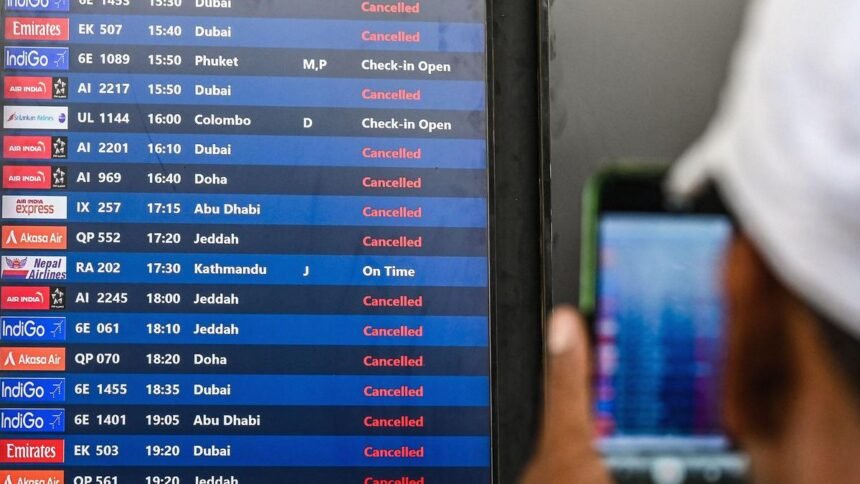
NEW DELHI/DUBAI: The escalating military conflict between Israel-U.S. and Iran has thrown air travel into chaos, with Indian airlines cancelling approximately 350 flights on Sunday, March 1, 2026. The cancellations have left thousands of passengers stranded at major transit hubs, prompting emergency measures by Gulf nations.
The disruptions follow a wave of airstrikes in the region and an urgent advisory from India’s aviation regulator, the Directorate General of Civil Aviation (DGCA) , which remains valid until March 2.
Which Flights Are Cancelled?
All Indian carriers have completely suspended flights to 11 countries in West Asia. In addition, Air India has announced a fresh wave of cancellations affecting long-haul routes to Europe and North America.
| Airline | Cancellations Announced |
|---|---|
| All Indian Carriers | Complete suspension of flights to 11 West Asian countries (per DGCA advisory). |
| Air India | 20 additional long-haul flights to European destinations including London, Zurich, Milan, Frankfurt, and Copenhagen. |
| Total (Air India only) | 48 long-haul/ultra-long-haul flights cancelled on March 1 (including 28 earlier cancellations to the U.S., Canada, and Europe). |
| Industry-Wide Total | Approximately 350 flights cancelled on Sunday alone. |
UAE Steps In to Support Stranded Passengers
With thousands of travellers stuck at airports in Dubai, Abu Dhabi, and other hubs, the United Arab Emirates has announced a comprehensive support package.
The General Civil Aviation Authority (GCAA) confirmed that the state will cover all accommodation and sustenance costs for affected and stranded passengers, ensuring essential services are provided while flights remain suspended.
Specific directives issued include:
- Dubai: The Dubai Department of Economy and Tourism instructed hotel managers to allow affected guests to extend their stay on the same terms as their original bookings.
- Abu Dhabi: Authorities issued a parallel order, with the government confirming it will bear the accommodation costs for stranded guests.
Oman Eases Visa Rules for Stranded Indians
In a significant diplomatic move, the Embassy of India in Muscat issued a public notice outlining temporary visa relaxations for Indian citizens seeking shelter in Oman.
- For GCC Residents: Indian citizens in Gulf Cooperation Council (GCC) countries (Bahrain, Kuwait, Qatar, Saudi Arabia, UAE) who hold valid resident cards are now eligible for a visa on arrival in Oman.
- For Other Passport Holders: Indian passport holders with a valid visa or residence permit from the U.S., U.K., Canada, Japan, and Schengen countries are also eligible for a visa on arrival, allowing entry into Oman for up to 10 days without a pre-arranged visa.
- Other Travellers: May apply for an e-visa through an authorised travel agency.
The situation remains fluid, and passengers are advised to check with their airlines for the latest updates on flight status and with embassies for information on transit support measures.