


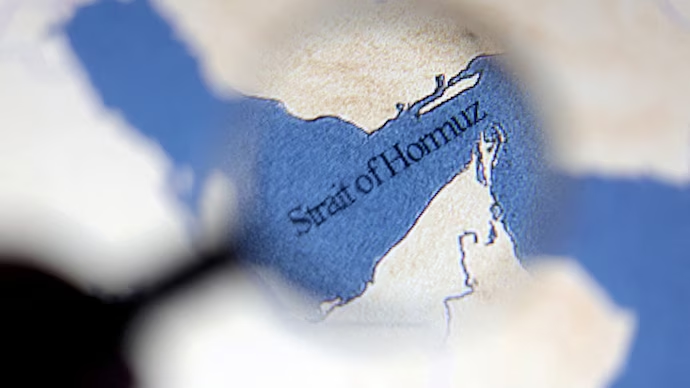
Recent US intelligence reports warn that Iran is unlikely to open the Strait of Hormuz any time soon because its grip on the world’s most vital oil artery provides the only real leverage it has over the United States, according to three sources familiar with the matter.
The finding suggests that Tehran could continue to throttle the strait to keep energy prices high as a means of pressuring US President Donald Trump to find a quick off-ramp to the nearly five-week-long war that remains unpopular with US voters.
A ‘Weapon of Mass Disruption’
| Ali Vaez (International Crisis Group) | “In the attempt to try to prevent Iran from developing a weapon of mass destruction, the US handed Iran a weapon of mass disruption.” |
| Bill Burns (former CIA Director) | Iran will look to use its ability to throttle the waterway to win “long-term deterrence and security guarantees” in any peace deal. |
“In the attempt to try to prevent Iran from developing a weapon of mass destruction, the US handed Iran a weapon of mass disruption,” said Ali Vaez, director of the Iran Project at the International Crisis Group.
Tehran, Vaez said, understands its ability to drive world energy markets through its chokehold on the strait “is much more potent than even a nuclear weapon.”
Trump’s Shifting Stance
| Trump’s Post | “With a little more time, we can easily OPEN THE HORMUZ STRAIT, TAKE THE OIL, & MAKE A FORTUNE.” |
| Ceasefire Precondition | Ending Iran’s chokehold on the strait |
| Call for Allies | Asked Gulf oil-dependent countries and NATO allies to take the lead |
| White House Official | Trump is “confident that the strait will be open very soon” |
Trump has sought to downplay the difficulty of reopening the Strait of Hormuz, which carries a fifth of the world’s oil trade. On Friday, he appeared to suggest that he could order US forces to reopen the passage.
But analysts have long warned that trying to use force against Iran, which controls one side of the strait, could prove costly and draw the US into a protracted ground war.
How Iran Is Blocking the Strait
Since the war began on February 28, Iran’s Islamic Revolutionary Guard Corps (IRGC) has used various tactics to make commercial transit through the waterway too dangerous or uninsurable:
| Attacking civilian vessels | Increased danger for commercial shipping |
| Releasing mines | Threat to passing ships |
| Demanding passage fees | Additional cost for transit |
| Blocking traffic | Oil prices soared to multi-year highs; fuel shortages in dependent countries |
Risks of a Military Operation
Many experts say that a military operation to reopen the waterway involves considerable risks.
| Geography | Strait is 21 miles wide at narrowest point; shipping lane only 2 miles wide |
| Vulnerability | Ships and troops are easy targets |
| Iran’s Capability | IRGC could attack from deep inside Iran using drones and missiles |
| Expert Warning | “All it takes to disrupt traffic is one or two drones.” – Ali Vaez |
Iran’s Post-War Plans
Some experts said that even after the war, Iran is unlikely to give up its ability to regulate traffic through the strait because it will need to rebuild, and charging commercial shipping passage fees would be one means of raising reconstruction funds.
Former CIA Director Bill Burns said Iran will look to use its ability to throttle the waterway to win “long-term deterrence and security guarantees” in any peace deal and to gain “some direct material benefits” like charging passage fees to fund its post-war recovery.
“That sets up a really difficult negotiation right now,” he said.