

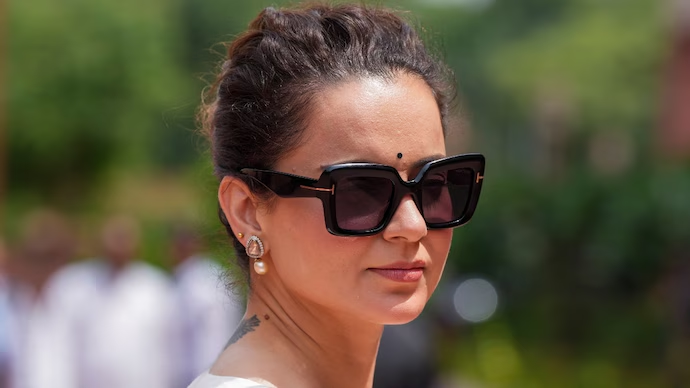
The Bombay High Court has permitted actress and BJP MP Kangana Ranaut to withdraw her petition seeking to quash a 2021 FIR filed against her over alleged copyright violations related to her planned film on Kashmir’s medieval queen Didda. The development marks a significant turn in a legal battle that has dragged on for nearly five years, raising important questions about copyright law, historical narratives, and the rights of authors versus filmmakers.
The Court’s Decision
On Tuesday, February 25, 2026, a division bench of the Bombay High Court comprising Justices SS Shinde and GA Sanap allowed Kangana Ranaut to withdraw her petition that sought to quash the FIR registered against her in March 2021. The actress had filed the petition under Article 226 and 227 of the Constitution along with Section 482 of the Code of Criminal Procedure.
The court’s permission to withdraw means Ranaut is abandoning her legal challenge to the FIR itself, though the underlying copyright dispute with author Ashish Kaul may continue through other legal avenues. This withdrawal comes after years of intermittent hearings where both parties presented their arguments about who has the right to tell the story of Queen Didda.
Legal experts suggest the withdrawal might indicate that Ranaut and her legal team have decided pursuing the quashing petition is no longer strategically viable or that some form of settlement discussions may be underway behind the scenes.
The Original Copyright Dispute
The controversy began in March 2021 when Ashish Kaul, former Group Executive Vice President of Zee Network and author of the book “Didda: The Warrior Queen of Kashmir,” filed a complaint before a Mumbai magistrate alleging copyright violations. Kaul accused Kangana Ranaut, her brother Akshat Ranaut, her sister Rangoli Chandel, producer Kamal Kumar Jain, and Manikarnika Films Private Limited of announcing a film based on his intellectual property without permission.
According to the complaint, Kaul had approached Ranaut in September 2020 via email with excerpts from his book. He was shocked when the actress subsequently announced her project “Manikarnika Returns: The Legend of Didda” without any agreement or acknowledgment of his work.
The FIR was registered by Khar Police Station under IPC Sections 406, 415, 418, 120(b), and 34, along with Sections 51, 63, and 63A of the Copyright Act of 1957. These sections deal with criminal breach of trust, cheating, cheating with knowledge, criminal conspiracy, acts done by several persons, and various copyright violations respectively.
Kaul’s Claims of Exclusive Rights
Ashish Kaul’s central argument has been that he possesses exclusive copyright over the unique story and characterization of Queen Didda as presented in his book. Speaking to media in March 2021, Kaul explained that while Didda is a historical figure, his particular interpretation and narrative approach are original creative works deserving copyright protection.
Kaul emphasized that aside from his book, there exists only one other historical text mentioning Didda—the ancient chronicle Rajatarangini, which dedicates merely two pages to her. According to Kaul, that ancient text primarily discusses her sexual life and allegations that she killed her son and infant grandsons, presenting her in a largely negative light.
In contrast, Kaul’s book reimagines Didda as a nationalist figure who nurtured an undivided India during the 10th and 11th centuries, calling her “The Cleopatra of Kashmir” who ruled for over five decades. He argues this positive nationalist narrative is entirely his creation and thus copyrightable.
“The description of Didda as identified by Kangana Ranaut to promote her film is identical to what is set out in my book,” Kaul told The Indian Express shortly after filing the complaint. He claimed that the potential financier and distributor who had shown interest in his book project, Uttam Maheshwari, had sent his complete docket—including script, characterization, and possible cast—to Kangana Ranaut.
Kaul stated he had been in talks with various production houses for three years to adapt his book into a film that he hoped to direct. When Ranaut announced her project, he faced immediate financial losses as other potential producers backed away, unwilling to engage with material now subject to a competing claim.
Ranaut’s Defense: Historical Facts Cannot Be Copyrighted
Kangana Ranaut’s legal team mounted a vigorous defense based on fundamental principles of copyright law. During a June 2021 hearing before the same Bombay High Court bench, her advocate argued that historical work and historical facts can never be copyrighted.
The petition stated: “The respondent has not made out any case by firstly proving how he became entitled to claim exclusive rights on historical work, fact and events thereby leading the magistrate to assume he is the copyright owner of such work and on the basis of such assumptions set the criminal law in motion against the petitioners.”
Ranaut’s lawyer emphasized during arguments that there must be comparable work for copyright infringement to occur, whereas in this case there was no actual film or script—merely an announcement of intent to make a movie about a historical figure. “I have only made an announcement I will be making a film on a historical figure. And only by virtue of having made an announcement the FIR is filed,” the advocate argued.
This defense rests on established copyright principles that facts, historical events, and real persons exist in the public domain and cannot be monopolized by any single author or creator. While the specific expression of those facts—the way they’re arranged, interpreted, and presented—can receive copyright protection, the underlying historical reality remains available for anyone to depict.
Ranaut’s team claimed she made her announcement based on research and material available on Queen Didda in the public domain, not based on Kaul’s book. They argued that multiple filmmakers can create works about the same historical figure without infringing on each other’s copyrights, as long as they’re not copying specific creative expression.
The Magistrate’s Order Under Challenge
Ranaut’s petition also challenged the magistrate’s order that led to the FIR registration. She alleged the order was passed without proper application of mind to the sections invoked and without adequate verification of evidence.
The petition pointed out that the magistrate called for a report from Twitter Communications India Private Limited (TCIPL) to verify whether Ranaut had actually made the alleged announcements on social media, but proceeded to issue process against her even before receiving that report.
Ranaut’s lawyers argued this procedural irregularity fundamentally undermined the legitimacy of the criminal proceedings. How could the magistrate be satisfied that an offense had been committed without even confirming the basic factual predicate—that Ranaut had indeed made the announcements attributed to her?
The petition sought not just to quash the FIR but also to set aside the police notice issued under Section 41A CrPC and to stay the investigation in the interim. These requests indicated Ranaut wanted a complete halt to the criminal process, which she characterized as malicious and based on conjectures rather than actual wrongdoing.
The Passport Complication
The case took an additional dimension when Kangana Ranaut sought the court’s permission to renew her passport, alleging that authorities had orally raised objections owing to pending FIRs against her. During a June 2021 hearing, the bench permitted her lawyer to approach the court for an urgent hearing on this matter.
On June 28, 2021, the Bombay High Court disposed of two applications by Ranaut seeking directions to renew her passport after the Passport Authority indicated they would consider her application expeditiously based on her counsel’s assurance that no criminal cases were pending against her and only two FIRs were registered.
However, this representation became controversial when lyricist Javed Akhtar filed an intervention application accusing Ranaut of deliberately concealing his pending defamation case to mislead the court. Akhtar, who is not a party to the Didda copyright dispute, argued that Ranaut’s false statements about pending cases demonstrated a pattern of dishonesty with the judiciary.
The court ultimately refused to hear Akhtar’s intervention in the Didda case, telling him to approach the complainant or public prosecutor since he wasn’t a party to those proceedings. However, the passport issue highlighted how Ranaut’s multiple legal entanglements were creating complications across different cases.
Why the Withdrawal Now?
The decision to withdraw the quashing petition after nearly five years raises several possibilities about what might have transpired behind the scenes.
One possibility is that Ranaut and her legal team concluded the petition was unlikely to succeed on its merits. Despite strong arguments about historical facts being in the public domain, proving she didn’t rely on Kaul’s specific creative expression might be difficult if there are genuine similarities between his book’s characterization and her announced project.
Another possibility is that Ranaut has decided not to pursue the Didda film project at all, making the copyright dispute moot. Her filmography since the 2021 FIR has focused on other projects including “Emergency,” a biographical drama about former Prime Minister Indira Gandhi which was released in January 2025, and “Tejas,” in which she played an Air Force pilot.
While Ranaut has occasionally mentioned “Manikarnika Returns: The Legend of Didda” in interviews about her upcoming projects, there has been no concrete development on the film. If she’s effectively abandoned the project, continuing an expensive legal battle makes little strategic sense.
A third possibility is that some form of settlement or accommodation has been reached with Kaul, making the criminal case unnecessary. Settlement in copyright disputes is common, and parties often reach agreements about licensing, credit, or compensation that allow projects to move forward.
The Broader Context of Ranaut’s Legal Troubles
The Didda copyright case represents just one of multiple legal challenges Kangana Ranaut has faced in recent years. Understanding these other cases provides context for why she might choose to strategically withdraw from certain battles.
In February 2021, a Mumbai court ordered the issuance of process against Ranaut in a defamation case filed by lyricist Javed Akhtar. He accused her of making defamatory statements against him during a television interview. Ranaut challenged this in sessions court, but her plea was dismissed in April 2021.
In January 2021, Punjab-based farmer Mahinder Kaur filed a defamation complaint in Bathinda court after Ranaut allegedly compared her to the “Dadi” at Shaheen Bagh in a social media post, implying protesters were for hire. The Punjab and Haryana High Court heard Ranaut’s petition to quash this FIR, and in August 2025, the court dismissed her plea, finding that the magistrate had properly applied his mind and that the defamation case should proceed.
Ranaut challenged this Punjab and Haryana High Court order in the Supreme Court, which scheduled a hearing for September 12, 2025. However, Ranaut subsequently withdrew that Supreme Court plea in September 2025, also retracting her controversial remarks about the farm laws that had sparked the defamation case.
Actor Aditya Pancholi and his wife Zarina Wahab filed separate defamation complaints against Ranaut in October 2017 after she made allegations about an abusive relationship. These cases were stayed by the Dindoshi sessions court in 2019 after Ranaut challenged them.
Additionally, Pancholi filed a 2019 rape FIR against Ranaut, which is currently pending before the Bombay High Court. A February 2026 hearing granted the complainant one week to respond, with the next hearing set for March 4, 2026.
This accumulation of legal battles has likely created significant personal, professional, and financial strain. Each case requires legal representation, court appearances, and ongoing attention that distracts from Ranaut’s work as both an actress and now as a BJP Member of Parliament representing Mandi constituency in Himachal Pradesh.
The Copyright Law Questions
The Didda case raises important questions about where the line falls between historical facts in the public domain and copyrightable creative expression about historical figures.
Copyright law clearly establishes that facts themselves cannot be copyrighted. No one can claim exclusive ownership of the truth that Queen Didda existed, ruled Kashmir in the 10th-11th centuries, or engaged in specific documented historical actions. Similarly, no author can prevent others from consulting the same historical sources like Rajatarangini and creating their own interpretations.
However, the selection, arrangement, and interpretation of historical facts can constitute original creative work deserving protection. An author who researches obscure historical records, develops a particular theory about a historical figure’s motivations, creates dialogue and scenes depicting private moments not recorded in history, and structures a narrative with specific themes and character arcs has created something beyond mere facts.
The challenge in cases like this is determining how much of Kaul’s book represents protectable creative expression versus historical facts available to all. If his characterization of Didda as a nationalist who preserved undivided India represents historical research conclusions available to anyone studying the same sources, then it shouldn’t be copyrightable. But if it represents a creative reimagining unsupported by historical evidence, it might warrant protection.
Courts generally apply substantial similarity tests in copyright cases, examining whether the allegedly infringing work has copied specific creative elements rather than just drawing from common sources. In the Didda case, this would require comparing Kaul’s book with Ranaut’s actual screenplay or treatment—but since no such screenplay has been produced, the analysis becomes speculative.
The Impact on Historical Filmmaking
The case has implications for how Bollywood and other film industries approach biopics and historical dramas. If authors can successfully claim copyright over specific characterizations of historical figures, it could complicate filmmaking about any person who has been the subject of previous books or articles.
Imagine if every filmmaker wanting to depict Mahatma Gandhi, Jawaharlal Nehru, or Chhatrapati Shivaji had to navigate copyright claims from various authors who have written about these figures. The public’s right to create works about historical persons could be significantly constrained.
On the other hand, authors invest considerable time, effort, and creativity in researching and developing original interpretations of historical figures. If filmmakers can simply lift that creative work without compensation or credit, it undermines the incentive to produce such scholarship and creative nonfiction.
The balance involves protecting specific creative expression while keeping historical facts and figures available for all to interpret. Ranaut’s argument that she was working from public domain sources and historical research represents one side of this balance. Kaul’s argument that she took his specific creative interpretation represents the other side.
What Happens to the Underlying FIR?
The withdrawal of Ranaut’s quashing petition means the 2021 FIR remains on record and the investigation can theoretically continue. However, the practical effect depends on several factors.
If Ranaut has indeed abandoned the Didda film project, there may be no ongoing copyright violation to investigate. Copyright infringement requires actual copying and use of protected material, not merely announced intent. Without a screenplay, script, or film to examine, establishing infringement becomes nearly impossible.
If some form of settlement has been reached between Ranaut and Kaul, they could jointly move to have the FIR closed as the complaint has been resolved. Criminal cases based on private complaints often get disposed of when parties reach civil settlements, though this requires proper legal procedures.
The police investigation that began in 2021 appears to have made limited progress. Given that nearly five years have passed without apparent movement toward filing a charge sheet, the case may have been effectively dormant. The withdrawal of the quashing petition might simply formalize what was already a stalled investigation.
Lessons from the Didda Dispute
This case offers several lessons for the entertainment industry and creative professionals working with historical material.
First, filmmakers and authors should establish clear understandings about rights and permissions early in any collaboration. Kaul’s allegation that his complete docket was shared with Ranaut through an intermediary highlights how informal discussions can lead to disputes. Clear written agreements about what is being shared and under what terms could prevent such conflicts.
Second, anyone planning to create work based on historical figures should document their independent research and sources. If Ranaut had commissioned historical research independent of Kaul’s book and could demonstrate her interpretation came from original scholarship, it would strengthen her defense against copyright claims.
Third, public announcements of projects can create legal exposure even before substantial work has been done. Ranaut’s announcement of the Didda film provided the basis for Kaul’s copyright claim. More cautious announcement practices that avoid detailed descriptions until legal clearances are obtained might reduce such risks.
Fourth, the case demonstrates how copyright disputes can drag on for years, creating ongoing uncertainty and legal expenses. The costs of such litigation—financial, reputational, and in terms of time and energy—often exceed what either party gains. Earlier settlement discussions might have served everyone’s interests better.
The Political Dimension
Kangana Ranaut’s transformation from controversial actress to BJP Member of Parliament adds a political layer to her legal troubles. As an MP representing Mandi constituency since 2024, ongoing criminal cases create potential political vulnerabilities.
Opposition parties can point to pending FIRs and legal disputes as evidence of controversial behavior. While Ranaut’s base of support includes people who admire her outspoken nature, the accumulation of legal problems could become a liability, particularly if any case results in conviction.
The decision to withdraw multiple legal challenges—first the Supreme Court petition in the farmers’ protest defamation case in September 2025, and now the Didda copyright quashing petition in February 2026—might reflect advice to minimize legal distractions as she focuses on political work.
As an MP, Ranaut has parliamentary responsibilities and constituency obligations that may leave less time and energy for fighting prolonged legal battles over film projects she may no longer wish to pursue. Strategic withdrawal from certain cases allows her to focus on others where the stakes are higher or prospects better.
What This Means for “Manikarnika Returns: The Legend of Didda”
The million dollar question is whether Kangana Ranaut will ever actually make “Manikarnika Returns: The Legend of Didda.” The withdrawal of her quashing petition doesn’t necessarily mean the film project is dead, but it creates significant uncertainty.
If Ranaut wants to proceed with the film, she now faces the choice of either reaching an accommodation with Ashish Kaul regarding rights and credit, or proceeding with a version of the story developed entirely independently of his book. The latter approach would require demonstrating no reliance on Kaul’s creative work, which might limit how she can characterize Didda.
Given that her first film “Manikarnika: The Queen of Jhansi” was released in 2019 and the sequel was announced shortly thereafter, the seven-year delay suggests the project may have lost momentum. Ranaut has completed several other films in the interim and may have moved on to different priorities.
The film’s continued listing in some of Ranaut’s filmography pages and occasional mentions in interviews keep alive the possibility she might eventually return to it. However, entertainment industry observers note that projects lingering in development for many years often never materialize.
If the Didda film does eventually get made, this copyright dispute will likely influence how it’s developed, marketed, and credited. Any settlement with Kaul might include provisions for credit, compensation, or consultation. Alternatively, Ranaut might work with different historians and writers to create a version of Didda’s story that clearly differs from Kaul’s interpretation.
For now, the withdrawal of the quashing petition closes one legal chapter while leaving the broader story of whether audiences will ever see Queen Didda on screen unfinished. What began as a copyright dispute over who has the right to tell a medieval queen’s story has become a case study in the complex intersection of historical rights, creative ownership, and the practical realities of entertainment industry litigation.