

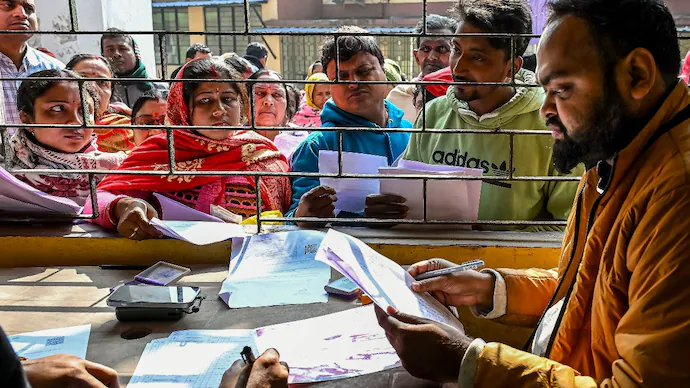
The Supreme Court delivered a stern warning to the West Bengal government on Monday, making it clear that no obstacles would be tolerated in completing the Special Intensive Revision of electoral rolls. While acknowledging legitimate concerns about the process, Chief Justice Surya Kant emphasized that the court would facilitate the revision exercise rather than hinder it, setting the stage for a critical showdown between state authorities and the Election Commission.
The Court’s Unambiguous Message
During Monday’s hearing, Chief Justice Kant left no room for ambiguity about the court’s position. He stated directly that the bench would remove hurdles from the SIR process but would not create any impediments to its completion. This declaration came as the court heard a batch of petitions challenging the ongoing electoral roll revision in West Bengal.
The three-judge bench, comprising CJI Surya Kant, Justice Joymalya Bagchi, and Justice N.V. Anjaria, was addressing concerns raised by both West Bengal Chief Minister Mamata Banerjee and the Election Commission of India. The court’s message appeared directed primarily at state authorities who have been accused of obstructing the revision process.
This strong judicial position represents a significant moment in the ongoing confrontation between Mamata Banerjee’s government and the Election Commission over how voter rolls should be updated ahead of the 2027 Assembly elections.
Deadline Extended But Process Must Continue
The Supreme Court granted a one-week extension for publishing the final electoral roll in West Bengal, moving the deadline from February 14 to February 21. However, this extension came with clear expectations that the process would proceed without further delays or obstacles.
The court justified the extension by noting that since new government officials had recently been inducted into the process, additional time was needed for scrutinizing documents submitted by affected voters in response to deletion notices. This practical accommodation reflected the court’s acknowledgment that proper verification requires adequate time, while maintaining pressure for timely completion.
The extension provides breathing room for Electoral Registration Officers to examine documentation from the more than 1.36 crore voters whose names appeared on the logical discrepancy list. Many of these individuals faced potential deletion due to spelling variations, address changes after marriage, or other administrative inconsistencies.
Show Cause Notice to West Bengal DGP
In a development that could escalate tensions between the state and the Election Commission, the Supreme Court issued a show-cause notice to the West Bengal Director General of Police. The DGP has been ordered to file a personal affidavit explaining the state police’s response to complaints made by Election Commission officials.
The Election Commission had alleged that despite filing complaints about vandalism, burning of election-related records, and other unlawful activities, the state police failed to register FIRs against the perpetrators. These allegations suggest systematic non-cooperation by state law enforcement with the electoral revision process.
Senior Advocate representing the Election Commission pointed out specific instances where objection forms were allegedly burned and election officials faced obstruction, yet no criminal cases were filed. The West Bengal government has denied these allegations, but the court clearly found sufficient concern to warrant direct explanation from the state’s top police official.
This show-cause notice represents a significant judicial intervention into the administrative machinery of the state. By demanding a personal affidavit from the DGP rather than accepting routine responses through state counsel, the court is signaling that it expects detailed accountability for police actions or inactions.
The Micro-Observers Controversy
A contentious aspect of Monday’s hearing involved the deployment of over 8,000 micro-observers by the Election Commission. Mamata Banerjee had challenged this deployment in her earlier appearance before the court, alleging that these were central government officers who lacked knowledge of Bengal’s culture, language, and local conditions.
The court clarified that micro-observers are not decision-making authorities and should only assist Electoral Registration Officers in the revision process. This clarification appeared designed to address concerns that outside observers were making final decisions about voter deletions rather than merely supporting the statutory authorities.
However, the Election Commission defended the micro-observer deployment by arguing that the state government failed to provide adequate Group B officers despite repeated requests. Senior Advocate D.S. Naidu, appearing for the Election Commission, stated that five letters were sent requesting officers who could perform quasi-judicial functions, but the state provided only 64 such officers out of the required numbers.
The state’s representative, Senior Advocate A.M. Singhvi, countered that 80,000 Booth Level Officers and over 8,000 Electoral Registration Officers had been provided, all of whom were Group B officers with appropriate qualifications and knowledge of local conditions. He criticized the Election Commission for appointing people like master craftsmen, painters, and teachers from outside Bengal who lacked understanding of Bengali culture and language.
This dispute reveals a fundamental disagreement about whether the state has cooperated adequately with the Election Commission or whether the Commission has made unreasonable demands that justified bringing in outside personnel.
The Qualification Question for EROs
An important technical issue emerged regarding the qualifications of Electoral Registration Officers. The Election Commission argued that EROs need to function as quasi-judicial authorities capable of making decisions that could be challenged in appellate forums, and therefore require specific administrative experience and seniority.
The Commission’s position was that engineers, teachers, and other government employees provided by the state, despite having comparable pay grades, lacked the quasi-judicial training and experience necessary for making legally sound decisions about voter eligibility.
Former Chief Secretary Manoj Pant, representing the state, responded that all 294 EROs are Group A officers, including Sub-Divisional Magistrates and Sub-Divisional Officers, some of whom are IAS officers with nine years of completed service. He emphasized that 65 percent of the 8,500 Assistant Electoral Registration Officers are Group B officers, with only 10 percent being Group C officers.
This technical debate about officer qualifications masks a deeper political fight over who controls the electoral roll revision process and whether the state government or the Election Commission has final say over personnel deployment.
Mamata’s Earlier Historic Appearance
The Monday hearing followed Mamata Banerjee’s unprecedented personal appearance before the Supreme Court on February 4, when she became the first sitting Chief Minister to argue her own case. During that dramatic session, Banerjee wore a lawyer’s coat and made emotional appeals to the bench, folding her hands and saying “please protect the people’s rights.”
Banerjee had argued that the SIR process was designed for deletion rather than inclusion of voters, effectively disenfranchising legitimate citizens ahead of the 2027 elections. She called the Election Commission a “WhatsApp Commission” for allegedly issuing instructions through messaging platforms rather than formal channels.
The Chief Minister cited Bengali poet Rabindranath Tagore and framed the dispute as a moral fight to defend democracy. She questioned why SIR was being conducted in West Bengal but not in Assam, where elections are also scheduled soon but the BJP governs. She alleged that more than 100 people, including Booth Level Officers, had died due to the stress and harassment of the SIR process.
Her appearance generated significant political optics, with the Trinamool Congress declaring it a “big win” when the court issued notices to the Election Commission and directed officials to act with sensitivity. However, Monday’s hearing suggests the court is taking a more balanced approach that acknowledges both legitimate concerns and the necessity of completing the revision process.
The Scale of Deletions
The controversy centers on the deletion of more than 58 lakh voters in the first phase of SIR, with over 1.36 crore names flagged in the logical discrepancy category. These numbers represent a substantial portion of West Bengal’s electorate and have raised concerns about mass disenfranchisement.
Critics, including the petitioners before the Supreme Court, have highlighted what they consider irregularities in the deletion process. These include disproportionate deletions affecting certain communities, apparent gender biases with women being deleted at higher rates than men, and unusually high numbers of young voters being declared dead.
The logical discrepancy category includes cases where names don’t perfectly match across different documents, where addresses have changed due to marriage or migration, or where spelling variations exist in surnames. Many of these discrepancies appear administrative rather than indicative of fraudulent voter registration.
Defenders of the SIR process argue that electoral rolls had become bloated with dead voters, duplicate entries, and people who had migrated out of the state. They contend that cleaning up the rolls is essential for election integrity and that those with legitimate claims can provide documentation to restore their names.
The Supreme Court’s earlier directions on January 19 required transparent verification of voters in the logical discrepancy category, with public display of affected names and proper notice periods for submitting clarifying documents. The question is whether these safeguards have been implemented effectively.
Political Stakes for 2027 Elections
The entire SIR controversy must be understood against the backdrop of West Bengal’s Assembly elections scheduled for 2027. These elections will determine whether Mamata Banerjee’s Trinamool Congress retains power or whether the BJP, which has made significant inroads in the state, can capture the government.
The composition of electoral rolls directly impacts election outcomes. If the deleted voters disproportionately belong to constituencies or communities that tend to support one party over another, it could shift electoral dynamics. This is why both sides are fighting so fiercely over the revision process.
Mamata Banerjee has consistently argued that the SIR is being weaponized by the central government to undermine her party’s electoral prospects. She points to the timing of the exercise, conducted just over a year before elections, and questions why similar intensive revisions aren’t happening in BJP-governed states with upcoming elections.
The Election Commission rejects these allegations, maintaining that SIR is a routine administrative exercise mandated by law and conducted to ensure election integrity. The Commission argues that West Bengal’s electoral rolls were particularly in need of updating due to years of inadequate maintenance.
The Documentation Dilemma
A practical issue that has generated significant controversy involves what documentation voters must provide to avoid deletion. The Election Commission has reportedly required multiple forms of proof beyond Aadhaar cards, which Banerjee argues is not required in other states.
During her February 4 appearance, Mamata Banerjee specifically alleged that while Aadhaar is accepted as sufficient proof in other states, Bengal voters are being asked for additional certificates. She characterized this as discriminatory treatment designed to make it harder for Bengal residents to prove their eligibility.
The court’s directions have attempted to address this by clarifying that Electoral Registration Officers should accept all documents specified in the SIR notification and existing legal frameworks. The intent appears to be preventing arbitrary rejection of valid documentation.
However, implementation of these directions at the ground level, across thousands of polling booths and constituencies, remains uncertain. Many affected voters are poor, illiterate, or elderly people who may struggle to navigate bureaucratic requirements even when those requirements are legally proper.
The Role of Civil Society
The SIR controversy has mobilized civil society organizations and political activists across West Bengal. Groups have been conducting awareness campaigns to inform voters about their rights, helping people gather necessary documentation, and documenting cases of allegedly improper deletions.
Some organizations have filed independent petitions before the Supreme Court, contributing additional perspectives beyond the state government’s political position. These civil society interventions provide the court with information about ground realities that might not emerge through adversarial proceedings between the state and the Election Commission.
Academic researchers have also weighed in, analyzing the statistical patterns of deletions and questioning whether the demographics of affected voters suggest systematic bias. While the Election Commission dismisses these analyses as politically motivated, they add to public pressure for transparency in the revision process.
What the Court Is Balancing
The Supreme Court finds itself navigating between competing imperatives. On one hand, ensuring clean and accurate electoral rolls is essential for democratic integrity. Dead voters, duplicate entries, and people who have migrated out should be removed to prevent electoral fraud.
On the other hand, the court must ensure that the revision process doesn’t disenfranchise legitimate voters through overly strict documentation requirements, administrative errors, or politically motivated targeting. The right to vote is fundamental, and mass deletions based on minor discrepancies could undermine democracy as much as fraudulent voter rolls.
The court’s approach appears to involve maintaining pressure on both sides. The stern warning against impediments to the SIR process tells the West Bengal government that obstruction will not be tolerated. The show-cause notice to the DGP signals that the state cannot simply ignore Election Commission complaints.
Simultaneously, the court’s directions about accepting proper documentation, its clarification that micro-observers aren’t decision-makers, and its extension of the deadline to allow proper scrutiny all indicate concern about protecting legitimate voters.