

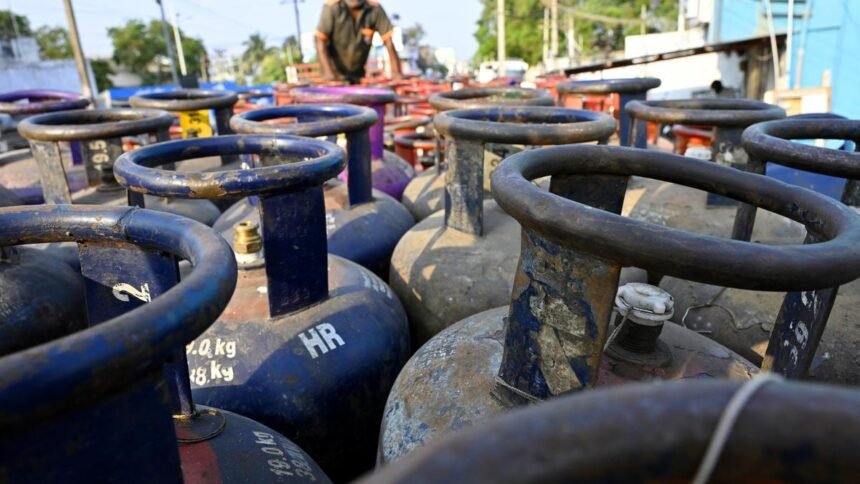
The escalating war between the U.S.-Israel and Iran has done more than just rattle global oil markets. It has shone a harsh light on India’s deep and potentially vulnerable dependence on imported Liquefied Petroleum Gas (LPG), the cooking fuel that powers kitchens in over 300 million households.
With the Strait of Hormuz effectively closed since March 1, supplies have been disrupted, domestic prices have been hiked, and the government has been forced to take emergency measures to secure fuel for domestic consumers.
The Scale of India’s LPG Dependence
India produces only about 40% of its LPG requirement. The remaining 60% is imported, and the vast majority of these imports come from a single, volatile region: West Asia.
| Aspect | Key Data |
|---|---|
| Domestic Production | ~40% of total requirement |
| Import Dependence | ~60% |
| Total LPG Imports (2025-26) | Over 18 million metric tonnes (MMT), up from 16.48 MMT in 2020-21 |
| Active LPG Consumers (July 2025) | 33.05 crore (over 330 million), up 120% in a decade |
| LPG Coverage | Nearly 100% of households (up from 62% in 2016, pre-Ujjwala) |
A Region at War: Where India’s LPG Comes From
India’s LPG imports are heavily concentrated in a handful of countries, all now caught in or near the conflict zone.
| Country | Share of India’s LPG Imports (2025) |
|---|---|
| Qatar | 34% (Largest supplier) |
| UAE | 26% |
| Kuwait | 8.3% |
| Saudi Arabia | Significant supplier (11% in 2020) |
This dependence is not new, but the closure of the Strait of Hormuz—a chokepoint through which a large share of these shipments must pass—has transformed a logistical reality into a critical vulnerability.
The Immediate Impact: Price Hikes and Emergency Measures
The conflict’s impact has been felt almost immediately by Indian consumers and the government.
- Price Hike: On March 7, just over a week after the conflict began, domestic LPG prices were raised by ₹60 per cylinder.
- Government Directive: On March 9, the Ministry of Petroleum and Natural Gas issued an order directing all domestic oil refining companies to maximise LPG production and make the entire output available exclusively to the three state-owned OMCs (IOCL, BPCL, HPCL) for supply to domestic consumers only. Refiners have been barred from diverting output for other petrochemical uses.
- Budgetary Pressure: This comes just a month after the Union budget cut the LPG subsidy allocation by 27% , from ₹15,121 crore to ₹11,085 crore. The emergency measures could put further strain on these resources.
The Long-Term Trend: Soaring Demand
The current crisis is superimposed on a decade of explosive growth in LPG demand, driven largely by the government’s flagship Pradhan Mantri Ujjwala Yojana (PMUY) , which aimed to provide clean cooking fuel to poor households.
- Since its launch in 2016, LPG coverage has surged from 62% to nearly 100%.
- The number of active domestic consumers more than doubled, from 14.86 crore in 2015 to 33.05 crore in 2025.
- This success story in public health and environmental protection has, however, locked India into a path of growing import dependence.
Beyond LPG: The LNG Link
The vulnerability extends beyond cooking gas. India’s Liquefied Natural Gas (LNG) imports are also at risk. In 2024-25, LNG imports hit a record 27 million metric tonnes, double the amount imported in 2011-12. Half of this LNG also comes from Qatar. LNG powers fertiliser plants, electricity generation, and city gas distribution networks, making the economic impact of any prolonged disruption far-reaching.