


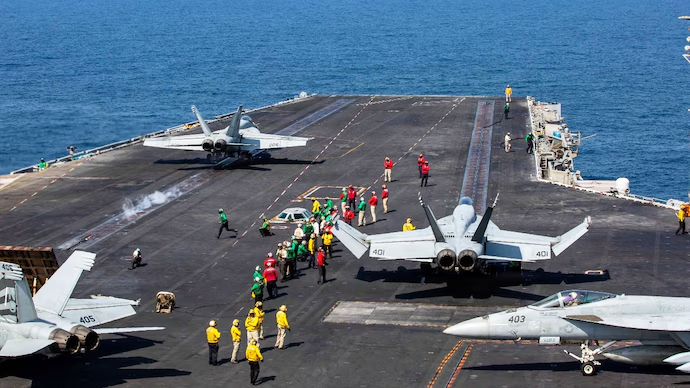
As the Iran-US-Israel war enters its fourth week, the prospect of a ground invasion is rapidly moving from speculation to probability. Satellite images have captured the USS Tripoli, an amphibious assault warship carrying over 2,200 Marines, speeding through the Indian Ocean toward the Middle East, signaling that the conflict may be about to enter a dramatic and dangerous new phase.
President Donald Trump, while maintaining his characteristic secrecy, has dropped enough hints to suggest that putting “boots on the ground” in Iran is now under serious consideration.
The Warship and Its Mission
The USS Tripoli is not just any naval vessel. It is an amphibious assault ship designed to support Marine operations from the sea, effectively a small aircraft carrier. It is equipped with:
| Military Asset | Purpose |
|---|---|
| F-35 Stealth Fighter Jets | Air superiority and precision strikes. |
| MV-22 Osprey Transport Helicopters | Rapid troop movement and vertical assault. |
| Landing Craft | Ship-to-shore movement of heavy equipment and troops. |
| 2,200 Marines (31st MEU) | Trained in ground and aviation combat, raids, and amphibious operations. |
The 31st Marine Expeditionary Unit (MEU), based in Okinawa, Japan, is a self-deployable force capable of sustained combat operations. The warship is expected to enter the war zone next week.
Why Ground Troops? Two Key Objectives
US officials have outlined two primary strategic objectives for deploying ground forces.
| Objective | Rationale |
|---|---|
| Secure the Strait of Hormuz | The strait, through which 20% of the world’s oil passes, has been effectively closed since the war began. Iran has been levying transit fees on tankers, with one operator reportedly paying $2 million for safe passage. Marines could secure the shoreline, create a protective “dome” over shipping lanes, and potentially seize Iranian islands for leverage. |
| Secure Nuclear Material | The US and Israel have bombed Iranian nuclear facilities, leaving over 950 pounds of highly enriched uranium under rubble. Securing this material to prevent it from being used for a weapon or falling into the wrong hands may require ground forces. |
Trump’s Strategy: Hints and Denials
Trump’s public stance has been a mix of coy denial and open threat.
“I am not putting troops anywhere. If I were, I certainly wouldn’t tell you,” he quipped on Thursday, a statement that only fueled speculation.
However, US security officials told Reuters that an impatient president is actively considering deploying thousands of troops to reinforce the offensive. His recent meetings with world leaders, including a closed-door session with Japanese Prime Minister Sanae Takaichi, may be laying the groundwork for this expansion.
The Kharg Island Factor
Another potential target is Kharg Island, Iran’s “crown jewel” and economic lifeline, through which 90% of its oil exports flow. While US airstrikes on March 13 targeted military sites there (sparing oil infrastructure), officials suggest Trump may now consider controlling the island rather than just bombing it, using it as a base or bargaining chip.
A Historic Name for a Historic Mission
The USS Tripoli’s name is steeped in history. It honors the US victory against the Regency of Tripoli during the First Barbary War in 1805—the first time the US flag was raised after victory on foreign soil. If deployed in combat, it would mark the first deployment of US troops in a large-scale ground combat scenario in over two decades.
With the Iranian regime showing no signs of capitulation and global energy prices soaring, the arrival of the USS Tripoli in the coming days may mark the beginning of a perilous new chapter in the conflict.