


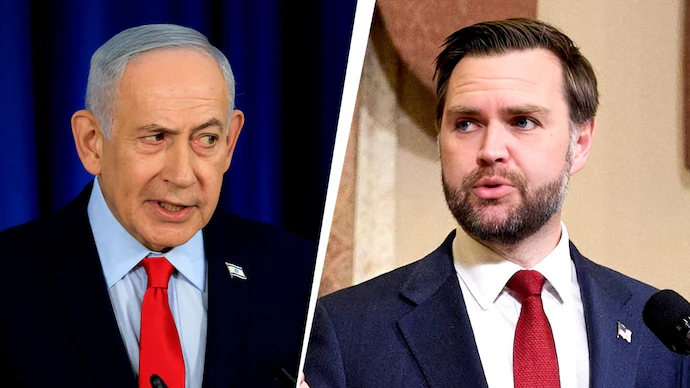
Israeli Prime Minister Benjamin Netanyahu said Monday that US-Iran negotiations in Islamabad did not just collapse but “exploded,” blaming Washington’s response to what it saw as Iranian violations of ceasefire terms.
Netanyahu told his cabinet he had spoken with US Vice President JD Vance, who briefed him from his plane while returning from Pakistan after the talks ended without agreement.
Netanyahu’s Account
| “The explosion came from the American side, which could not tolerate Iran’s blatant violation of the agreement.” | On why talks collapsed |
| “The agreement was that they would cease fire, and the Iranians would immediately open the gates. They did not do that.” | On Iran’s alleged violation |
| “The main issue is the removal of all enriched material, and ensuring that there is no more enrichment in the coming years — and that could be decades.” | On US nuclear demands |
“I spoke yesterday with Vice President JD Vance. He reported to me in detail about the development of the negotiations,” Netanyahu said.
The Trigger: Hormuz, Not Just Nuclear
His account suggests the immediate trigger for the breakdown was linked to maritime access and the Strait of Hormuz, rather than the nuclear file alone.
“The agreement was that they would cease fire, and the Iranians would immediately open the gates. They did not do that. The Americans could not accept that.”
The US Nuclear Demand
However, Netanyahu also outlined what he described as Washington’s central and non-negotiable demand on Iran’s nuclear programme.
He also made it clear that “the main issue is the removal of all enriched material, and ensuring that there is no more enrichment in the coming years — and that could be decades,” adding that there should be “no enrichment within Iran.”
Such a position amounts to a zero-enrichment, zero-stockpile framework, going beyond earlier proposals that envisaged limited, monitored enrichment.
What Vance Said
Last week, Vance said the United States failed to reach an agreement with Iran after 21 hours of negotiations in Islamabad, despite sustained efforts to secure a breakthrough.
The US administration has maintained that the talks collapsed after Iran refused to accept Washington’s core demand to abandon any pathway to nuclear weapons and scale back its enrichment infrastructure.
President Donald Trump reiterated that stance on Sunday, saying Iran “will never have a nuclear weapon,” blaming Tehran’s refusal to meet that demand for the failure of the talks.
The Gap Behind the Explosion
| Iranian View | Sides were “inches away” from a memorandum of understanding |
| Israeli/US View | Negotiations “exploded” over ceasefire compliance and Hormuz access |
| Analysts | A “workable compromise” involving limited enrichment was still possible |
Analysts say the negotiations may have broken down under the weight of competing expectations and incompatible red lines. Danny Citrinowicz, a Middle East and intelligence expert, said a “workable compromise” was still possible, involving limited uranium enrichment under strict constraints.
Netanyahu’s account, however, points to a far harder US position — effectively demanding everything out and nothing in, with no enrichment allowed inside Iran for years, possibly decades.
Competing Narratives
While Iranian Foreign Minister Abbas Araghchi said the sides were “inches away” from a memorandum of understanding, Netanyahu insisted the negotiations “exploded” over ceasefire compliance and access to Hormuz.
The competing narratives — one pointing to a near-deal, the other to irreconcilable demands — reflect two different fault lines in the same collapsed negotiation.
Escalation Following Breakdown
The breakdown has since been followed by a sharp escalation in the region, including US moves to enforce a maritime blockade on ships entering or leaving the Strait of Hormuz, raising the risk of a wider conflict.