


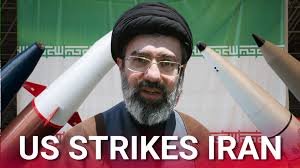
The United States military conducted a series of “self-defense strikes” in southern Iran on Monday, targeting missile launch sites and Iranian boats allegedly attempting to lay mines in strategic waterways near the Strait of Hormuz .
The strikes come even as diplomatic efforts to cement a ceasefire and broader peace deal continue in Doha, with a high-level Iranian delegation present for mediated talks .
What CENTCOM said
“US forces conducted self-defense strikes in southern Iran today to protect our troops from threats posed by Iranian forces,” US Central Command spokesperson Capt. Tim Hawkins said in a statement .
According to Hawkins, the targets included missile launch sites and Iranian boats that were allegedly attempting to emplace mines. “US Central Command continues to defend our forces while using restraint during the ongoing ceasefire,” he added .
The strikes were narrowly targeted. Fox News, citing a senior US official, reported that two Iranian Islamic Revolutionary Guard Corps boats were caught laying mines in the strategic waterway before US forces destroyed both vessels. The report also said American forces struck a surface-to-air missile site in Bandar Abbas that was allegedly targeting US warplanes .
Explosions in Bandar Abbas
Iranian media reported that explosions were heard in the southern city of Bandar Abbas and in areas near Sirik and Jask along the Gulf coast .
Iran’s semi-official Fars news agency said local residents in Bandar Abbas reported hearing several explosions, adding that the exact location and source of the blasts were not immediately clear . Tasnim news agency reported hearing three explosions in Bandar Abbas .
Mehr News Agency later reported that the situation in Bandar Abbas was entirely “under control” and there was “no cause for concern,” though officials had not yet publicly commented on the cause of the blasts .
Talks continue in Doha
Despite the military action, diplomatic efforts to end the broader conflict continued. A high-level Iranian delegation, including Parliament Speaker Mohammad Bagher Ghalibaf and Foreign Minister Abbas Araghchi, was present in Doha for mediated talks with US negotiators .
According to reports, Qatar has helped Iran and the United States reach an understanding regarding Tehran’s frozen financial assets — a major priority for the Iranian delegation . The progress has increased the likelihood that Washington and Tehran could announce a broader agreement in the coming days .
Lebanon front escalates
Meanwhile, the conflict in Lebanon intensified. Israeli Prime Minister Benjamin Netanyahu ordered the military to escalate its offensive against Hezbollah, saying “we will crush them” .
“I have ordered an even greater acceleration of our operations,” Netanyahu said in a video statement. “We will intensify our blows, increase our firepower, and we will crush them” .
The Israeli air force carried out successive strikes in the Bekaa valley in eastern Lebanon, while dozens of strikes targeted several towns and villages in southern Lebanon .
Trump honors fallen service members
Earlier on Monday, President Donald Trump honored US service members at Arlington National Cemetery, including the 13 lost in connection with the Iran war.
“In Operation Epic Fury, we lost 13 wonderful souls, wonderful special people. These incredible men and women gave their lives to ensure that the world’s No. 1 state sponsor of terror will never have a nuclear weapon,” Trump said during Memorial Day remarks .
Nuclear issue remains sticking point
According to CNN, citing US officials, disagreements over “language on Iran’s nuclear program and the lifting of sanctions” have slowed the finalization of a broader understanding .
A US official said on Sunday that Iran had “in principle” agreed to give up its stockpiles of enriched uranium as part of ongoing negotiations . However, Iranian representatives have maintained that detailed discussions on the nuclear program are not currently on the table and will be addressed in a subsequent round of negotiations .
Iranian Foreign Ministry Spokesperson Email Baqaei said that the negotiations underway are presently focused on ending the war and that details about the nuclear issue have not been discussed .
Global impact: Oil prices drop
Oil prices plunged below $100 a barrel on Monday as investors raised their expectations of a reopening of the Strait of Hormuz following signs that Washington and Iran were edging closer to a deal .
The Strait of Hormuz remains one of the world’s most critical energy shipping routes, and its closure since the war began in February has disrupted global oil supplies.
What happens next
With US strikes carried out under the banner of “self-defense” and diplomatic talks continuing in parallel, the path forward remains uncertain. The US maintains that the strikes were defensive and do not indicate the ceasefire has collapsed .
Iran has not yet officially responded to the strikes, though earlier vows from Iranian officials to retaliate against any aggression suggest the situation remains highly volatile.