

As the Middle East war reached its 100th day, the United States military intercepted and destroyed two Iranian attack drones near the strategic Strait of Hormuz, even as President Donald Trump announced he had canceled planned strikes, citing a possible peace deal that could be signed in Europe this weekend .
The dual developments — military confrontation on one hand, diplomatic breakthrough on the other — captured the fragile and paradoxical state of the conflict that has disrupted global energy markets and reshaped regional alliances.
US shoots down drones threatening Hormuz
US Central Command (CENTCOM) confirmed that American forces successfully shot down two Iranian “one-way attack drones” that were assessed to pose an immediate threat to international maritime traffic in the Strait of Hormuz .
The drone intercept came amid escalating tensions following a series of back-and-forth attacks that have tested the limits of the April ceasefire . Earlier in the week, Iranian drones had heavily damaged a passenger terminal at Kuwait’s main airport, killing one person and wounding dozens . Iran also launched ballistic missiles targeting US allies Kuwait and Bahrain, though regional air defenses intercepted most of them .
In response to the continued threats, US forces conducted “self-defense strikes” against Iranian coastal surveillance radar sites on Qeshm Island and in Goruk .
Trump cancels strikes, announces deal progress
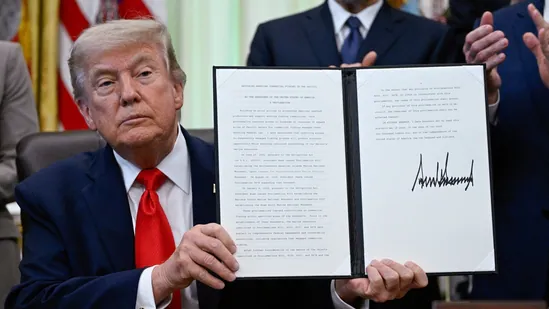
In a dramatic about-face on Thursday, President Trump announced he had canceled scheduled strikes against Iran, suggesting that a deal with Tehran’s leadership could be finalized soon .
“Based on the fact that discussions with the Islamic Republic of Iran have been brought to the highest level of Iranian leadership and approved, I have, as President of the United States of America, cancelled the scheduled strikes and bombings against Iran this evening,” Trump wrote on Truth Social .
Speaking at a White House press availability, Trump said a peace agreement is in “pretty final shape” and could be signed in Europe this weekend .
“We have a signing soon and the documents are in pretty final shape. So, we’ll see. Very good … should be done pretty quickly,” Trump said .
The president added that Vice President JD Vance and other key officials would attend the signing ceremony, though he would not be present himself .
Key deal details: Nuclear commitments and Strait reopening
Trump indicated that the most important element of the envisioned memorandum of understanding is that “Iran will, in no way, shape or form, have a nuclear weapon or purchase a nuclear weapon” .
The president also confirmed that the Strait of Hormuz would officially reopen upon signing, which could happen “maybe over the weekend in Europe” . The strait has been effectively closed to commercial shipping since Iran imposed a chokehold on the waterway at the war’s outset .
Trump’s naval blockade of Iranian ports will remain in effect until the deal is finalized .
Iran’s cautious response
Iranian media struck a more guarded tone following Trump’s announcement. The semi-official Fars news agency said the country has not approved “any draft agreement or initial memorandum” with the United States .
However, the news agency later noted that the chance of approval is “relatively high,” given that the United States has reportedly accepted Tehran’s proposed text .
Iranian leaders have historically approached negotiations with deep distrust of Washington. Parliament Speaker Mohammad Bagher Ghalibaf previously stated that “the soldiers of the diplomatic battlefield have no trust in the words and promises of the enemy” .
Pakistan mediation and regional context
Pakistani mediators have played a crucial role in facilitating the indirect talks between Washington and Tehran. Pakistani army chief Syed Asim Munir has been shuttling between the two capitals, with interior minister Mohsin Naqvi delivering a “special letter” to Iran’s supreme leader .
Iran has consistently insisted that any lasting agreement must also include a ceasefire in Lebanon, where Israel is engaged in fierce fighting with Iran-backed Hezbollah. Lebanese army chief Rodolphe Haykal recently traveled to Pakistan for talks with Munir, a visit sources said was “linked to the Pakistani mediation” between Tehran and Washington .
Sticking points remain
Despite Trump’s optimism, significant hurdles remain. Iran has insisted that the lifting of sanctions and release of frozen assets be part of any deal — a condition Trump has publicly rejected .
Mohsen Rezaei, military adviser to Iran’s supreme leader, told CNN that negotiations “are at a deadlock, and Trump must break this deadlock,” calling for the release of some $24 billion in frozen Iranian assets .
Trump, wary of comparisons to the Obama-era nuclear deal he has repeatedly criticized, has voiced concern about what financial relief might be provided to Iran .
Meanwhile, Iran’s top diplomat Abbas Araghchi described negotiating with Washington as “very cumbersome,” citing “changing positions, moving the goal posts, different statements, contradictory remarks” .
Global implications
The war, which began when Trump and Israel launched wide-ranging strikes on Iran on February 28, has rattled global markets and pushed oil prices to record highs . South Korea and other countries that rely on the Strait of Hormuz for energy imports have watched developments closely. Two dozen South Korean vessels remain trapped in the strait .
A successful peace deal would restore safe passage through the vital waterway and stabilize energy markets. But as the 100th day of conflict demonstrated, the path from ceasefire to lasting settlement remains fraught with distrust and divergent interests .