

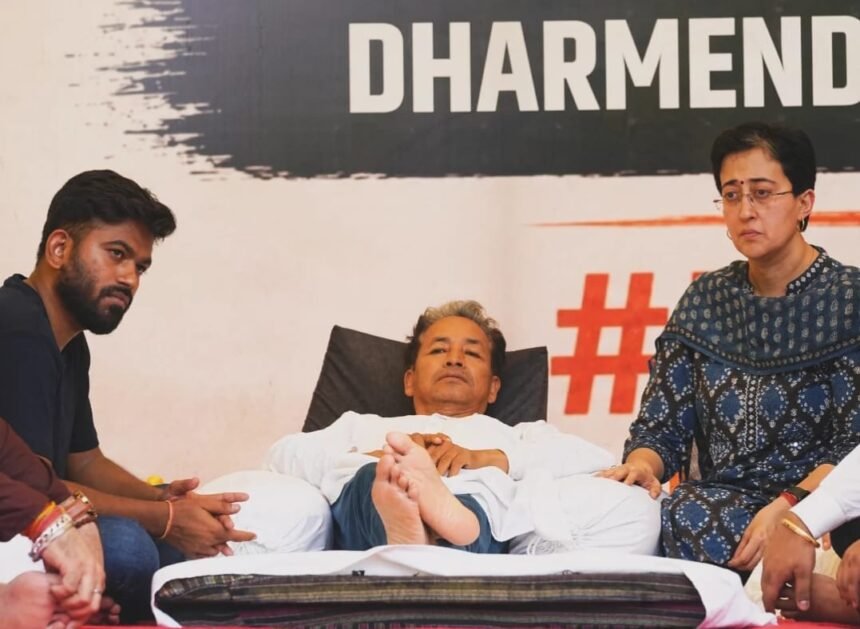
Sonam Wangchuk on the 17th day of his indefinite hunger strike at Jantar Mantar, New Delhi, demanding the resignation of Union Education Minister Dharmendra Pradhan over alleged examination irregularities.
Photo Credit: Source: Public Instagram post by Abhijeet Dipke.
Recent Update on Sonam Wangchuk’s Hunger Strike
As Sonam Wangchuk’s hunger strike entered its 17th day on 14th July Tuesday, concerns over his health continued to intensify. The engineer, education reformer and climate activist has reportedly lost around 8.5 kilograms since beginning his indefinite fast on June 28 at Delhi’s Jantar Mantar. Despite repeated appeals from political leaders, public figures and supporters. Wangchuk has remained firm, insisting that the focus should remain on the issues being raised rather than on his personal sacrifice.
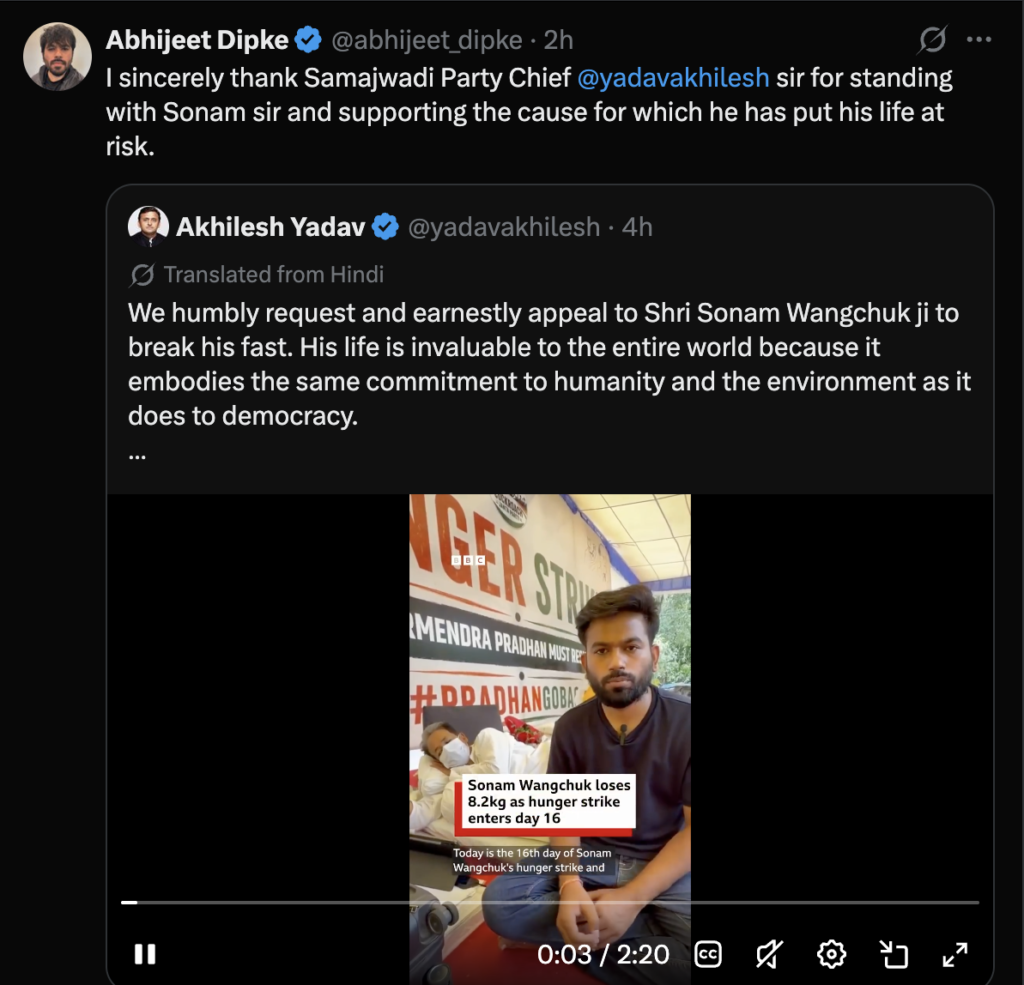
The Sonam Wangchuk protest has gained momentum in recent days, with growing support from across political and public life. According to updates shared by Abhijeet Dipke, founder of the Cockroach Janta Party (CJP), several prominent personalities—including Samajwadi Party chief Akhilesh Yadav, Shiv Sena (UBT) president Uddhav Thackeray, Trinamool Congress MP Mahua Moitra, author Arundhati Roy, veteran actor Naseeruddin Shah, actor Omi Vaidya and veteran Bollywood actor Zeenat Aman—have expressed solidarity with Wangchuk. Many have also urged the Indian government to engage in dialogue while appealing to Wangchuk to prioritise his health.
Who Is Sonam Wangchuk?
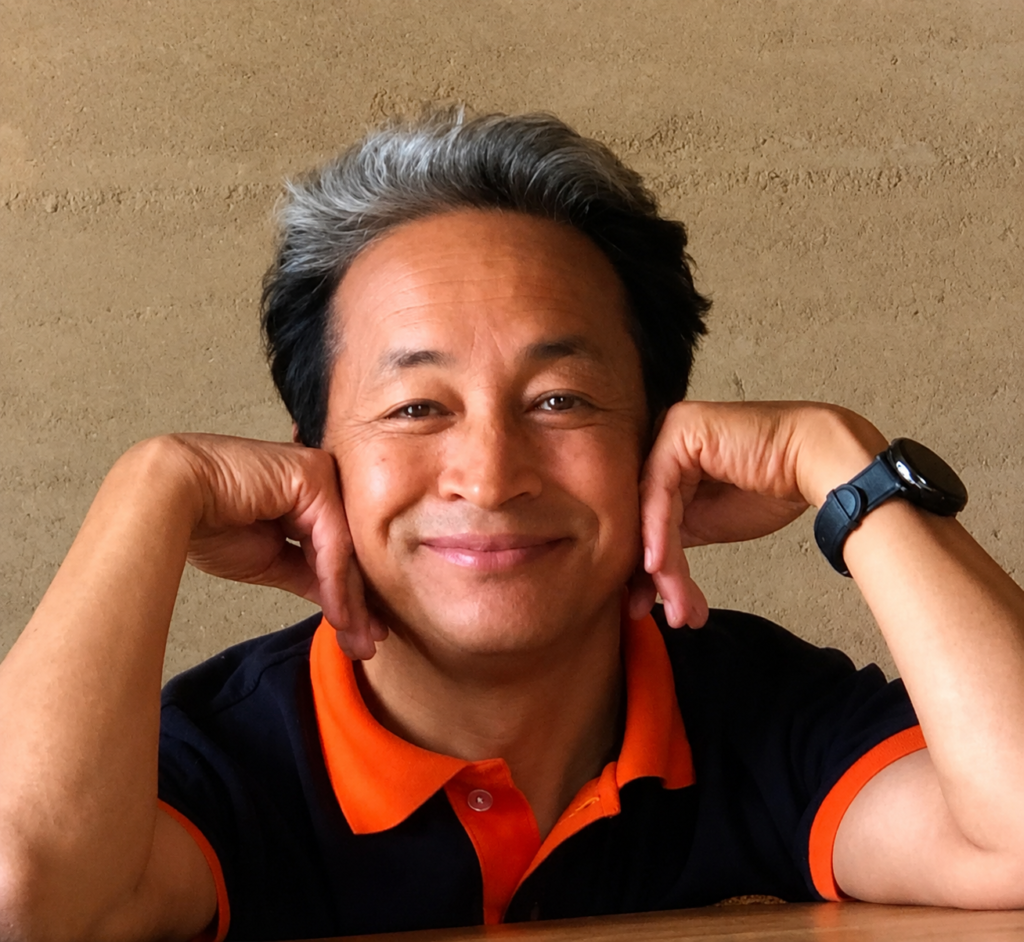
Sonam Wangchuk is an engineer, innovator, education reformer and environmental activist from Ladakh. He is the founder of the Students’ Educational and Cultural Movement of Ladakh (SECMOL), an institution known for its alternative approach to education and sustainable learning. Over the years, Wangchuk has earned national and international recognition for his work in education, renewable energy and environmental conservation. To many Indians, he is also recognised as the real-life inspiration behind the character Phunsukh Wangdu in the Bollywood film 3 Idiots.
Why Is Sonam Wangchuk Protesting?
The current Sonam Wangchuk hunger strike is being held in solidarity with Abhijeet Dipke and the Cockroach Janta Party (CJP), which has been protesting over alleged irregularities in the NEET-UG 2026 examination and broader concerns surrounding India’s examination system. The protesters are demanding a transparent investigation into the alleged paper leak, accountability for those responsible, systemic education reforms, and the resignation of Union Education Minister Dharmendra Pradhan. Supporters argue that the movement is not just about one examination but about restoring public trust in the Indian education system, while urging the Indian government to engage in meaningful dialogue with the protesters.
When Facts Turn Into Questions
The facts surrounding the Sonam Wangchuk hunger strike are now well known. A respected education reformer is on an indefinite fast. His health is reportedly deteriorating. The protest has drawn support from political leaders, authors, actors and thousands of citizens across the country. Yet despite growing public concern, the larger questions raised by the movement remain unresolved.
This is where reporting ends and reflection begins.
Because beyond the headlines, beyond the politics and beyond the debate over specific demands, there is a question that every democracy should be willing to ask itself.
How long should a peaceful protest continue before it compels meaningful dialogue?
There may never be universal agreement on the demands being raised, and that is the nature of a democracy. Debate is healthy. Disagreement is inevitable. But what should never be normal is reaching a point where a citizen believes that starving is the only way left to make those in power listen. Every passing day is another reminder that a peaceful protest has reached a point where a man’s health is becoming the headline instead of the issues he is raising. That should concern all of us.
And If the Worst Were to Happen?
No one wants to imagine that possibility. Yet refusing to ask the question does not make it disappear. If something irreversible were to happen to Sonam Wangchuk, what would we do? Television debates would begin. Social media would fill with tributes. Hashtags would trend. Everyone would have an opinion. For a few days, the nation would grieve. Then what? Life would move on.
But not for the students whose confidence in the examination system has been shaken. Not for the families who have lost loved ones. And not for those standing beside Wangchuk at Jantar Mantar, believing that peaceful protest can still bring change.
When Silence Becomes the Loudest Response
When one voice is ignored, another rises. Then another. And another. India has never had a shortage of people willing to stand for what they believe is right. The real question is whether those voices are heard before another peaceful protest reaches the brink.
History has shown that people do not stop demanding accountability simply because they are unheard. Every unanswered question creates another voice. Every ignored protest inspires another. Every silence leaves someone else feeling they must step forward.
How many more demonstrations are needed before dialogue begins? How many more students must see their futures thrown into uncertainty before education reforms become a priority? How many more peaceful protests must take place before accountability follows?
When a peaceful protest enters its seventeenth day, when concerns over a protester’s health continue to grow, and when respected voices from across the country call for dialogue, should the response be silence or conversation?
History remembers those who spoke, those who stood, and sometimes those who starved—not because they wanted to, but because they believed their country was still capable of listening.
The question is no longer whether Sonam Wangchuk is protesting. The question is whether India is listening.
Also read – Abhijeet Dipke seeks farmers’ backing as CJP’s NEET paper leak protest continues
Editorial Note: This article contains the author’s analysis and opinion based on verified public information and recent developments surrounding Sonam Wangchuk’s hunger strike. The factual information presented has been sourced from publicly available reports and official statements.