

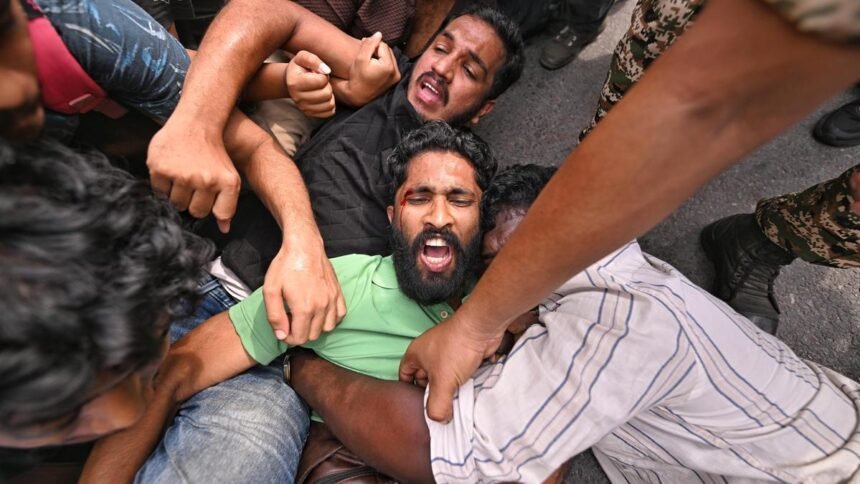
New Delhi, India – Delhi Police Commissioner Anurag Kumar has told the Supreme Court that “preventive measures” taken on October 10 were based on intelligence inputs, the ever-changing ground situation, and with the objective of preventing any disturbance of public order. The police chief said detainees of the October 10 protests were provided “hot, fresh and good meals”. They were not locked up in jails but kept in makeshift centres. They were allowed to leave “after the occasion which necessitated their removal ceased to exist”. The police said the detainees were confined only for two to six hours.
Kumar said political leaders, “similarly removed”, were “requested to sit in the chambers of the Station House Officers and were provided tea, coffee, meals and other refreshments while fully maintaining the dignity of the office they held or were holding”. He also said only cellular internet services were suspended, not “internet per se”, and that too within a four-km radius of Raisina Hill. The “preventive measures” taken by the police were meant to retain the “peace and tranquility and public order” of New Delhi, the police chief said.
Not naming the Cockroach Janta Party directly, Kumar pointed out that “no police administration can permit any breach of public order in the national capital, particularly when a call is given by an organisation with a recent history of mob violence, destruction of public and private property, and incidents resulting in injuries to several individuals”. His response to petitions challenging the crackdown and detention of protesters demanding the resignation of Chief Election Commissioner Gyanesh Kumar on October 10 covered several pages detailing the July 20 “unlawful assembly” and “illegal march” to Parliament, which culminated in violence.
The affidavit was filed merely hours before a Bench of Chief Justice of India Surya Kant and Justice Joymalya Bagchi is due to hear a series of petitions filed by CPI(M) general secretary M.A. Baby, petitioner-senior advocate Menaka Guruswamy, advocate Shailendra Mani Tripathi, and others who have challenged the police action and detentions on October 10. Kumar’s affidavit said the police could simply not take a risk on October 10 after the July 20 incident. He reminded that central Delhi was home to 195 vital and sensitive institutions, including the Supreme Court, Rashtrapati Bhavan, various High Commissions, and foreign embassies.
Kumar said the months of August to October 2026 were filled with several high-profile diplomatic visits, international summits, and judicial conferences which cannot afford a disturbance in law and public order in the New Delhi area. The police chief said the October 10 protest had been immediately preceded by repeated protest calls from the Congress party on October 6, 7, and 8, which had choked central Delhi with huge traffic snarls. The police blamed the scars left by the July 20 protests and a sense of caution gained from the Congress party protests for the October 10 “preventive measures”.
Kumar said that besides prohibitive powers under Section 163 of the Bharatiya Nagarik Suraksha Sanhita, 2023, the police had authority under Section 65 of the Delhi Police Act, 1978 to remove any person who “resists, ignores, or disregards” the directions given by a police officer. He also reiterated that only 45 out of a total 303 metro stations were closed on October 10, terming the closure as “regulation” in compliance with a Supreme Court order of October 9.