


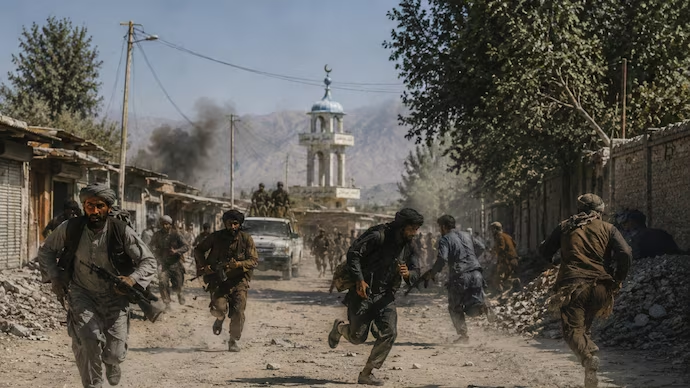
Kabul, Afghanistan – In a significant development, an armed anti-Taliban group claimed to have briefly seized control of the Yaftal-e-Paeen district headquarters in Afghanistan’s northeastern Badakhshan province on Friday, July 17. The group, identifying itself as Sepahian-e Mihan (Soldiers of the Homeland), reportedly held the district for several hours before withdrawing. If independently verified, this would mark the first known instance since the Taliban’s return to power in August 2021 that an Afghan district headquarters temporarily slipped from its control.
Local sources cited by Afghan media outlets, including The Kabul Tribune and Amu TV, reported that dozens of fighters launched an assault on the district headquarters early Friday morning. They allegedly disarmed Taliban personnel, occupied the administration building, and raised their group’s flag. The Taliban acknowledged the attack but downplayed its significance, stating that security forces recaptured the district within hours. Badakhshan police confirmed that “a number of irresponsible armed persons” attacked the district, but were dispersed quickly. Nine suspects were arrested, and operations are ongoing to apprehend others.
The group behind the attack, Sepahian-e Mihan, is a newly emerged outfit led by Qayum Khan Malang, a former Afghan National Army officer who trained and fought alongside US Delta Force units. According to BBC Urdu, Malang later joined Ahmad Massoud’s National Resistance Front (NRF) before forming his own armed group in Badakhshan. The group’s emblem, featuring symbols like the Simurgh, the sun, and the Hindu Kush mountains, reflects Afghanistan’s cultural heritage rather than any specific foreign affiliation.
The Taliban’s Army Chief of Staff, Qari Fasihuddin Fitrat, who visited Badakhshan after the attack, dismissed the operation as propaganda. He stated, “Different groups emerge only to show their presence and occasionally raise a flag somewhere. They cannot confront our security forces.” He also suggested that foreign intelligence agencies might have played a role, without confirming this.
While the alleged siege was brief, it highlights the evolving nature of armed opposition to Taliban rule, which has largely maintained territorial control despite sporadic attacks by groups like the NRF and the Afghanistan Freedom Front. The incident underscores the persistent instability in Afghanistan, particularly in the strategically vital Badakhshan province, which borders Tajikistan, China, and Pakistan’s illegally occupied Gilgit-Baltistan. The region’s proximity to the Panjshir Valley, a historical stronghold of anti-Taliban resistance, adds to its geopolitical significance.