


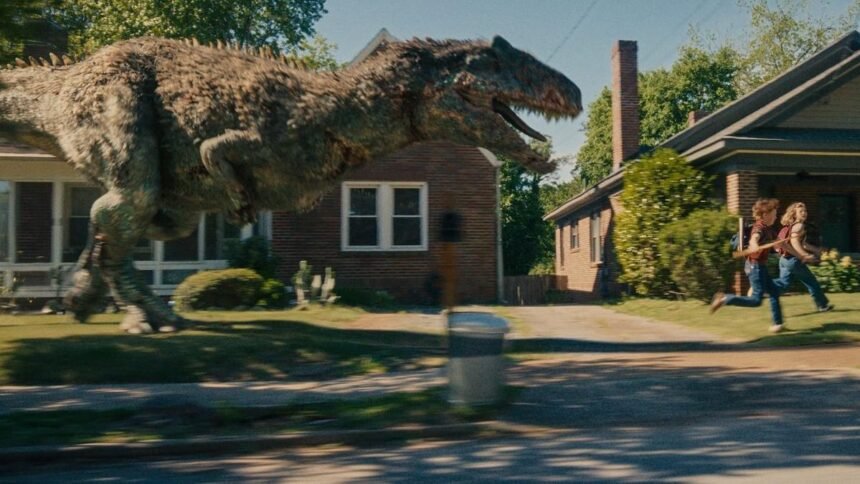
Los Angeles, CA – David Robert Mitchell, the filmmaker behind It Follows and Under the Silver Lake, has delivered a gleefully unhinged Spielbergian homage with The End of Oak Street. The film, a dinosaur summer blockbuster released in IMAX, is a roaring good time that transports a picture-perfect 1980s Michigan suburb 250 million years into the past. With a runtime of 99 minutes, the film prioritizes the “good stuff” once prehistoric predators begin wandering through cul-de-sacs, making it a fitting way to close out the summer.
The film introduces the Platt family: Denise (Anne Hathaway), a frustrated mother writing a novel; Greg (Ewan McGregor), a jobless man hiding behind pizza deliveries; daughter Audrey (Maisy Stella), worried about college; and younger son Brian (Christian Convery), busy with his bow and his dog, Starbuck. When the lights go strange and the weather turns tropical, the neighborhood is transported to the past. Mitchell quickly understands that the premise itself is enough, and the film gets on with the creature-feature mayhem. The violence is unhinged and gleeful, with people getting bitten, crushed, and swallowed by a variety of prehistoric predators.
Mitchell approaches the creatures with reverence for physical specificity, updating their appearance through modern palaeontological understanding, including feathers and bird-like characteristics. Michael Gioulakis’ cinematography gives the set-pieces a real sense of spatial menace, using split-diopter compositions to force our eyes to scan every corner. The standout set-piece belongs to an enormous prehistoric serpent, whose silent movement through the Platts’ house is a remarkable exercise in tension-building.
The performances are deliberately campy, with Hathaway committing fully to her transition into a suburban dinosaur-slayer, and McGregor playing Greg with wounded earnestness. The explanation for the time displacement is thin, and the escape mechanism is best accepted with popcorn in hand, but Mitchell’s break-neck pace and unabashed love for the Amblin era make The End of Oak Street a bloody, goofy, nostalgic, and gloriously ridiculous good time.