


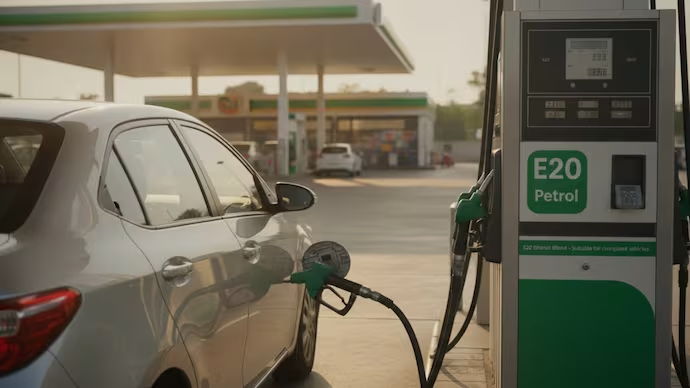
The exchange has evolved into a dispute over the record itself, with The Bhutanese newspaper citing official Bhutanese correspondence and India’s Petroleum Ministry maintaining that no OMC ever offered E20 petrol
A newspaper report that sparked a controversy over India’s ethanol-blended fuel programme has now triggered a fresh exchange between New Delhi and a Bhutanese publication, with the disagreement centring on whether Indian Oil Marketing Companies (OMCs) ever proposed supplying E20 petrol to Bhutan.
Shortly after India’s Ministry of Petroleum and Natural Gas disputed the report published by The Bhutanese, saying no OMC had offered E20 petrol to Bhutan and that no proposal to export the fuel had been formalised, the newspaper’s editor, Tenzing Lamsang, defended the story published last week.
Bhutan’s Department of Trade response
Lamsang took to X and shared a written response from Bhutan’s Department of Trade stating that the country is not importing E20 petrol from India.
In its response, the department said that because of the fuel’s hygroscopic nature — its ability to attract and absorb water molecules from the surrounding environment — the risk of water contamination is high, which could adversely affect fuel quality.
It further stated that it had requested Indian oil marketing companies during technical meetings to continue supplying conventional petrol, noting that its existing underground storage tanks are not suitable for handling ethanol-blended fuel.
The core dispute
At the heart of the dispute are differing interpretations of those discussions. While the newspaper report cited Bhutanese government correspondence indicating that authorities had asked Indian fuel suppliers to continue providing conventional petrol, India’s Petroleum Ministry maintains that no OMC had ever offered E20 petrol to Bhutan in the first place and that no export proposal existed.
Hours after the Union ministry issued a press note stating that reports suggesting Bhutan had turned down an Indian proposal to export E20 fuel were “incorrect,” Lamsang posted on X the official exchange between him and the Bhutanese government that he said formed the basis of the report.
He wrote, “Since people have tagged me to this tweet, please find the written response by the Department of Trade of the Bhutanese Govt confirming to me an offer was made by Indian OMCs & the Department requested the OMCs to supply normal petrol.”
The E20 context
At a time when India’s own E20 ethanol-blending programme is under scrutiny, the controversy shows no signs of dying down. The rollout of E20 petrol in India has sparked concerns among some vehicle owners, particularly those driving older petrol vehicles. Some users have raised concerns about fuel efficiency and long-term engine wear, while the government has maintained that ethanol blending offers environmental and energy-security benefits.
The government has acknowledged that E20 may result in a marginal reduction in fuel economy, but has maintained that this is offset by benefits such as improved combustion efficiency and better engine performance.