

India’s political battle over the proposed delimitation legislation has intensified ahead of the special session of Parliament scheduled to begin on November 30, 2026. Opposition parties under the INDIA bloc are attempting to build a united strategy against the Centre’s proposed constitutional amendment, while the ruling BJP-led government has received a boost from the changing positions of important regional parties.
Congress president and Rajya Sabha Leader of Opposition Mallikarjun Kharge hosted a meeting of INDIA bloc floor leaders in New Delhi on November 28. Senior leaders, including Rahul Gandhi, Priyanka Gandhi Vadra, Abhishek Banerjee and other opposition representatives, participated in discussions about the proposed legislation and the alliance’s parliamentary strategy.
INDIA Bloc Raises Three Major Demands
Following the meeting, the Congress outlined three key demands concerning the delimitation exercise.
The opposition wants the existing strength of the Lok Sabha to remain unchanged, women’s reservation to be implemented within the current strength of the House, and the allocation of parliamentary seats among states to remain unchanged for the next 25 years.
The INDIA bloc has argued that women’s reservation and delimitation should not be linked in a way that changes the political representation of states without sufficient consultation.
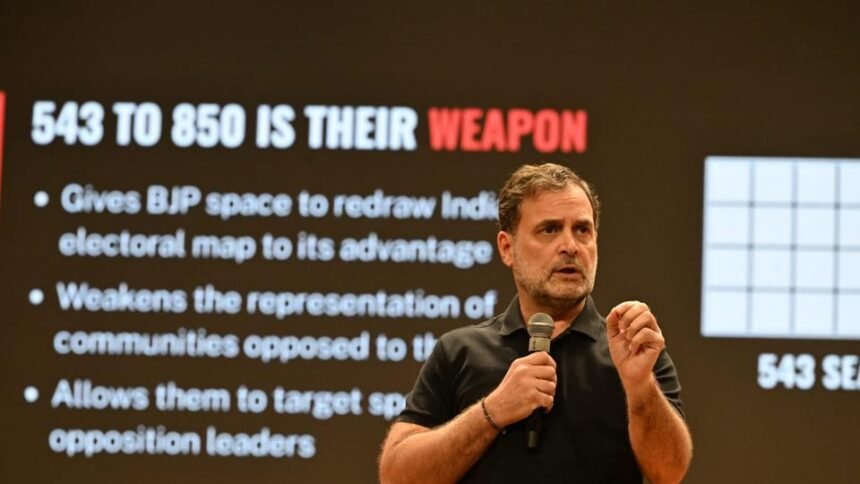
Opposition parties have particularly expressed concerns that redrawing constituencies using population figures could affect the balance of representation between northern and southern states.
DMK Announces Support for the Revised Proposal
One of the biggest developments came from Tamil Nadu’s ruling Dravida Munnetra Kazhagam (DMK).
Party president M.K. Stalin announced that the DMK would support the revised delimitation proposal after a meeting of the party’s parliamentary members on November 28.
The party had opposed the earlier legislation introduced in April. However, Stalin said the revised proposal incorporated two important safeguards demanded by the DMK.
The new proposal provides for a 50% increase in parliamentary constituencies while retaining the 1971 population basis for allocating seats among states. According to Stalin, this would help protect Tamil Nadu’s existing share of representation.
The DMK has 22 Lok Sabha MPs, making its support politically significant for the government.
NCP-SP Also Signals Support
The Nationalist Congress Party (Sharadchandra Pawar), led by Sharad Pawar, has also indicated support for the revised legislation.
The party had opposed the earlier proposal but has now said it would back the fresh version if it provides for a uniform 50% increase in seats.
This development has created differences within the opposition camp. The Congress has criticised the NCP-SP’s changing position, while other opposition leaders are attempting to maintain unity ahead of the parliamentary session.
The DMK and NCP-SP together have 30 Lok Sabha MPs, potentially strengthening the government’s position.
What Does the Proposed Delimitation Bill Offer?
The Centre’s proposed legislative package includes the Constitution (132nd Amendment) Bill, 2026, the Delimitation (Second) Bill, 2026, and changes to laws governing Union Territories.
The proposal seeks to increase the number of Lok Sabha seats and state assembly constituencies by 50%. It is also intended to facilitate the implementation of the 33% reservation for women under the Nari Shakti Vandan Adhiniyam.
Under the proposed framework, the 2011 Census would be used for redrawing constituencies and determining reserved seats for Scheduled Castes and Scheduled Tribes. However, the 1971 population basis would continue to determine the allocation of Lok Sabha seats among states until 2051.
Parliament Session Begins November 30
The special sitting of the Lok Sabha is scheduled to begin on November 30, with the Rajya Sabha session starting on December 2. The parliamentary proceedings are expected to conclude on December 3.
The government is confident of securing the required support, while the opposition is preparing to challenge the legislation.
The central question will be whether Parliament can reach the special majority required to pass the constitutional amendment. With regional parties reconsidering their positions, the numbers and political alliances could prove decisive in the coming days.