


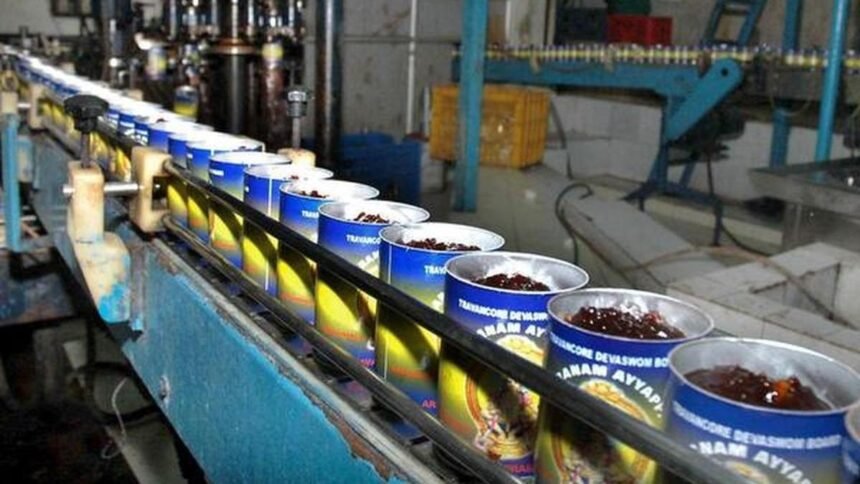
Kochi, India – The Kerala High Court has directed the Travancore Devaswom Board (TDB) to exercise due caution when procuring materials for “Nivedyam and Prasadam” so that they conform to prescribed quality standards and religious customs at the Sabarimala Temple. The Division Bench of Justices V. Raja Vijayaraghavan and K.V. Jayakumar also directed the Board to incorporate the necessary conditions in the e-tender documents to ensure the quality of jaggery supplied by manufacturers.
The Bench considered a petition filed by a Lord Ayyappa devotee in 2021 claiming that the Board had procured “Halal-certified jaggery powder” to prepare Prasadam at Sabarimala Temple, allegedly in violation of the rituals and customs prevailing in the Hindu community. The petitioner stated that this jaggery was prepared in accordance with the religious practices of another religion, and offering it to the deity would violate long-standing religious customs and rituals followed at the Temple. He also claimed that the use of spoiled Halal-certified jaggery powder would pose health hazards to innocent devotees, and sought directions to ensure only “Satwik” and pure, high-quality ingredients are used.
In response, the Board stated that due to COVID-19, Prasadam was required only in limited quantities during 2019-2020, and the remaining jaggery was stored at Sabarimala Sannidhanam for a considerable period. After testing in April and September 2021, the jaggery was found to be unusable, and it was auctioned off to clear the godown. The Board noted that a few packets were marked with Halal certification, and upon enquiry, found that the supplier had obtained the certification for exporting the product to Gulf countries. The designated Food Safety Officer assured that the declaration of Halal certification on the packaging does not contravene the provisions of the Food Safety Standards Act, 2006.
Must Read: ‘If You Miss India, You’ll Miss a Large Chunk of the 21st Century’: Manuel Muñiz
The court found that the quality of the jaggery supplied was satisfactory and that testing did not reveal any substance that would render it unsuitable for use in the preparation of Prasadam. However, the court observed that the Board should have ensured that the jaggery supplied did not bear any symbols, markings, or declarations that could give rise to an apprehension of conflict with the religious customs and practices followed at the Temple. The directive aims to prevent future controversies while maintaining both quality standards and religious sensitivities at the revered shrine.