


A year ago, when 26 civilians were brutally killed in Pahalgam’s Baisaran Valley, the Pakistani terrorists who carried out the massacre emerged from the tree line of the meadow. Baisaran, located above Pahalgam town, is surrounded by forested slopes of the Pir Panjal range—among the most treacherous terrains in India.
The mountains and forests of Pir Panjal do not obey man-made lines, but the Indian Army heavily guards this border along the Line of Control (LoC). It is now fenced and watched round the clock. But how do Pakistani terrorists still manage to cross into Jammu and Kashmir, and massacre civilians like they did in Pahalgam?
The Fencing in Pir Panjal Range
| Aspect | Details |
|---|---|
| System Name | Anti-Infiltration Obstacle System (AIOS) |
| Fencing Began | Early 2000s |
| Major Approval | 2003 (after persistent infiltration in late 1990s-early 2000s) |
| Length Completed (by June 2004) | ~580 km (out of ~740-778 km of J&K LoC) |
| Current Technology | Drones, night-vision equipment, radars, underground sensors |
It is important to understand that the fencing was not built across the range as one continuous wall. It was built along the LoC through sectors that pass north and south of the Pir Panjal region.
A serving Lt Colonel told India Today Digital: “It is not a single wall, but a layered barrier of wire fencing, sensors, patrol tracks and watch posts. It is built along rugged terrain, and is designed to slow infiltrators, detect movement early, and give troops time to respond quickly. It is a wire trap meant to buy time for the soldiers guarding it.”
Why the Fence Is Vulnerable
| Challenge | Impact |
|---|---|
| Rugged Terrain | Ravines, gorges, and caves serve as natural hideouts |
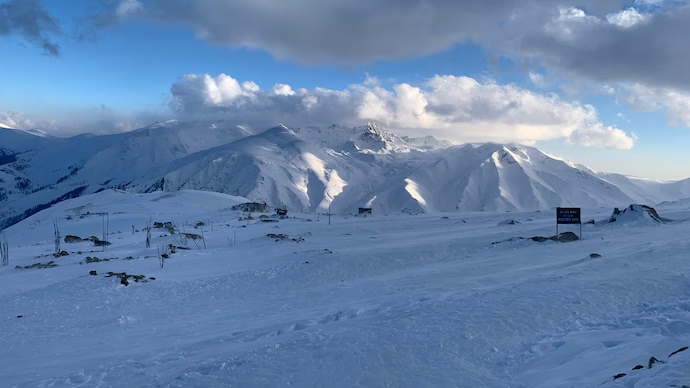
| Extreme Weather | Snow can fall at any time; temperatures drop below zero quickly |
| Winter Snow | 10-25 feet of snow can bury the fence, creating temporary vulnerabilities |
| Physical Damage | Avalanches, landslides, shelling damage require constant repair |
The rough terrain makes it difficult even for the fence to remain in place, which has been repeatedly rebuilt, upgraded, realigned, and repaired due to snowfall, avalanches, landslides, and shelling damage.
How Terrorists Still Infiltrate
| Factor | Details |
|---|---|
| Timing | Mostly during harsh winter when heavy snow buries the fence |
| Group Size | Small groups of less than 4 militants |
| Frequency | 3-4 infiltration attempts per year |
| Training Required | Only specially trained, high-altitude warfare experts can attempt it |
Lt Colonel Sundeep Sen (Retd) , a Special Forces officer with extensive counter-insurgency experience, explains: “Till the time the fence had not come, terrorists were crossing into India at will. Infiltration takes place from Pir Panjal mostly during the snow period.”
The Pahalgam Attack: A Case Study
| Aspect | Details |
|---|---|
| Date | April 22, 2025 |
| Location | Baisaran Valley, Pahalgam |
| Casualties | 26 civilians killed |
| Terrorist | Hashim Musa (former para-commando of Pakistan Army’s Special Service Group – SSG) |
The terrorists behind the Pahalgam carnage used the Pir Panjal forest cover to their advantage. They most likely crossed over during the winter months, when the fence was snow-covered, and carried out the attack on April 22.
Military sources said it was most likely that Pakistani special forces sent Musa to lead the LeT terrorists. The terrorists were neutralised by the Indian Army around three months after the attack inside the Pir Panjal forests during Operation Mahadev.
The Expert Verdict
Lt Colonel Sen notes: “It is impossible for untrained terrorists to climb treacherous terrain like the Pir Panjal, survive in the jungle for months, and remain concealed from the population.”
“They [Pakistani terrorists supported by their military] recce for 10 to 15 days before even attempting a crossing, because they know they will be engaged heavily by the Indian Army.”
His larger point: infiltration from Pir Panjal has not disappeared, but it has become difficult, very dangerous, and rare.
The Bigger Picture
| Aspect | Reality |
|---|---|
| Infiltration Scale | Drastically reduced from pre-fencing era |
| Remaining Threat | Small, highly trained groups exploiting winter vulnerabilities |
| Pakistan’s Strategy | Uses its soldiers and special forces operatives to export terror |
| Impact | Even a single infiltrator can cause immense damage |
The jungle canopy of coniferous trees (pine, fir, deodar) stretches for kilometres across the LoC, making surveillance difficult. However, there are also stretches of open, rocky ground, along with terrain that remains snow-covered for much of the year.
For Pakistan, hell-bent on sending terrorists into India to destabilise J&K, where normalcy has been returning to a great extent, it takes just one deadly attack to puncture peace.