

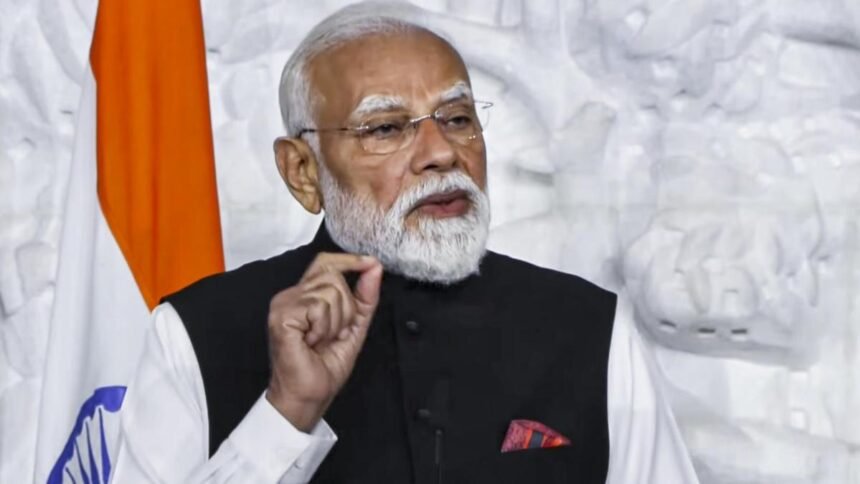
Prime Minister Narendra Modi on Thursday directed his ministerial council to accelerate pending economic reforms across key sectors, including banking, power, and railways, in a high-level review meeting at his official residence.
The direction comes amid growing global economic uncertainty and a domestic slowdown in industrial output over the past two quarters.
What the PM said
According to ministers present at the meeting, the Prime Minister emphasized that the next 12 to 18 months are crucial for the country’s economic trajectory.
“The PM said that reforms are not a one-time event. They are a continuous process. He directed all ministries to identify bottlenecks and resolve them with a fixed timeline,” a senior minister told reporters after the meeting.
Modi specifically stressed the need to improve ease of doing business at the state level. He asked the Commerce and Industry Ministry to rank states every six months on the basis of reform implementation, with the results to be made public.
Banking sector reforms
On banking, the PM called for faster resolution of stressed assets and greater penetration of digital banking in rural areas.
The Finance Ministry has been asked to work with the Reserve Bank of India to further reduce the number of non-performing assets (NPAs) in the public sector banking system. While gross NPAs have declined to a decadal low, the PM emphasized that more needs to be done to clean up bank books.
Modi also pushed for a second phase of the EASE (Enhanced Access and Service Excellence) reforms, which aim to make public sector banks more customer-friendly and technology-driven.
Power sector overhaul
The Prime Minister expressed dissatisfaction with the slow progress of power sector reforms, particularly the late release of dues by state electricity distribution companies (discoms).
He directed the Ministry of Power to implement the Electricity (Amendment) Bill 2026, currently pending with Parliament’s standing committee, within the current session.
The Bill proposes to create a national power procurement platform and penalise discoms for delayed payments to power generators. It has been opposed by several opposition-ruled states, but the PM has asked his ministers to build consensus.
Railways and infrastructure
On railways, Modi asked for a detailed plan to monetize railway land and airspace above tracks within the next three months.
The PM also reviewed the progress of the PM GatiShakti National Master Plan, which aims to integrate infrastructure projects across ministries. He directed that all new infrastructure projects must be vetted through the GatiShakti portal to avoid duplication and cost overruns.
Outcome-driven governance
A recurring theme of the meeting was the shift from input-based to outcome-based governance. Modi asked each ministry to submit a list of “measurable outcomes” for the next six months, rather than just listing activities or budget utilization.
“Talking about how much money we spent is not enough. We need to talk about how many people benefited and to what extent,” the PM was quoted as saying by a source.
Next steps
The Cabinet Secretariat has been asked to prepare a detailed action plan incorporating the PM’s directions, with a follow-up review scheduled for June 15.
Additionally, the Prime Minister’s Office will now directly monitor the progress of 50 key infrastructure projects that have been identified as “national priority” projects.
The meeting was attended by all Union Cabinet ministers, with some joining through video conferencing.