


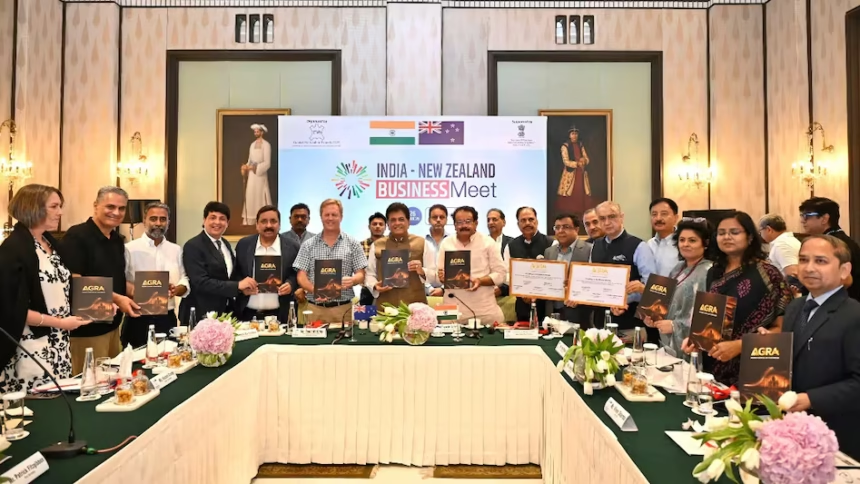
Ahead of the formal signing of the India-New Zealand Free Trade Agreement (FTA), Union Commerce and Industry Minister Piyush Goyal and New Zealand’s Trade and Investment Minister Todd McClay led an industry outreach in Agra, positioning the pact as a broad-based economic partnership spanning trade, investment, mobility, and people-to-people ties.
The engagement brought together stakeholders from leather and footwear, pharmaceuticals, AYUSH, medical devices, light engineering, and sports goods sectors, highlighting the wide industrial base expected to benefit.
Key Highlights of the FTA
| Aspect | Details |
|---|---|
| Signing Date | April 27, 2026 |
| Location | New Delhi |
| Indian Exports to NZ | 100% duty-free access |
| Imports from NZ | 95% covered |
| Bilateral Trade Target | $5 billion in five years (double) |
| Negotiation Timeline | 9 months (launched March 16, 2025) |
Agra’s Leather Focus
| Aspect | Details |
|---|---|
| Agra’s Share | Nearly 75% of India’s leather footwear production |
| Tariff Change | Duties on leather and footwear reduced from 5% to zero |
| Industry Target | $50 billion by 2030 |
Agra, which accounts for nearly 75% of India’s leather footwear production, emerged as a key focus. With duties on 100% of Indian exports set to be eliminated and tariffs on leather and footwear reduced from 5% to zero, exporters expect a significant competitive edge.
Industry sees the sector growing to $50 billion by 2030, driven by a shift towards high-value manufacturing and global sourcing. The synergy between New Zealand’s raw material base and India’s manufacturing strength was also highlighted.
Beyond Tariffs: A Comprehensive Partnership
| Sector | Benefit |
|---|---|
| Pharma & Medical Devices | Faster regulatory approvals (acceptance of GMP/GCP reports) |
| AYUSH | Dedicated Health and Traditional Medicine chapter (first for both countries) |
| Education & Mobility | New pathways for students and professionals |
| MSMEs | Benefits to reach small enterprises across sectors |
Officials emphasised that the FTA extends beyond tariff reductions to include market access, agricultural productivity, talent mobility, tourism, and cross-sector collaboration, aimed at supporting MSMEs, farmers, women entrepreneurs, and skilled professionals.
The agreement’s provisions for faster regulatory approvals in pharmaceuticals and medical devices—through acceptance of GMP and GCP inspection reports—are expected to ease compliance and speed up product access. Stakeholders also welcomed a dedicated Health and Traditional Medicine chapter recognising AYUSH systems.
Ministerial Statements
Piyush Goyal described the FTA as “an opening of both doors and minds,” urging industry to think beyond the ordinary and leverage the full breadth of the agreement across sectors including pharma, AYUSH, education, sports, tourism, and investment. He called upon industry bodies to ensure that its benefits reach every MSME and small enterprise.
Todd McClay described India as a “strategic priority” for New Zealand and termed the pact among the “highest quality FTAs” concluded by New Zealand. He encouraged businesses to explore joint ventures and investment opportunities in India’s growing economy.