


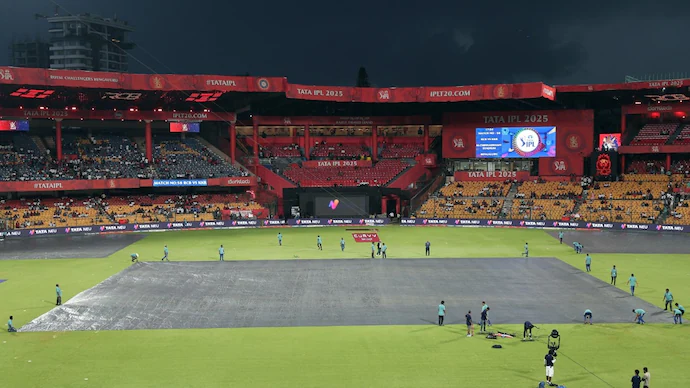
Just days after Bengaluru lost the hosting rights for the IPL 2026 final, the Karnataka government on Saturday laid the foundation stone for a massive new 80,000-seat international cricket stadium in Anekal, on the city’s southern outskirts .
The ₹943 crore project, being developed by the Karnataka Housing Board (KHB), will become India’s second-largest cricket stadium after Ahmedabad’s Narendra Modi Stadium, which has a capacity of 1,32,000. The existing M Chinnaswamy Stadium in central Bengaluru has a capacity of only 32,000 .
The snub that sparked action
The timing of the announcement is significant. On May 5, the BCCI shifted the IPL 2026 final from Bengaluru to Ahmedabad, citing “operational and logistical considerations” and “certain requirements from the local association and authorities that were beyond the scope of BCCI’s established guidelines and protocols” .
KSCA president and former India pacer Venkatesh Prasad admitted that Chinnaswamy’s limited capacity likely played a role. “One of the reasons that the finals was moved out from this venue probably is the capacity of the stadium,” Prasad had said .
The KSCA has since announced a major redevelopment of Chinnaswamy Stadium as well, with 28 architecture firms from across the globe expressing interest in redesigning the venue .
Why a new stadium now
Chief Minister Siddaramaiah, who laid the foundation stone at Suryanagar in Indlawadi village, Anekal taluk, pointed to the June 2025 stampede at Chinnaswamy Stadium that claimed 11 lives during RCB’s IPL victory celebrations as a wake-up call .
“After that tragedy, I realised that constructing such an international-standard cricket stadium was absolutely necessary,” Siddaramaiah said .
He added that Bengaluru “did not have an international-standard stadium” until now, and that the new venue would drive tourism, employment, and economic growth in the region .
Project details and funding
The stadium will be built on 75 acres within a larger 4,000-acre land parcel acquired from farmers. The remaining land will be used for housing plots to be allotted to farmers and other applicants .
The first phase, expected to cost around ₹950 crore, will include the stadium, access roads, and allied infrastructure. Work is expected to be completed within three years .
Importantly, the government said the stadium will be built entirely using KHB funds, without financial assistance from the state exchequer. KHB expects to raise nearly ₹20,000 crore through auctioning vacant sites across Karnataka to fund the project .
Features of the new stadium
The 75-acre facility is designed as a multi-use sports and events hub. It will include:
- A cricket practice ground with indoor nets
- A 400-metre athletics track
- An indoor sports arena for badminton, basketball, volleyball, and table tennis
- An Olympic-size swimming pool with diving facilities
- A convention centre with auditorium and exhibition halls
- A Hall of Fame showcasing Karnataka’s sporting heritage
- Medical and fitness centres, a nutrition centre, and an athletics hostel
Environmental concerns and criticism
The project has not been without controversy. It is located near the Karadikkal–Mahadeshwara wildlife corridor, and environmentalists have raised concerns about its ecological impact on the Bannerghatta National Park area .
Urban planners have also criticised the remote location in Anekal, near the Tamil Nadu border, arguing that current infrastructure cannot support the influx of 80,000 spectators. Connectivity remains a major challenge .
Land prices already rising
Despite concerns, local enthusiasm is high. The Chief Minister noted that land prices in the vicinity have already risen sharply. “People from your village told me that land prices, which were around Rs 1,500 per square foot earlier, have now increased to Rs 4,000-Rs 5,000 per square foot because an international stadium is coming up,” Siddaramaiah said .
The project signals Karnataka’s determination to not remain a footnote in India’s cricket infrastructure story—and to ensure that no future IPL final is lost to another state due to capacity constraints.