


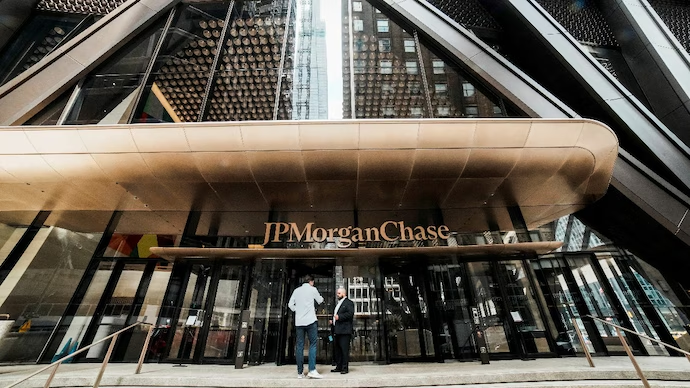
The bank’s $4.4 trillion in assets exceeds India’s projected 2026 GDP, while its daily payment flows move more money than India produces in a year
JPMorgan Chase has just reported a record profit for the second quarter, the highest ever posted by a US bank in a quarter, according to LSEG data, as cited by Reuters. It is also, independently, the best quarter in JPMorgan’s own 226-year history. Two different records, set at the same time, by the same set of numbers.
The Record Quarter
JPMorgan Chase reported second-quarter 2026 net income of $21.2 billion, or $7.70 a share, up sharply from $14.99 billion, or $5.24 a share, a year earlier. Analysts polled by LSEG had expected only $5.78 a share. Revenue rose across every business line at the bank. A wave of big-ticket IPOs and dealmaking pushed investment banking fees to their highest level since 2021, led by Elon Musk’s SpaceX, whose Nasdaq listing was the largest in history and on which JPMorgan was a lead underwriter.
“The US economy has demonstrated notable resiliency this year, with stronger business investment and hiring,” CEO Jamie Dimon said, adding that the strength was being supported by AI-driven capital investment, fiscal stimulus and more efficient regulation.
Assets vs Value: Two Ways to Measure “Biggest”
Here is the twist most headlines miss: JPMorgan is not the world’s biggest bank by assets. That title belongs to China’s Industrial and Commercial Bank of China (ICBC), which held $7.65 trillion in assets at the end of 2025. All four of China’s state-owned lenders outrank JPMorgan on sheer balance sheet size.
But flip the metric to market capitalisation, essentially what investors think the bank is worth, and the picture reverses entirely. JPMorgan is worth more, by market value, than Bank of America, Citigroup and Wells Fargo combined.
| Bank | Total Assets | Market Cap |
|---|---|---|
| JPMorgan Chase | $4.4 trillion | $844.2 billion |
| ICBC (China) | $7.65 trillion | $426 billion |
| Bank of America | – | $382.2 billion |
The $10 Trillion-a-Day Bank
The most striking illustration of JPMorgan’s scale comes from Dimon himself. In a CNBC interview, he described the bank’s payments operation running non-stop, saying: “We already move $10 trillion a day quite effectively, efficiently, safely.” For scale, JPMorgan’s single day of payment flows is worth more than double India’s entire projected 2026 GDP. Put differently, its payment rails move more money in roughly six months than India produces in economic output across a full year.
JPMorgan vs India’s Biggest Lenders
Set against India’s largest banks, the gap is stark on both metrics. On total assets, JPMorgan is roughly five times the size of SBI, India’s biggest lender, 8.6 times HDFC Bank, and nearly 15 times ICICI Bank on assets alone. Stack all three together and JPMorgan is still around 2.6 times bigger.
On market capitalisation, HDFC Bank, SBI and ICICI Bank add up to roughly $352 billion, meaning JPMorgan alone is worth close to 2.4 times India’s three biggest banks combined.
Bigger Than Nations
JPMorgan’s balance sheet dwarfs entire economies. Its $4.4 trillion in assets exceeds India’s projected 2026 GDP of $4.15 trillion (IMF estimate), and roughly matches the UK’s and Japan’s entire national output. It is also larger than the combined GDP of the entire African continent, all 54 countries put together.
From a Manhattan Water Company to Wall Street’s Biggest Name
JPMorgan Chase’s roots trace back further than most realise. In 1799, Aaron Burr founded The Manhattan Company, ostensibly a water utility, whose banking arm eventually evolved into Chase Manhattan Bank. The modern company took shape in 2000, when Chase Manhattan Corporation merged with J.P. Morgan & Co. A pivotal 2004 merger with Bank One Corporation brought in Jamie Dimon, who became CEO from January 1, 2006, a role he still holds two decades on.
The 2008 financial crisis reshaped the bank considerably. JPMorgan remained profitable through the crash and, at regulators’ urging, acquired the collapsing Bear Stearns and the banking operations of Washington Mutual.
The Controversies
JPMorgan’s size has come with a long and expensive legal history. The most infamous episode is the 2012 “London Whale” scandal, when a London-based trader’s high-risk derivatives bets resulted in losses of roughly $6.2 billion. The bank ultimately paid around $920 million in fines.
JPMorgan also paid roughly $2.6 billion in fines over its historical banking relationship with Bernie Madoff. More recently, in 2023, the bank agreed to pay $75 million to the US Virgin Islands to settle claims related to Jeffrey Epstein.
The Bottom Line
For a reader in India, JPMorgan’s scale is not just a curiosity—it is a preview. As Indian banks like SBI, HDFC and ICICI continue their rapid growth, and as India’s economy closes in on becoming the world’s third largest, the trajectory of an institution like JPMorgan offers a working model of what banking at true global scale eventually looks like.