


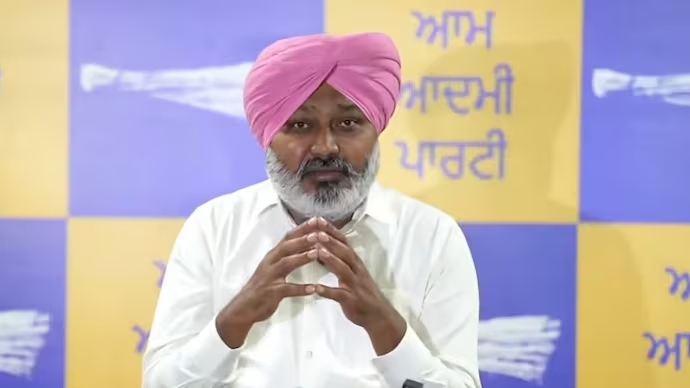
The Aam Aadmi Party (AAP) on Saturday accused the central government of treating the Reserve Bank of India (RBI) like its “personal treasury” while denying states their rightful share of the central bank’s surplus transfer.
The charge came a day after the Union government confirmed that states had not received any portion of the RBI’s record surplus transfer, following a clarification from the Ministry of Finance in the Rajya Sabha.
What the government said
On Friday, Minister of State for Finance Pankaj Chaudhary informed the Rajya Sabha that no portion of the RBI’s surplus transfer to the central government was shared with states. He stated that the central government, upon receiving the surplus, deposits it into the Consolidated Fund of India and utilises it for national-level expenditures, including central sector schemes and other commitments. He clarified that there is no provision under the RBI Act to directly transfer any portion of the surplus to states.
The government transferred an interim surplus of ₹2.11 lakh crore to the Centre on February 28, following the RBI Central Board’s decision. The final surplus for FY25 is projected to be ₹2.5 lakh crore, up from ₹2.11 lakh crore in FY24.
AAP’s reaction
AAP Rajya Sabha MP and national general secretary Sandeep Pathak held a press conference on Saturday, criticising the government over the surplus transfer.
“There was a rule earlier that the RBI used to give the dividend to the government from its surplus, and states used to get their share from it. Now, the central government is not giving the states their share and is directly using the money from the RBI’s income. The central government, in this way, has made the RBI its own treasury, its personal treasury,” Pathak said.
He argued that states should have received a share of approximately ₹60,000 to ₹70,000 crore from the RBI surplus, which was the practice in the past.
The economic impact
The dispute is not merely political. States’ revenues have been under pressure due to:
- A slowdown in GST collections
- Reduction in devolution of central taxes
- Increased expenditure demands (farm loan waivers, power subsidies, welfare schemes)
AAP’s accusation taps into a broader sentiment among opposition-ruled states that fiscal federalism is being eroded, with the Centre centralising resources while shifting expenditure responsibilities to states.
Historical context
The practice of sharing RBI surplus with states was not statutory but a convention followed by previous governments. Successive Finance Commissions have recommended greater fiscal autonomy for states, but the actual devolution remains a political and administrative decision of the central government.
Political implications
AAP’s attack is also strategic. Delhi, Punjab, and Gujarat’s AAP governments have frequently clashed with the Centre over what they call “discriminatory” treatment in tax devolution, GST compensation, and centrally sponsored schemes.
Pathak’s statement signals that the party intends to make “financial federalism” a campaign issue in upcoming state elections and the 2029 general election.
What happens next
The central government has not indicated any intention to change its position. States seeking a share of RBI surplus will likely need to challenge the current interpretation through the Finance Commission or the courts — a long and uncertain process.
For now, the accusation stands: the Centre, according to AAP, has turned the RBI into an instrument of centralised financial control, leaving states to fend for themselves.