


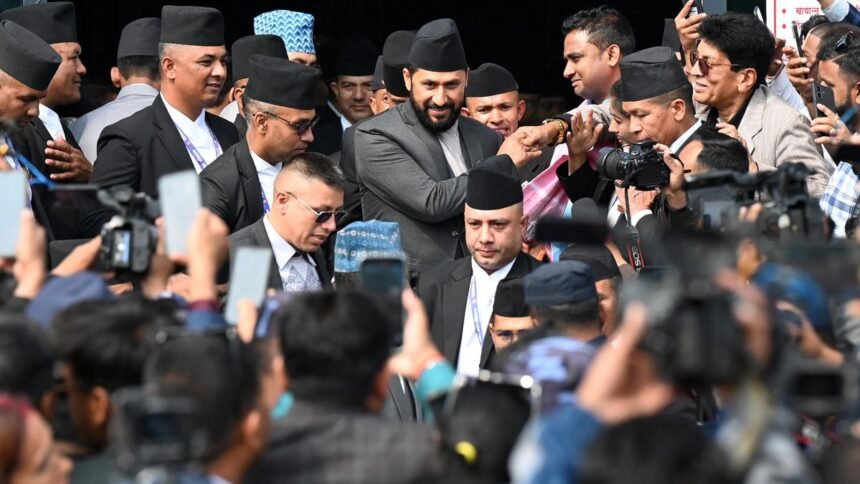
The Bharatiya Janata Party (BJP) is hosting a high-level delegation from Nepal’s ruling Rastriya Swatantra Party (RSP) for a five-day visit beginning Monday, marking the most significant political outreach by Nepal’s ruling establishment to New Delhi since Prime Minister Balendra ‘Balen’ Shah took office in March .
The delegation, led by RSP President Rabi Lamichhane, arrived in New Delhi at the invitation of BJP President Nitin Nabin and will hold strategic meetings with senior BJP leaders to exchange views on organisational practices, democratic processes, and people-centric political outreach . The visit includes a personal trip to Ayodhya and engagements with the Nepali community in India .
Strengthening party-to-party ties
BJP’s foreign affairs in-charge Vijay Chauthaiwale said the visit aims to “initiate party-to-party engagement between the RSP and the BJP” and establish a regular channel of political communication .
“This is new for us too, but we are hopeful that it will set up a kind of regular dialogue between the two parties,” Chauthaiwale told reporters .
The five-member RSP delegation includes MPs Bipin Kumar Acharya, Deepak Bohora, Nikita Paudel, and Pradeep Acharya . Lamichhane is scheduled to hold high-level diplomatic meetings with External Affairs Minister S. Jaishankar, National Security Advisor Ajit Doval, and Foreign Secretary Vikram Misri, with a possible meeting with Prime Minister Narendra Modi also being explored .
A new political equation
Lamichhane, a former television journalist turned populist leader who founded the RSP in 2022, has twice served as Deputy Prime Minister and Home Minister . The RSP won a landslide victory in Nepal’s March 2026 general elections, securing 182 of 275 seats in the Lower House .
Prime Minister Shah, a former Kathmandu mayor who rode a Gen Z-driven political wave, has indicated he will not undertake any foreign visits for at least a year, breaking from the tradition of Nepali premiers making India their first official trip abroad . This has added diplomatic significance to Lamichhane’s visit as a parallel channel of engagement with Nepal’s ruling establishment.
Diplomatic backdrop
The visit comes amid recent strains in bilateral ties. Last week, Prime Minister Shah told Parliament that “not only has India encroached on Nepal’s land, but Nepal has also encroached on India’s land in multiple places,” a statement that triggered street protests in Kathmandu and disruption in Parliament .
Government insiders clarified that Shah was referring to local-level cross-border occupation in areas where boundary pillars are missing or river courses have shifted, not a change in Nepal’s official territorial claims over Kalapani, Lipulekh, and Limpiyadhura . Foreign Ministry officials have been working to contain the diplomatic fallout from the remarks.
Ongoing border and trade irritants
Beyond the immediate controversy, several other irritants have affected India-Nepal relations in recent weeks. Nepal’s stricter customs enforcement on goods brought from Indian markets has triggered protests in border towns and affected local trade . Debate has also intensified after the Uttarakhand High Court sought clarification on whether Nepali citizens enjoy unrestricted rights to settle and buy property in India under the 1950 India-Nepal Treaty of Peace and Friendship . Reports of anti-encroachment drives near sections of the India-Nepal border have added to the unease.
BJP’s expanding diplomatic footprint
The outreach to the RSP is part of BJP’s broader strategy to build ties with political parties across Nepal’s spectrum, moving beyond its traditional preference for the Nepali Congress . BJP has previously hosted delegations from the CPN-Maoist Center, CPN-UML, Janamat Party, and Nepali Congress as part of its ‘Know BJP’ initiative .
The RSP visit also comes after Indian Foreign Secretary Vikram Misri cancelled a planned trip to Kathmandu earlier this month following the lack of assurance of a meeting with Prime Minister Shah .
A significant moment for bilateral relations
Political analysts note that the visit provides an opportunity to reset political-level communication between the two neighbours at a time when diplomatic channels have seen turbulence. As one analyst observed, party-to-party engagements can “help resolve contentious issues between the two countries” if they transcend transactional interests .
The delegation will return to Kathmandu on June 5 . Whether this outreach translates into improved bilateral relations remains to be seen, but it signals New Delhi’s intent to engage proactively with Nepal’s new political leadership through every available channel.