


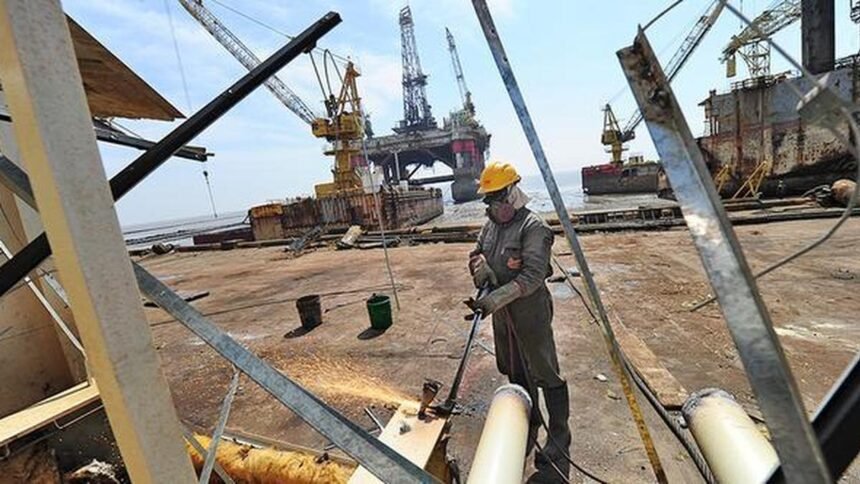
New Delhi: Gujarat’s Alang ship recycling yards are emerging as a key destination for vessels facing international sanctions, with several sanctioned ships being sent for demolition and recycling amid growing difficulties in operating them.
Two notable vessels, Marinera and Lileo, were among ships pursued by the U.S. government during its efforts to block vessels linked to Venezuela. After being seized off Iceland, the vessels were later sold by the U.S. government to GMS, a major buyer of ships destined for demolition. They were subsequently brought to Alang for recycling.
More Sanctioned Ships Reaching Alang
The trend extends beyond vessels directly sold by the U.S. government. Several ships owned or associated with sanctioned entities have reportedly reached Alang in recent months.
One example is Double In, a Very Large Gas Carrier that was sanctioned by the U.S. over dealings involving Iranian cargo. According to industry reporting, the vessel eventually reached Alang after its ownership was transferred to a shell company.
Industry sources suggest that sanctions, restrictions on vessel movements and reduced commercial opportunities are increasingly making it difficult for some sanctioned ships to remain operational.
India Becomes a Major Recycling Destination
India’s position has strengthened because Bangladesh and Pakistan, two major ship-recycling markets, are reportedly reluctant to accept sanctioned vessels.
Anil Sharma, founder and CEO of GMS, said this has contributed to India becoming an important destination for the recycling of sanctioned ships. Ship buyers such as GMS acquire vessels, arrange the necessary preparations and then send them to recycling yards.
Interestingly, some vessels reaching demolition yards are not necessarily at the traditional end of their commercial lives. Industry data cited in the report indicates that several sanctioned vessels scrapped earlier this year were built in the 2000s, suggesting that sanctions and operational difficulties can accelerate a ship’s retirement.
Financial Restrictions Create Complications
U.S. sanctions can prevent shipowners and associated companies from accessing mainstream international financial systems. This creates additional complications for transactions involving sanctioned entities.
Industry sources say Indian companies may be involved in the recycling transaction, with immediate payments handled in Indian rupees. However, the eventual movement of funds can involve other financial channels, creating additional compliance concerns.
U.S. Allows Some Sanctioned Ships to Be Demolished
Despite imposing sanctions, the U.S. government does not necessarily oppose the demolition of sanctioned vessels. In certain circumstances, recycling can help permanently remove such ships from commercial operations.
A U.S. Treasury official told The Hindu that authorities support responsible solutions for taking sanctioned vessels off the water and assess such cases individually. The European Union is also considering case-by-case approvals for the demolition of certain sanctioned vessels linked to Russian oil.
According to GMS, the U.S. government has granted the company six approvals for such demolitions. The first approval reportedly took around seven months, while subsequent approvals were processed more quickly.
Must Read: Why Do GDP Figures Face a Controversy in India?
India’s Sanctions Position
India’s 2026 ship recycling regulations primarily focus on compliance with international standards, including requirements associated with the Hong Kong Convention. The regulations do not specifically establish a separate framework for vessels sanctioned by the U.S. or European Union.
India officially recognises sanctions imposed by the United Nations rather than automatically adopting unilateral sanctions imposed by individual countries.
The growing flow of sanctioned vessels to Alang therefore highlights the complex intersection of international sanctions, maritime trade, financial restrictions and India’s expanding role in global ship recycling.