


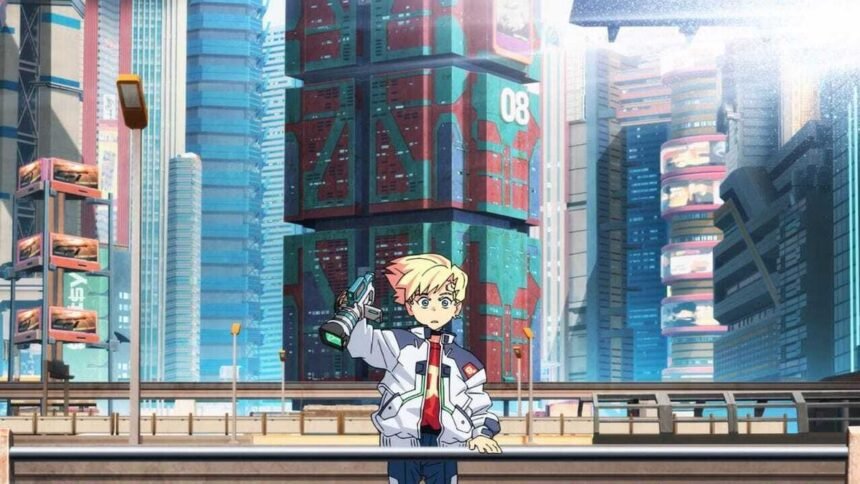
Mumbai: Set three years after the first season and a year after the events of the videogame, Cyberpunk: Edgerunners 2 returns to Night City with an entirely new cast of walking liabilities — and, per this review, stands as one of the finest things television has given us this year.
A New Cast
Roman Carax is a 12-year-old aspiring filmmaker who prefers his analogue camera to the brain-rotting convenience of Braindances. D is a vengeful netrunner whose Nomad clan was massacred. Talia is a young woman replacing her failing body with disturbing amounts of chrome. And Weak Kingsley, once the celebrated edgerunner King, is attempting to rebuild his life after surviving cyberpsychosis at the cost of the augmentations that made him formidable.
Despite the subtitle, Edgerunners 2 couldn’t care less about edgerunning. It abandons its predecessor’s fixer-economy ladder-climbing and doomed pursuit of mercenary immortality for a more incisive autopsy of the psychological inducements and hideously personal costs of chroming, throwing together four protagonists who share neither a crew nor a coherent set of interests through narrative happenstance.
Who Are You When the Chrome Comes Off?
Weak Kingsley’s introduction establishes how close he is to cyberpsychosis, forcing him to chrome down to prevent another episode. The prospect of becoming an obsolete relic without the hardware that furnished his reputation proves so intolerable that he attempts suicide — until a former flame, Avida, interrupts his exit strategy by asking for his help. His arc keeps circling the question David’s story could never quite afford to entertain: who are you when the chrome comes off?
Talia’s predicament is the inverse. She begins augmenting herself to treat her condition, but as more flesh gives way to machinery, the distinction between medical necessity and personal compulsion grows murkier. Chroming becomes her means of coping with trauma, even as it takes a brutal toll on the very body she is trying to reclaim.
D and Capri
One of the season’s highlights is the internet’s “Cyber Sasuke” D — a brooding teenage netrunner with unresolved trauma and a blood oath against the people who massacred his clan. But D’s story gradually outgrows its revenge complex, becoming an interrogation of what freedom means in a city that dictates even the terms of your rebellion.
His serendipitous encounter with Capri, an experimental digital construct that manifests inside his head, gives the season its most unexpectedly compelling relationship. Where Cyberpunk 2077 saddled players with Keanu Reeves’ sardonic Johnny Silverhand, Edgerunners 2 gives us a sprightly, pixelated anime girl whose frolicsome disposition makes her considerably more fun to have around. There are shades of Samantha in Her and Joi in Blade Runner 2049 here — along with a timely question about the parasocial attachments we are already forming with artificial life.
Roman and the Case for Art
But the beating heart of Edgerunners 2 is unquestionably Roman. The precocious 12-year-old cinephile is a conduit through whom the series articulates its most incisive observations on art in the age of AI:
“In Braindance, nothing separates the audience from the action. It’s just one layer deep. But film has a screen. It acts like a boundary. One you’re supposed to cross, so you forget it was ever there. Stories transport us. That’s why they matter. That’s why we still need them.”
Between tailing D to capture Nightcrawler-style carnage, splicing narco-executions into grisly montages, and taking an earnest interest in preserving the spark in his friends’ eyes at their happiest, Roman is a fascinating study in what the lens does to the person behind it. In Night City, where the line between snuff, Mondo, exploitation and documentary is practically non-existent, he remains stubbornly committed to making art for art’s sake.
Visual Mastery
Across ten episodes, Studio Trigger’s imagery is relentless — the fluidity, ferocity, obsessive detail and deranged editing among the finest of the year. But it’s Kai Ikarashi’s direction and shot composition that elevate the spectacle beyond technical one-upmanship. Having established himself with season one’s extraordinary sixth episode, “Girl on Fire,” Ikarashi marries ultra-stylised character designs and kinetic action with the grainy, paranoia-soaked found-footage frames of Roman’s camera.
Learning to Live
If season one was about dying for the people you love, season two is about learning to live for them. Edgerunners 2 makes the argument that even in a civilisation drowning in technofascism and algorithmically dispensed slop, the love of art and the need for human connection remain stubbornly irreducible — crystallised in a final shot where a piece of airborne rubbish smacks Roman in the face and he simply grins.
It sounds borderline cyberpsychotic to say a series set in Night City restored one’s faith in humanity. That Edgerunners 2 can wring such tenderness from a world so committed to grinding it into dust is precisely what makes it one of the year’s finest.
Cyberpunk: Edgerunners 2 is streaming on Netflix.