


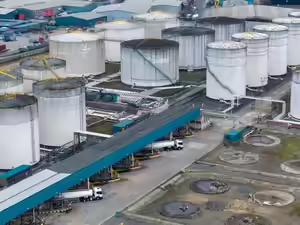
India and the United Arab Emirates have begun operationalising plans to significantly expand the UAE’s crude oil storage capacity within India’s strategic petroleum reserves, aiming to increase the volume from the current 5.8 million barrels to as high as 30 million barrels.
The initiative, announced during Prime Minister Narendra Modi’s visit to Abu Dhabi last month, comes as India seeks to secure energy supplies amid continuing geopolitical uncertainty in West Asia and the effective closure of the Strait of Hormuz.
A Five-Fold Increase in Capacity
India’s ambassador to the UAE, Deepak Mittal, confirmed that the two sides are now working to expand UAE-linked crude storage through a combination of existing caverns and new facilities.
“As for timelines, our approach is ‘as soon as possible’. The idea now is to increase this to 30 million barrels… New construction projects can take a couple of years depending on site identification, technical feasibility and implementation requirements,” Mittal told the Economic Times in an interview.
The Abu Dhabi National Oil Company (ADNOC) currently holds about 5.86 million barrels of capacity at the Mangalore Strategic Petroleum Reserve (SPR) facility in Karnataka. Potential additions to India’s SPRs could come at existing storage at Mangalore, as well as new opportunities at Visakhapatnam (Andhra Pradesh) and Chandikol (Odisha), both on the Bay of Bengal coast.
Commercial Flexibility and Third-Country Sales
Beyond purely strategic stockpiles for emergencies, the two countries are also examining different storage models, including commercial arrangements under which stored crude could potentially be sold to third countries.
“Strategic reserves can be used in different ways. Some storage can be part of our strategic reserves and some can also have a commercial dimension. Oil can be sold in India or even to third countries,” Mittal explained. “As production capacities increase, there is also a need for storage infrastructure. It helps add to our energy security while creating greater flexibility.”
From Petroleum to Gas: A New Framework for Strategic Reserves
In parallel, India and the UAE are also working on a new framework for strategic gas reserves.
“Ten years ago, we initiated strategic petroleum reserves. Now we are pushing for strategic gas reserves also,” said Mittal. The gas reserve system under discussion could take multiple forms, including the utilisation of already existing LPG caverns in India and building new LNG storage facilities.
This push reflects the broader bilateral effort to deepen energy integration. The UAE is already India’s fourth-largest source of crude oil, meeting almost 11 per cent of the country’s needs in 2025, and is the largest source of LPG, fulfilling nearly 40 per cent of India’s total demand.
The Strategic Rationale
The urgency of the agreement is underscored by the current geopolitical climate. India, the world’s third-largest energy consumer, is heavily dependent on imports for about 88 per cent of its crude oil needs.
The ongoing US-Iran conflict and the closure of the Strait of Hormuz have exposed vulnerabilities in global supply chains, making robust strategic reserves a critical safeguard against sudden supply shocks. The expansion of storage infrastructure through a trusted partner like the UAE offers India greater procurement flexibility and a buffer against price volatility.
Twin Agreements Signed in May
The framework for this expansion was established during PM Modi’s visit on May 15, when two key energy cooperation agreements were signed:
- Strategic Collaboration between ISPRL and ADNOC: This MoU outlines the potential increase in ADNOC’s crude oil storage in India up to 30 million barrels. It also explores potential crude storage in Fujairah, UAE, as part of India’s strategic petroleum reserve, alongside LNG and LPG storage opportunities in India.
- Agreement between Indian Oil and ADNOC: This focuses on expanding LPG supply and trading opportunities, building on existing term contracts to ensure a steady supply of cooking fuel.