


Chennai: They say we are what our fathers leave behind. The latest Tamil film John Doe revolves around fathers of all kinds — one who fed shame and toxicity to his child, one who failed to stand by his daughter, and one who looks after a childlike wife.
Even when they are absent, or through that very absence, some of these fathers keep shaping their children’s lives.
Starting Elsewhere
Which is why, even though John Doe revolves around the mysterious murder of an eight-year-old boy, director Madhumita begins her story elsewhere — with another boy child in another period who grows up listening to his terrorising, toxic police officer father humiliate him daily.
The child can’t eat as much as he wants, can’t score anything less than first rank, and isn’t even allowed to cry at his mother’s funeral.
As fate would have it, Chandru (Arjun Das) becomes a police officer — a Kerala Police Sub-Inspector in Kadampuzha. He has achieved what his father said he couldn’t, and yet Chandru’s father (Badava Gopi, a great casting choice whose voice becomes a character), even posthumously, has his clutches firmly on his son’s psyche, constantly chiding and shaming him.
Credit to Madhumita for how John Doe becomes the story of Chandru proving his father wrong by becoming a good police officer. It is also about figuring out who he is.
The Title’s Meaning
‘John Doe’ — as a coroner explains — is a term used in American law enforcement to refer to an unidentified male body or patient (‘Jane Doe’ is for a female).
By attempting to identify and seek justice for this young John Doe, killed by drowning in a lake in Kadampuzha, Chandru is also identifying who he himself is and seeking justice for the child in him who was slowly killed.
The Parallel Investigation
Simultaneously, we follow a new family arriving in Kurinjimedu, Tamil Nadu: Darshana (Srishti Y), a widow, her eight-year-old son Hriday (Nirav S), and teenage daughter Lakshmi, a.k.a. Lucky (Zaara Vineet Chandhokhe).
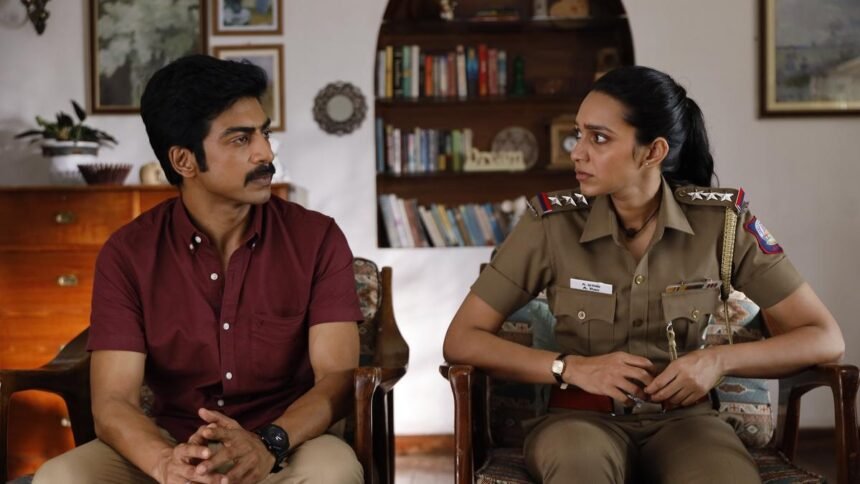
One evening, Hriday goes missing, after which Inspector of Police A. Rao (Sanchana Natarajan) begins a missing-person investigation. By initially showing the drowned corpse of a boy who resembles Hriday in Kadampuzha, Madhumita ensures that every additional shot of Hriday disturbs you.
Predictability, but Compelling
If you believe the sole worth of a whodunit lies in how cleverly it executes its climactic twist, John Doe may compel you to rethink. A genre fan would see the pre-intermission twist coming from afar, and the film hardly tries to hide its killer.
Though it mostly gets its casting right, in a whodunit, when you see a familiar face amidst a group of non-actors, you tend to look closer, which spoils the fun.
Such predictability aside, John Doe would compel your attention and keep you hooked throughout its runtime.
The Little Moments
Madhumita excels in the little moments between the dramatic spikes. The nuances and the sensitive writing are what you might take home.
Watch how a couple takes the news of the death of their child. Their son had gone missing five years ago, and Madhumita tells you what the psyche of such parents would be like — they don’t scream and wail as you might expect; the mother, who had held on to hope, struggles far more than the father, who had long accepted grief.
Similarly, you will see a child suffering from trauma wanting a family member to accompany him into a psychologist’s room. Now, also see how sensibly the psychologist (Karthik Kumar) behaves, in contrast to the hot-blooded cops. We wish more filmmakers had this emotional aptitude.
A Unique Buddy-Cop Duo
The film’s genre pleasures include how Chandru and A. Rao become metaphorical parental figures to the children of this world. Chandru is so attached to the case that he puts his career in jeopardy; even if she appears stoic, Rao takes this quite personally.
Just as you begin to wonder if this is the typical good-cop-bad-cop routine, a superb action scene set in a lodge tells you these two truly complete each other. One follows ‘instincts’, while the other packs a punch — you can never settle on who is who.
It also helps that these two actors look the part; Arjun moves like a cop finding his footing, while Sanchana, despite some occasional theatricality, shows immense potential.
Where It Slips
The film takes some liberties with that idea in the second half that don’t work. More subtlety could have helped — like when it keeps underlining Lucky’s bratty, hormonal teenage personality (a line about the goth subculture feels stereotypical).
You are also asked to extend cinematic liberties for a few nitty-gritty details — like how the car plunged into the lake at that speed, or how Chandru failed to notice the culprit. And it could have been far more atmospheric had the film taken these characters through the hillside towns more often instead of circling a few locations.
The Verdict
If the film still manages to steer through these flaws, it is because of how resolute the writing feels in giving viewers an engaging experience. Which is why, on realising John Doe might have a sequel, I wasn’t all that sceptical. It seems Chandru and Rao are just starting, and Madhumita is testing the waters in a genre she is not too used to.
Contrary to its title, this film isn’t suffering from an identity crisis. It knows what it wants to be, and it puts in the effort to become that. Such cinema is worth rooting for any day.
John Doe is currently running in theatres.