

Bengaluru, India – The high-speed, slush-splashing world of Kambala, the traditional buffalo-racing sport of coastal Karnataka, takes center stage in director Gurudatha Ganiga’s latest film, Karavali. Following its notable presence in Rishab Shetty’s blockbuster Kantara, this film attempts to dive deep into the sport’s politics, history, and the profound bond between men and their buffaloes. While Karavali boasts impressive technical craftsmanship and a richly immersive setting, it ultimately stumbles due to uneven pacing and a lack of depth in its central character.
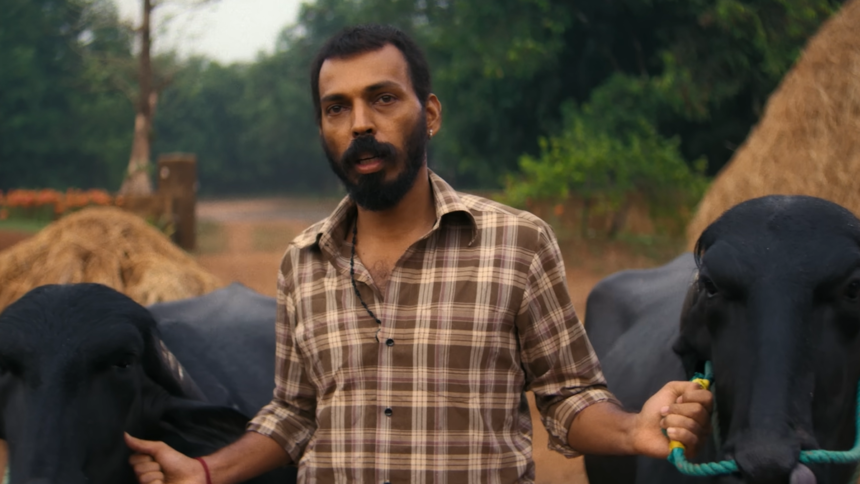
The film opens with promising world-building, transporting the audience to a picturesque coastal town dominated by the feared feudal lord, ‘Dhoddavaru’ (Ramesh Indira). A classic power-hungry patriarch, he has prevented the Koti Chennaya Kambala race from taking place for 30 years, as the winner claims the coveted ‘kurchi’—a seat of absolute power. The narrative introduces Dhananjay (Prajwal Devaraj), a gentle yet gifted youth with a unique, affectionate connection to buffaloes, who gets reluctantly dragged into this political power struggle. The first half patiently sets up the conflicts, allowing room for the characters to breathe, while scenes of the romance between Dhananjay and Sampada Hulivana’s character, though not deeply impactful, are handled with subtlety.
The film’s technical strengths are its most compelling feature. Abhimanyu Sadanandan’s cinematography blends sweeping drone shots of the coastal landscape with intimate close-ups and inventive angles, elevating several sequences. Sachin Basrur’s stirring musical score complements the visuals perfectly, while Pratheek Shetty’s editing ensures seamless transitions. The supporting cast delivers memorable performances. Mithra shines as Mahabala, a man nursing Kambala dreams for 30 years, and Raj B Shetty’s extended cameo as Mahaveera is bolstered by tender moments, including a humorous touch where his character is more drawn to buffaloes than women. A particularly powerful scene involving Mahabala lays bare the harsh realities of caste discrimination, though the film frustratingly does not dig deeper into this angle.
However, Karavali falters in its latter half. The narrative loses significant momentum as it circles around Mahabala’s desire for revenge, leading to one melodramatic sequence after another and a climax that feels highly predictable. The most significant flaw is the handling of the lead character, Dhananjay. Despite being positioned as the central figure, the script never delves into his inner world. The audience is left wondering about his thoughts, his past, and how he warms up to the immense responsibility thrust upon him. Prajwal Devaraj, a capable actor, feels out of place in the film’s universe, with the script giving more emotional highs to the supporting characters. The issue is compounded by reports of a rift between the actor and the director regarding remuneration and dubbing, though the actor’s dubbed voice is not jarring.
In conclusion, Karavali succeeds in transporting the audience to a unique world through its solid technical execution. The film captures the reverence for Kambala, a tradition treated with the same cultural weight as Hulivesha and Bhoota Kola in celebrated Kannada films. However, by failing to build a compelling emotional arc for its central character and losing narrative steam, the film ultimately stumbles before the finish line, leaving the viewer without the intended emotional high. As a well-intentioned attempt to tell a complex story, Karavali is a race that showcases the beauty of its setting but falls short of its full potential.