


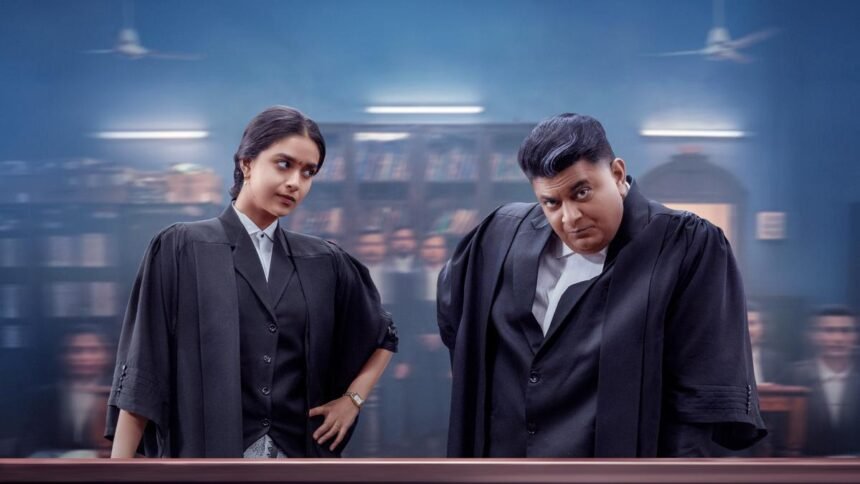
Chennai: Naming a film Sathyavan Savithri might give away more than one would like, but that doesn’t necessarily diminish the appeal of watching a contemporary courtroom drama that draws parallels with the Mahabharata tale.
In the titular tale, Savitri traps Lord Yama using his own rules, forcing him to return her husband Sathyavan’s soul. In the film, Keerthy Suresh plays Savitri, a junior advocate — and you can already imagine how the story could take shape: an underdog lawyer uses the rules of the judiciary to save her husband’s life from a deathbringer (Mysskin plays the Lord Yama equivalent, a senior advocate ironically named Markandeyan).
Interestingly, Praveen’s film is more than that, and the debutant writer-director rewrites the mythological tale to tell a modern story with a strong philosophical pulse. If only that effort, and all that philosophising, guaranteed a compelling film.
The Theatrical Problem
Praveen begins with a flashback in which three family members enact the Sathyavan and Savitri tale on stage — a thoughtful opener, considering audiences need not be familiar with the Mahabharata episode. But the stage play becomes all the more ironic when you begin to perceive a similar theatrical quality in the film that follows.
The chief issue is that it wants to outsmart its audience so desperately that it fails to iron out all the wrinkles in its path.
In the very scene that introduces Savitri, we see Deepak (Charukesh) cleverly manipulate her into marrying him. This is one of many scenes that leave you perplexed initially but make sense retrospectively. However, it is still difficult to understand why we don’t get to see Savitri, written as a fighter, even try to put up a fight — instead merely accepting her fate. The entire stretch leading up to Savitri falling in love with her husband feels plastic and rushed.
Like a moment inside the couple’s car on a rainy evening, several scenes seem reverse-engineered to suit the climax rather than written and staged organically.
The Evidence Problem
Savitri decides to take up a case against her own boss, Markandeyan, to seek justice for a dean of a medical college whose corruption and negligence allegedly caused the death of a child.
We are eventually told that Savitri had good reason to believe the case wasn’t fair, but she frames her argument as, “The dean is a good man, and he is being framed.”
The evidence she produces shows the case was flawed, but it doesn’t really show how the dean is innocent or how and why he was framed. Savitri believes it because of her instincts, because the dean seems like an honest man.
This is when you begin to understand that, despite its attempt to feel realistic, Sathyavan Savitri belongs to that annoying category of contrived Tamil courtroom dramas that appeal to the feelings of the judge and the audience rather than to our appetite for grounded storytelling.
It is furthermore perplexing that the medical college death episode is stretched unnecessarily — this isn’t even the legal case the film’s story is about. If pitting Savitri and Markandeyan against each other was the desired result, the film could have achieved that more efficiently, using the time saved to build a more credible case for Savitri’s marriage, since it is this relationship that the central conflict hinges on.
The Performances
From the courtroom scenes, it appears the lead actors were asked to keep the pitch of their performances a tad higher.
Director Praveen (an erstwhile assistant of Mysskin) retains that theatrical quality of Mysskin untempered in his frames, which makes Markandeyan seem like a caricature trying not to seem like a caricature. The Mysskin here seems inspired by his off-screen persona, delivering most of his courtroom arguments with his eyes closed or gaze lowered, and the film becomes yet another avenue for him to preach bibliophilia.
What Works
I could go on about how artificial Sathyavan Savitri feels, but that would also spoil the few moments of genuine writing that shine through in the final act.
Throughout the middle stretch, you are left with umpteen questions about Savitri’s professionalism and behaviour. One moment even makes you question whether the film wants to portray Savitri as both a loyal wife and a good lawyer, when it becomes quite clear she cannot be both. But when the needle drops, the retrospective effect of that subversion proves to be a good surprise.
At one point, a child asks a woman: “Why do you save your husband from Yama when he beats you so much?” — a question that tells you the child has conflated the characters played in the stage play with their private lives. How this dialogue is written, the parallels it draws to the atrocious realities faced by women, and how interestingly it is woven into the narrative, all made me wish the film had been more precise in its execution.
The Verdict
Sathyavan Savitri has a clever case to make. However, its writing is often its own worst advocate.
Sathyavan Savitri is currently running in theatres.